- Damage
 Damage classificationDamage
- Corrosion: types and removalDamage · Coming soon
- Cracks and stop drillingDamage · Coming soon
- Dents, nicks and scratchesDamage · Coming soon
- Repair design
- Structural repair principlesRepair design · Coming soon
- Patches and doublersRepair design · Coming soon
- Flush patches and insertionsRepair design · Coming soon
- Stringer and frame splicesRepair design · Coming soon
- Metal-bonded honeycomb panelsRepair design · Coming soon
- Identifying and substituting materialRepair design · Coming soon
- Fastening
- Rivet pitch, edge distance and patternsFastening · Coming soon
- Removing and replacing rivetsFastening · Coming soon
- Blind fasteners in repairsFastening · Coming soon
- Forming
- Bending: bend allowance and setbackForming · Coming soon
- Joggles, relief holes and lightening holesForming · Coming soon
- Forming and heat treatmentForming · Coming soon
- Protection
- Fay-surface and fillet sealingProtection · Coming soon
- Protecting a repair: conversion coat and primerProtection · Coming soon
Nothing matches. Try the site search (⌘K).
Sheet Metal Damage: Which of the Four Classes Is It?
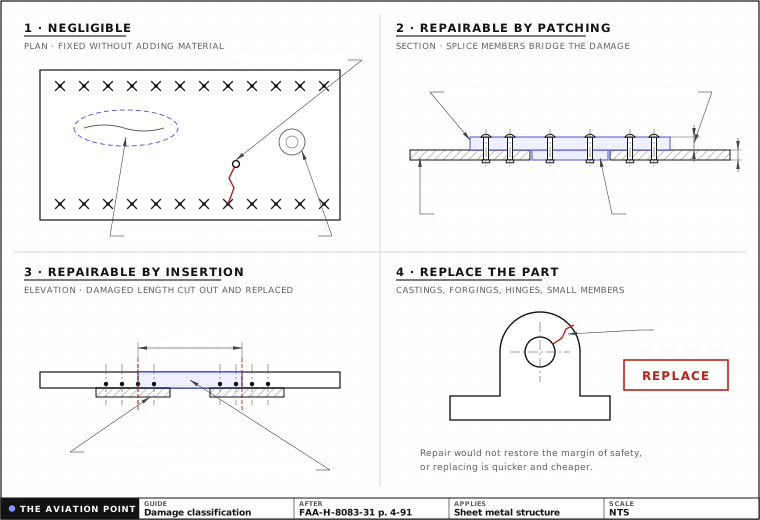
Every structural damage ends in one of four boxes: negligible (fixed without adding material), repairable by patching, repairable by insertion, or replace the part. The limits between them are not general: they come from the aircraft's structural repair manual (SRM). This guide is how to sort the damage before you open…
GuideUpdated 2026-10-28
Corrosion: types and removal
What it will cover. Surface, pitting, intergranular, filiform, exfoliation and galvanic corrosion; how much may be removed.
Corrosion Blend-Out Calculator →Galvanic Corrosion Checker →
Cracks and stop drilling
What it will cover. Finding the crack tip, stop-drill size, when a stop drill is only temporary.
Dents, nicks and scratches
What it will cover. Measuring them, blending them out, when they need a patch.
Structural repair principles
What it will cover. Strength, stiffness, weight and shape; same material; never thinner than the original.
Patches and doublers
What it will cover. External and internal patches, sizing the doubler, counting the rivets.
Skin Doubler Layout: Rivets, Rows and Size →Rivet Spacing & Pitch Calculator →Rivet Edge Distance Calculator →
Flush patches and insertions
What it will cover. Cutting out the damage, filler plate, backing doubler, keeping the contour.
Stringer and frame splices
What it will cover. Splicing an angle, a channel or a frame: splice length, rivets each side.
Metal-bonded honeycomb panels
What it will cover. Potted repairs, core replacement, riveted patches on metal sandwich.
Identifying and substituting material
What it will cover. Reading the marking, clad or bare, which alloy may replace which.
Rivet pitch, edge distance and patterns
What it will cover. Single and multiple rows, staggered patterns, transverse pitch.
Rivet Spacing & Pitch Calculator →Rivet Edge Distance Calculator →
Removing and replacing rivets
What it will cover. Drilling out a rivet, oversize, when to go to the next size or a different fastener.
Rivet Replacement in an Enlarged Hole →Rivet Shop Head Inspection →
Blind fasteners in repairs
What it will cover. Where blind rivets may replace solid rivets, grip, installation checks.
Bending: bend allowance and setback
What it will cover. Minimum radius, bend allowance, setback, flat pattern, sight line.
Joggles, relief holes and lightening holes
What it will cover. Joggle depth and length, relief holes at bend intersections, flanged lightening holes.
Forming and heat treatment
What it will cover. Which temper forms, icebox rivets, solution heat treatment and ageing.
Fay-surface and fillet sealing
What it will cover. Sealant classes, fay-surface, fillet and fastener sealing, cure times.
Sealant Fillet & Cartridges →Two-Part Mix Ratio Calculator →
Protecting a repair: conversion coat and primer
What it will cover. Cleaning, conversion coating, primer, wet installation of fasteners.