The four classes
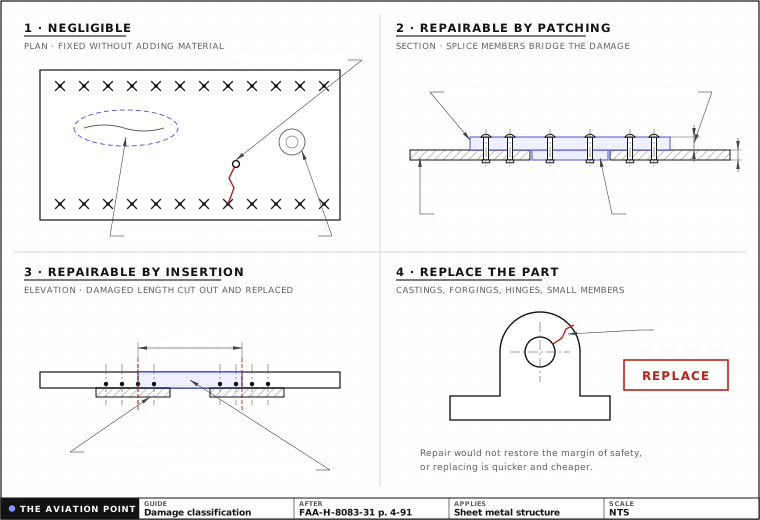
What puts a damage in each class
| Class | What it is | Typical fix | Material added |
|---|---|---|---|
| 1 · Negligible | Surface damage that does not affect structural integrity, inside the manual's limits | Smooth, sand or blend; stop-drill; hammer out a dent. Then inspect it often | None |
| 2 · Patch | Beyond negligible limits, but a splice member can bridge it | Patch over the damage, overlapping sound structure; filler plate to restore bearing or contour | Patch: same material, one gauge heavier. Filler: same gauge |
| 3 · Insertion | Too large to patch, or a patch would foul the alignment (hinge, bulkhead) | Cut the damaged length out, fit a member identical in material and shape, splice each end | Insert and splices |
| 4 · Replace | Repair impractical, uneconomic, or would not restore the margin of safety | New part: castings, forgings, hinges, small members, highly stressed members | A new part |
FAA-H-8083-31 Vol. 1 pp. 4-91 and 4-92, classification of damage. Availability of material and time often decides between repair and replacement.
Before you classify: inspect the whole load path
A dent you can see is rarely the whole damage. A load that hits one end of a member travels its full length, so check every rivet, bolt and attachment along it for partial failure and elongated holes.
Signs of hidden damage. Working rivets show as a dark, greasy residue or broken paint round the head. Diagonal wrinkles across a wing point to a warped structure. Small cracks often run away from rivets. Canted, buckled or wrinkled skin points to distorted structure underneath.
Corrosion and coatings. Look into pockets and corners where water and salt collect, and keep drain holes clear. A scratch through Alclad's pure aluminium layer lets the alloy under it corrode, so recoat exposed metal at once.
What the eye cannot see. A visual inspection cannot prove that a crack in a major member is there, or how far it goes. Eddy current and ultrasonic inspection find what is hidden.
Negligible is not the same as ignore
Negligible damage may be left as it is, or fixed by a simple procedure without restricting flight. Either way, something must be done to stop it spreading, and the area must be inspected often.
The limits are set per component and per aircraft. A dent that is negligible on a fairing can be a repair on a stringer. Find the limit in the SRM before you call it negligible.
Typical negligible fixes: blending out a scratch or nick; stop-drilling the end of a small crack so the stress at its tip stops it growing; hammering out a small dent. None of them adds material.
Patch or insertion
A patch bridges the damage with splice members that overlap the sound structure round it. Internal riveted and bolted patches are normally the same material as the damaged part, one gauge heavier. A filler plate of the same gauge can fill the hole, to carry bearing or restore the contour. The rivets in the patch restore the original load path: count them in the doubler calculator.
An insertion replaces the damaged length with a new piece of identical material and shape, spliced at each end. It is the answer when the damage is too big to patch, or when a patch would get in the way of the alignment, as at a hinge or a bulkhead.
Whether a repair is possible at all depends on five things: the type of damage, the original material, where it is, the repair it needs, and the tools and equipment you have.
Damage words, one line each
| Word | What it means |
|---|---|
| Brinelling | Shallow round dents from a small-radius part under high load |
| Burnishing | Polished by sliding contact; no metal removed |
| Burr | Thin metal standing past an edge or a hole |
| Corrosion | Metal lost by chemical or electrochemical action |
| Crack | Two portions of metal separated, seen as a fine line |
| Cut | Long, narrow, deep metal loss from a sharp edge |
| Dent | Indentation from an impact, edges slightly upset |
| Erosion | Metal worn off by grit or sand, rough and lined |
| Chattering | Surface broken up by vibration; usually no metal loss |
| Galling | Metal torn and welded between parts that rub |
| Gouge | Groove from heavy pressure; metal lost or pushed aside |
| Inclusion | Foreign material inside the metal from manufacture |
| Nick | Local notch on an edge; metal displaced |
| Pitting | Small, deep, sharp-edged cavities |
| Scratch | Light, shallow tear in the surface |
| Score | Deeper tear than a scratch, may be heat-discoloured |
| Stain | Local change in colour |
| Upsetting | Material pushed past the normal contour; no loss |
FAA-H-8083-31 Vol. 1 pp. 4-90 and 4-91, types of damage and defects, condensed.
Questions people actually ask
Who decides if a damage is negligible?
The aircraft's SRM, by component. Without a limit from the manual, a damage is not negligible by default; it needs approved data.
Why one gauge heavier for a patch?
The patch carries the load round the hole through its rivets, and the extra thickness gives it the margin. It is the usual rule for internal riveted and bolted repairs; the SRM may say otherwise.
Is stop-drilling a permanent repair?
It stops the crack growing and counts as a negligible-damage fix when the manual's limits allow it. Beyond them, the crack needs a patch or a new part.
When is replacement better than repair?
When the damage is in a casting, forging, hinge or small member, when a new part is cheaper or quicker, or when a repair would not restore the margin of safety of a highly stressed member.
Limits of this guide
What the sources support, and no further.
- No limits are given here. Dent depths, crack lengths and blend-out sizes are set per part in the SRM.
- Typical, not authority. The Handbook itself says its methods are typical and not the authority for a repair.
Sources
- FAA-H-8083-31, AMT Handbook — Airframe, Volume 1, Chapter 4 — p. 4-90, inspection of damage; pp. 4-90 and 4-91, types of damage and defects; pp. 4-91 and 4-92, classification of damage, repairability of sheet metal structure.