Ten surface profiles and four plan views
Where to buy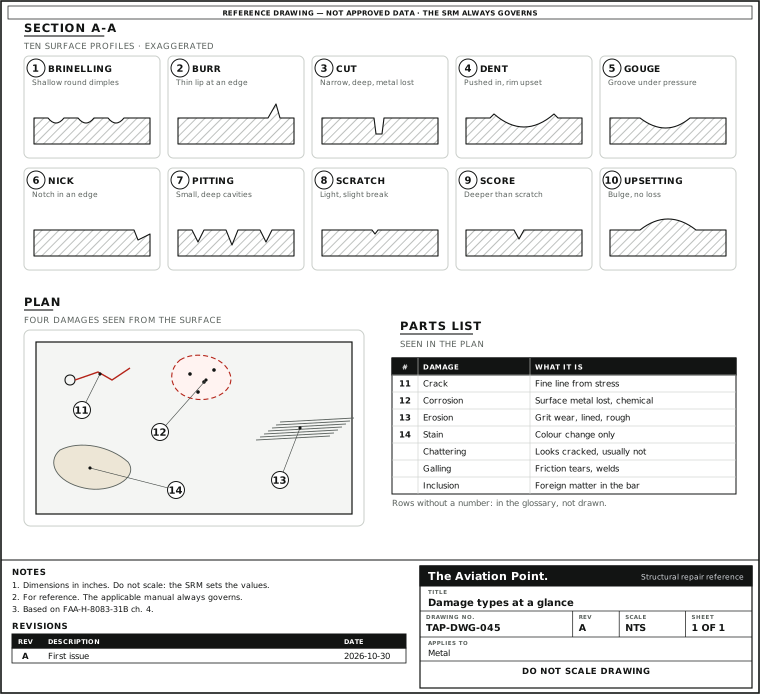
The terms
| Term | What it is | Tell-tale |
|---|---|---|
| Brinelling | Shallow spherical depressions from a small-radius part pressed hard on the surface | Round dimples |
| Burnishing | Polishing by sliding contact with a smooth, harder surface | Usually no metal moved or removed |
| Burr | A small, thin section of metal beyond a regular surface | At a corner or a hole edge |
| Chattering | Surface breakdown from vibration | Looks like metal loss or cracking; usually neither happened |
| Corrosion | Loss of metal from the surface by chemical or electrochemical action | Products come off mechanically; iron rust |
| Crack | Physical separation of two parts of the metal from excessive stress | Fine line; a few thousandths in to through the thickness |
| Cut | Loss of metal over a long narrow length, by saw, chisel or a sharp stone | Appreciable depth |
| Dent | Indentation from an object striking with force | Surround slightly upset |
| Erosion | Loss of metal by mechanical action, such as grit or fine sand | Rough, lined in the direction of travel |
| Galling | Breakdown or build-up of surfaces from friction between parts moving against each other | Softer metal torn off and welded to the harder |
| Gouge | A groove or breakdown from foreign material under heavy pressure | Metal lost, or mostly moved |
| Inclusion | Foreign material wholly inside the metal | Put in when the bar or tube was rolled or forged |
| Nick | A local break or notch on an edge | Metal moved rather than lost |
| Pitting | Sharp, localised breakdown: a small, deep cavity | Defined edges |
| Scratch | A slight tear or break from light, momentary contact | Shallow |
| Score | A tear deeper than a scratch, from contact under pressure | May show discolouration from friction heat |
| Stain | A local change of colour | Looks different from the area around |
| Upsetting | Material displaced beyond the normal contour: a local bulge | Usually no metal lost |
Definitions shortened from FAA-H-8083-31B Vol. 1 pp. 4-89 and 4-90.
Words that get mixed up
Scratch, score, gouge, cut run from light to heavy: a scratch is a slight tear from light contact, a score is deeper and made under pressure, a gouge is a groove from heavy pressure, and a cut is a long, narrow loss of metal. Nick is on an edge; burr is a lip left on an edge or at a hole.
Dent pushes the surface in, with a slightly upset rim; upsetting is a bump where the material was moved out and usually none is lost. Corrosion is chemical, erosion is mechanical, and pitting is a small deep cavity. Chattering looks like a crack, so confirm before calling it one.
Why the word matters
Scratches that go through the pure aluminium layer of Alclad let corrosion attack the alloy under it, so they are recoated at once (p. 4-89). A suspected crack in a major structural member cannot be confirmed or sized by eye: the Handbook names eddy-current and ultrasonic methods for hidden damage (p. 4-89). Beyond the word comes the class: negligible, patchable, insertion or replacement (p. 4-90).
For homebuilt and UAV work
Write the term, the place and the size on the squawk. If it could be a crack, stop and have it checked with a method that can see it.
Questions people actually ask
What is the difference between a scratch and a score?
A scratch is a slight tear from light, momentary contact. A score is deeper and comes from contact under pressure; it may show heat discolouration (p. 4-90).
Is a dent the same as upsetting?
No. A dent is an indentation, and the surface around it is usually slightly upset. Upsetting is a bump with usually no metal lost (pp. 4-89, 4-90).
What is chattering?
Breakdown of the surface by vibration. It can look like metal loss or cracking, though usually neither has occurred (p. 4-89).
Does a named damage tell me if the part is airworthy?
No. The limits are in the SRM; the Handbook only classes damage as negligible, patchable, insertion or replacement (p. 4-90).
Limits — when NOT to use this chart
What the sources support, and no further.
- Handbook words only. Some SRMs and shops use these terms a little differently.
- No limits. Depth, length and spacing allowed come from the SRM.
- Not covered. Composite damage: see the composite damage types guide.
Where to buy
Distributors coming soon.
Sources
- FAA-H-8083-31B, AMT Handbook — Airframe, Volume 1 (2023), Chapter 4 — pp. 4-89 to 4-90, definitions from brinelling to upsetting; p. 4-89, alclad scratches, hidden cracks; p. 4-90, classification of damage.