Cutouts, patch side, taper and rivet size
Where to buy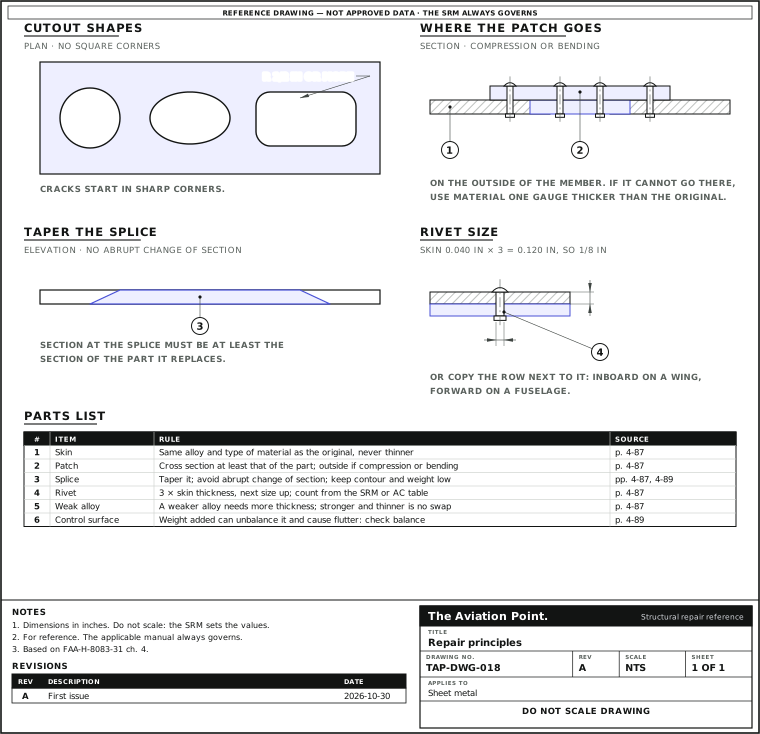
Six rules and where they come from
| Rule | In practice | Source |
|---|---|---|
| Strength | Splice or patch at least the cross-section of the part; taper it | H 4-87 |
| Same material | A weaker alloy needs more thickness; stronger but thinner is not an equal swap | H 4-87, 4-93 |
| Contour | Fit the original contour exactly; critical on smooth skin of high-speed aircraft | H 4-89 |
| Weight | Small patch, no extra rivets; check balance after repairing a control surface | H 4-89 |
| Not too strong | An over-stiff repair is as undesirable as a weak one: structure must flex | H 4-87, 4-88 |
| Corrosion | All corrosion removed first; parts insulated from each other | H 4-94 |
H = FAA-H-8083-31 Vol. 1 page. The SRM may give a substitution table.
Quick check
The SRM has no repair for this damage. What next?
- Use a guide from this site
Not this one. This site's guides and calculators are aids, not approved data.
- Get approved data
Best fit. With no SRM repair, the repair needs approved data.
- Copy the last repair you did
Not this one. Only the SRM or approved data can support the repair.
On a real job, the SRM decides.
Material and thickness
The repair material must duplicate the strength of the original. If a weaker alloy has to be used, use a heavier gauge for equal cross-section. A lighter gauge must not be used even with a stronger alloy (H 4-93): buckling and torsional strength depend mainly on thickness, and one alloy can be stronger in tension but weaker in compression.
Where the patch can go on the outside of a member in compression or bending, it goes there. If it cannot, use material one gauge thicker (H 4-87). A buckled or bent member is replaced or spliced over; it is never trusted to carry load again however it is strengthened.
Forming: heat-treated and cold-worked alloys take little bending before they crack. Strong alloys are formed annealed and heat treated before assembly (H 4-87). Check the temper chart before you order sheet.
Rivets, pattern and contact faces
Size. Copy the row next to it (inboard on a wing, forward on a fuselage), or take three times the skin thickness and go to the next size up: 0.040 in gives 0.120 in, so 1/8 in (H 4-87). Normally rivet size and material match the originals.
Enlarged hole. If a hole was enlarged or deformed, use the next larger rivet after reworking the hole, and keep the edge distance for the larger one (H 4-94). Oversize and standard rivets share the same head; NAS1097 reduced-head rivets have the head one size smaller. See the rivet replacement guide.
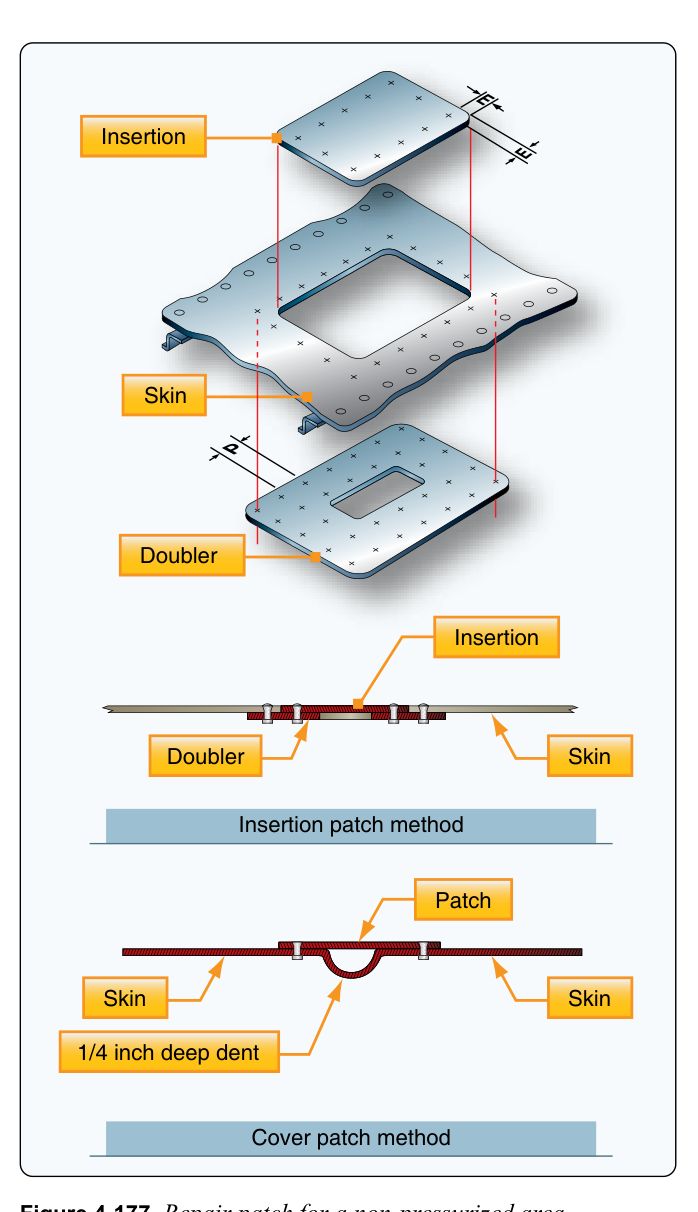
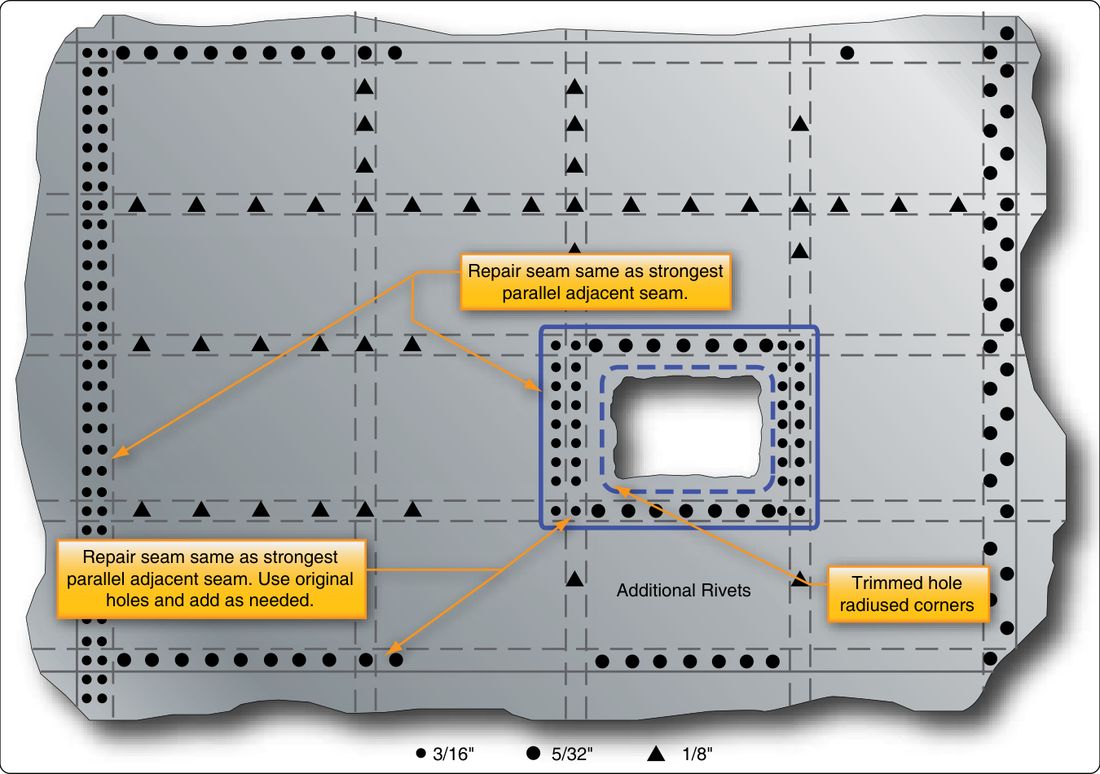
Pattern. It follows the aircraft manual, and the existing pattern is used wherever possible. Blind rivets only as the manual recommends (H 4-94). Count and pitch: rivet layout guide.
Balance. Weight added to a flight control can unbalance it and cause flutter. Repair it so the weight distribution is not changed; add or remove balance weights only as the manufacturer instructs (H 4-89).
Who approves it
14 CFR 43.13(a) requires the methods in the current manufacturer's manual or instructions, or other methods acceptable to the Administrator. AC 43.13-1 gives acceptable methods for non-pressurised areas only when there are no manufacturer repair instructions, and mostly for minor repairs. Its data can support a major repair approval and be cited in block 8 of FAA Form 337 when the conditions in the Handbook are met (H 4-94).
In practice: find the SRM repair first. If there is none, the repair needs approved data. This site's guides and calculators are aids, not approved data.
Questions people actually ask
Can I use a thinner, stronger alloy?
No. A lighter gauge should not be used even with a stronger alloy (H 4-93).
Why not make a repair as strong as possible?
Because structure must flex; an over-strong repair is as undesirable as a weak one and makes the skin flex at its edge (H 4-87, 4-88).
Which rivet for a patch?
The row next to it, or 3 times the skin thickness rounded up to the next size (H 4-87). The SRM has priority.
Can I rely on AC 43.13-1B?
Only where there is no manufacturer data and the area is non-pressurised (H 4-94).
Limits of this guide
What the sources support, and no further.
- No dimensions beyond the sources. Patch sizes, rivet counts and pitch are from the SRM.
- Not legal advice. Approval of repair depends on the authority and the aircraft; ask yours.
- Metal only. Composite repair has its own principles.
Where to buy
Distributors coming soon.
Sources
- FAA-H-8083-31, AMT Handbook — Airframe, Volume 1, Chapter 4 — pp. 4-87 to 4-89, maintaining strength, contour and weight; p. 4-93, repair material selection; p. 4-94, rivet selection, corrosion treatment, approval of repair.