The layers of a protected repair
Where to buy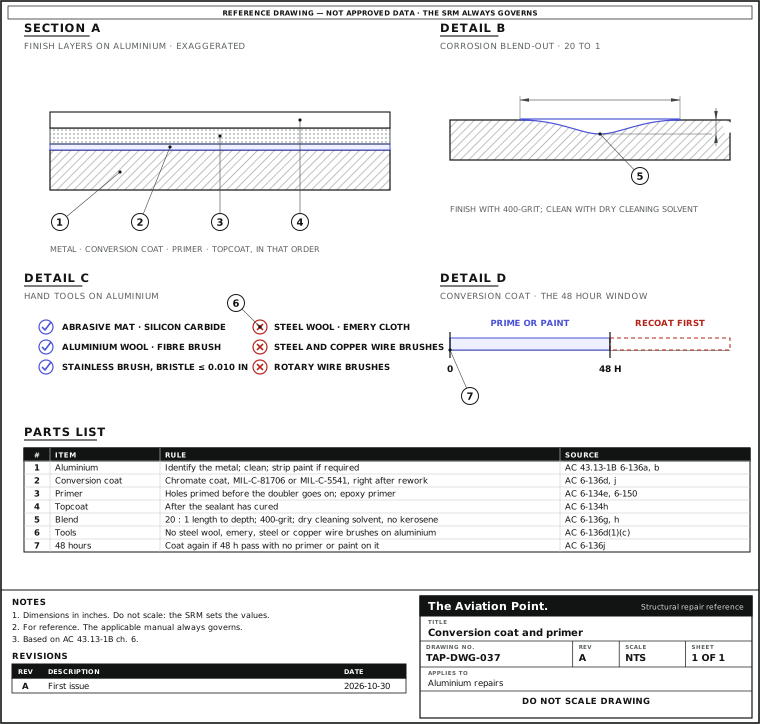
Protect a repair, one step at a time
| Step | Action | What to do |
|---|---|---|
| 1 | Prepare | Identify the metal, clean it, and strip paint if required. |
| 2 | Remove and blend | Remove the corrosion and blend the area at 20 to 1. |
| 3 | Clean | Use dry cleaning solvent. |
| 4 | Conversion coat | Apply it at once. If it stays uncovered for 48 hours or more, apply it again. |
| 5 | Prime and fasten | Prime the holes and faces, then fit with sealant and with fasteners wet. |
| 6 | Seal and paint | Run the fillet bead, let it cure, then paint. |
Why the sequence matters
Anodising is the usual treatment of aluminium. It protects as long as the film is not damaged; once broken it can only be partly restored by chemical treatment, so take care at the edges of sheet (AC 43.13-1B par. 6-133). Every cut, drilled hole and blend-out on a repair breaks that film. The repair restores it with a conversion coat, then primer, then paint.
Clean and strip to bare metal
First identify the metal as aluminium, clean the area, and strip paint if required (AC par. 6-136a, b).
Use only these on aluminium by hand: aluminium grit or silicon carbide abrasive, non-woven abrasive mat (MIL-A-9962), abrasive cloth and paper, aluminium wool, fibre bristle brushes, pumice powder. A stainless steel brush is allowed if the bristles are not over 0.010 in diameter, followed by 60 then 400 grit aluminium oxide paper (par. 6-136d(1)(a), (b)).
Never use steel wool, emery cloth, steel wire brushes (other than the stainless one above), copper-alloy brushes, rotary wire brushes or severe abrasives on aluminium. Do not break the protective film more than you must (par. 6-136d(1)(c)).
Blend a corrosion rework area at 20 to 1 (length to depth), finishing with 400-grit paper, then clean with dry cleaning solvent. Not kerosene or any petroleum-base fuel. Check the depth against the SRM rework limits (par. 6-136g to i). The blend-out calculator sets the length.
Conversion coat, then primer
Conversion coat. After corrosion removal and a clean-water rinse, apply a chromate conversion coating, such as MIL-C-81706 or MIL-C-5541 (Alodine 1200), immediately (par. 6-136d(2)(e), j). Where blending can trap water, coat it and fill the area with structural adhesive or sealant to the original contour (par. 6-134a).
The 48 hour rule. If 48 hours or more pass after the conversion coat and no primer or final paint is on it, apply the coat again before going on (par. 6-136j). Keep the chemical away from magnesium and from steel above 180,000 psi (note to 6-136).
Prime before assembly. Drill, countersink, surface-treat and prime every rivet hole before the doubler goes on (par. 6-134e). Anodise the doubler (preferred) or conversion-coat it after all cutting and drilling (6-134d).
Fasteners. Around countersunk fasteners the panel gets a conversion coat, primer and fasteners installed wet with sealant (par. 6-135a). A fastener may instead be set while wet with primer (6-135b(3)). Sealing is in the sealing guide.
Magnesium repairs may need two coats of epoxy primer on both doubler and skin where one would do on aluminium (par. 6-150).
Paint goes on after the fillet sealant has cured (par. 6-134h). Film thickness comes from the paint system's data sheet; the paint film calculator turns it into wet film.
The order in one table
| Step | What | Source |
|---|---|---|
| 1 | Identify the metal; clean; strip paint | AC 6-136a, b |
| 2 | Remove corrosion; blend 20 : 1; 400-grit | AC 6-136d to g |
| 3 | Clean with dry cleaning solvent | AC 6-136h |
| 4 | Conversion coat at once; recoat after 48 h | AC 6-136j |
| 5 | Prime holes and faces; fit with sealant, fasteners wet | AC 6-134e to g |
| 6 | Fillet bead; cure; paint | AC 6-134h |
AC 43.13-1B pars. 6-134 and 6-136 (pp. 6-25 to 6-28).
Questions people actually ask
Do I need a conversion coat on clad sheet?
The AC procedure applies it after reworking any aluminium surface, clad or not. A damaged clad layer is a corrosion-removal case: check the SRM limits.
Can I use a steel wire brush on a small spot?
No. Steel wool and steel wire brushes should not be used on any aluminium surface, apart from the stainless brush with the 0.010 in bristles.
How long can the part wait before primer?
Under 48 hours after the conversion coat. At 48 hours or more, apply it again first.
Limits of this guide
What the sources support, and no further.
- No product, film thickness or cure time is given here beyond the military specifications the AC names. The SRM and the paint system data sheet give them.
- Aluminium sheet. Steel, titanium and magnesium need their own treatments.
- Specification numbers are as printed in the AC; they have been superseded in some cases, so use the current equivalent that the SRM calls up.
Where to buy
Distributors coming soon.
Sources
- FAA AC 43.13-1B CHG 1, Chapter 6 — Par. 6-133, anodised surfaces; par. 6-134, repair of aluminium sheet after extensive corrosion removal (p. 6-25); par. 6-135, countersunk fasteners (p. 6-26); par. 6-136, examples of removing corrosion from aluminium, conversion coating and the 48 hour limit (pp. 6-26 to 6-28); par. 6-150, magnesium repairs (p. 6-29).