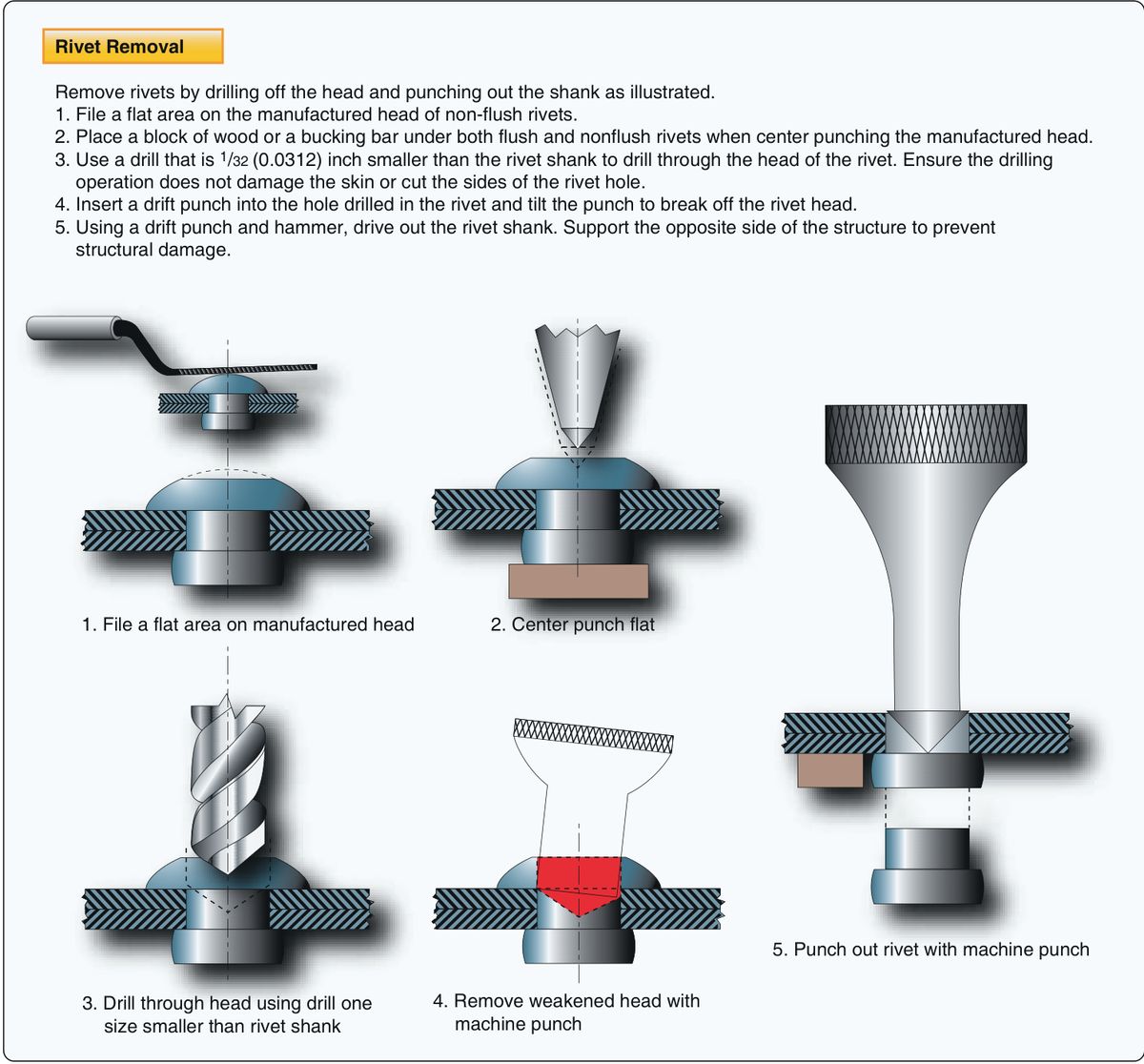
Drill-out in four steps
Where to buy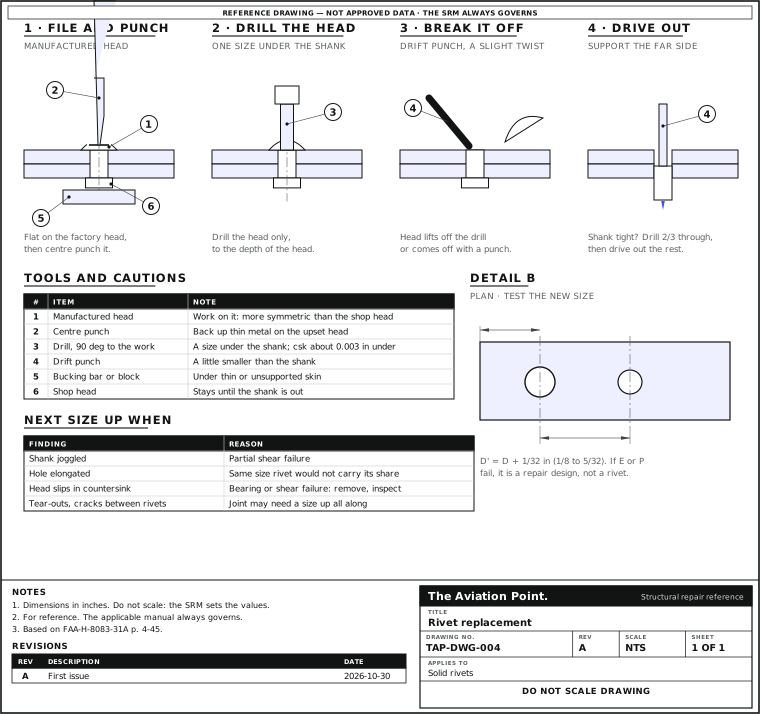
Drill out a rivet, one step at a time
| Step | Action | What to do |
|---|---|---|
| 1 | Pick the right head | Work on the manufactured head. It is more symmetric about the shank, so there is less chance of damaging the hole. |
| 2 | Prepare the head | On a universal head, file a flat and centre punch it. Do not file a countersunk rivet. |
| 3 | Drill the head only | Hold the drill at 90 degrees. Too deep and the shank turns with the drill and tears the metal. |
| 4 | Break the head off | Use a drift punch. |
| 5 | Punch out the shank | Use a punch slightly smaller than the shank, and support the far side. |
| 6 | Inspect the hole | A joggled shank, an elongated hole or a slipped head each change what goes back in. |
Work on the manufactured head
Work on the manufactured head: it is more symmetric about the shank than the shop head, so there is less chance of damaging the hole. On a universal head, file a flat and centre punch it, backing thin metal on the upset head. Drill to the depth of the head only, holding the drill at 90 degrees. Too deep and the shank turns with the drill and tears the metal. Break the head off with a drift punch, then punch out the shank with a punch slightly smaller than it, supporting the far side.
Countersunk rivets. No filing. Use a drill about 0.003 in under the shank, and drill about half the thickness of the top sheet. If the shank will not come out, drill about two-thirds through and punch out the rest.
Drill size: the Handbook is not consistent. The text says one size under the shank; Fig. 4-98 says 1/32 in under. For the small rivets the two are not the same bit. Use the SRM or your approved procedure.
When the next size up is needed
| Finding | What it means |
|---|---|
| Shank joggled in the hole | Partial shear failure: next size up |
| Hole elongated | A same-size rivet would not carry its share |
| Head slipped in countersink or dimple | Bearing or shear failure: remove and inspect |
| Tear-outs, cracks between rivets | Often damaged rivets; repair may need the next size |
FAA-H-8083-31A p. 4-45. If the rivet is removed correctly, it does not need to go up a size (p. 4-45).
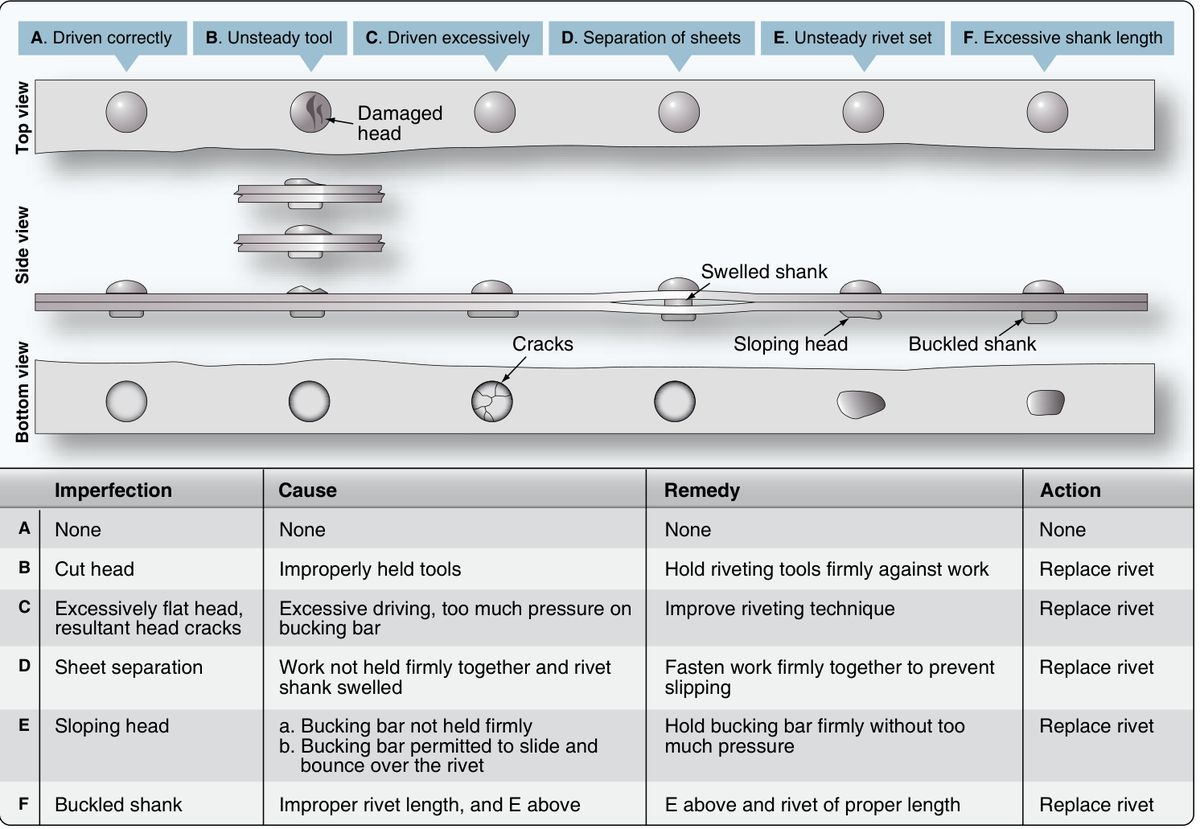
What goes back in
Replace with the same size and strength where you can. If the hole is enlarged, deformed or damaged, drill or ream for the next larger size (1/32 in more diameter), but check that edge distance and spacing still meet the minimums (AC 43.13-1B 4-57b). See the layout guide and the rivet replacement calculator.
Never a weaker rivet, unless a bigger size or more rivets make up the strength. 2017 rivets up to 3/16 in and 2024 up to 5/32 in may be replaced with 2117 for general repairs if the replacement is 1/32 in larger.
Countersunk holes. A NAS1097 rivet has the head one size smaller than its shank (per the distributor listing), so a NAS1097 5/32 has the head of an MS20426 1/8. An enlarged 1/8 in countersunk hole can take it without recountersinking, and standard and oversize rivets of one size share a head. The manual or engineering must authorise the substitution.
Blind fasteners are not a fix for a loose hole. They shall not be used in fluid-tight areas or in engine air intakes, and AC 43.13-1B adds control surfaces, hinges, flight control actuating systems, wing attachment fittings and landing gear fittings; metal repairs need the manufacturer's or the FAA's authority.
Compare the two routes for a loose rivet
Oversize solid rivet
- What it is
- The "repair rivet": same head, larger shank.
- What you do
- Ream the hole, then fit the rivet.
- Result
- The outside look is unchanged.
NAS1097 rivet
- What it is
- A rivet with a head one size smaller than its shank.
- What you do
- Ream the hole for the larger shank and fit the rivet.
- Result
- The existing countersink is not touched.
Both only where the manual or engineering authorises them. Check edge distance and pitch for the new shank.
A loose rivet or a slightly elongated hole
The usual shop repair keeps the original head and outside look. Two routes, both only where the manual or engineering authorises them:
(a) Oversize solid rivet, the "repair rivet". It keeps the same head, so the outside is unchanged, and has a larger shank to fill the reamed hole.
(b) MS20426 1/8 in countersunk. Ream the hole to 5/32 in and fit a NAS1097 5/32 in. Its head is the size of the 1/8 in head (per the distributor listing), so the existing countersink is not touched.
Either way, check edge distance and pitch for the new shank (see Detail B). If they fail, it is a repair design, not a rivet.
Questions people actually ask
Can I reuse a hole after a drill-out?
Yes, if the hole kept its size and shape: the same size rivet goes back.
Why not a bigger rivet everywhere?
Edge distance and pitch minimums grow with the diameter, so a hole that was legal at 1/8 in can fail at 5/32 in.
Is NAS1097 a standard repair?
It is a common one for oversize countersunk holes, but the SRM or engineering has to allow it for your part.
Limits of this guide
What the sources support, and no further.
- Not for a row. A row of oversize rivets is a repair design, not a series of single replacements.
- No strength values here. Shear and bearing come from the manual.
- Drill bit sizes differ between Handbook text and figure; the manual wins.
Where to buy
Distributors coming soon.
Sources
- FAA-H-8083-31A, AMT Handbook — Airframe, Volume 1, Chapter 4 — p. 4-45, inspection and removal of rivets; p. 4-46, countersunk removal, replacing rivets, Fig. 4-98; p. 4-47, blind fastener limits.
- FAA AC 43.13-1B CHG 1, Chapter 4 — par. 4-57b, replacing rivets (p. 4-16); par. 4-57c, minimums; par. 4-57f, blind rivets.
- NAS1097 reduced-head countersunk rivets (SKU Z04F10ZZ1) — head one size smaller than the shank. The 5/32 to 1/8 example is a mechanic's confirmation; use the part's own standard for the substitution.