How one goes in, and the three questions first
Where to buy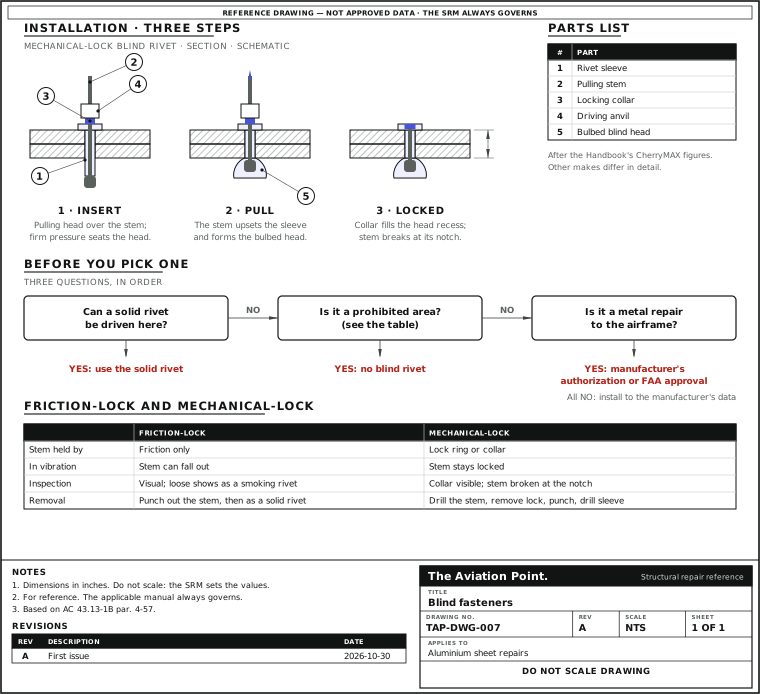
Where a blind rivet may not be used
| Place | AC 43.13-1B par. 4-57f |
|---|---|
| Fluid-tight areas | “in fluid-tight areas” |
| Engine air intakes | “air intake areas where rivet parts may be ingested by the engine” |
| Flight controls | “control surfaces, hinges, hinge brackets, flight control actuating systems” |
| Main fittings | “wing attachment fittings, landing gear fittings” |
| Floats and hulls | “floats or amphibian hulls below the water level” |
| Anywhere else loaded hard | “other heavily-stressed locations on the aircraft” |
AC 43.13-1B CHG 1, par. 4-57f, p. 4-19; FAA-H-8083-31A Vol. 1 p. 4-47 repeats the list.
Quick check
A bucking bar cannot reach a rivet on a hinge bracket. Is a blind rivet the answer?
- Yes, if it is mechanical-lock
Not this one. The lock type does not change the rule for this area.
- Yes, if the stem is filed flush
Not this one. Filing does not change where a blind rivet may go. On a CherryMAX it also weakens the lock.
- No, this area is barred
Best fit. AC 43.13-1B lists hinges and hinge brackets among the places a blind rivet may not be used.
On a real job, the SRM decides.
Can a blind rivet stand in for a solid one?
Sometimes, and not by your own judgement. AC 43.13-1B par. 7-2j says NASM20600 to NASM20603 rivets and the mechanically locked NAS1398, 1399, 1738 and 1739 rivets sometimes may be substituted for solid rivets, but not where the looseness or failure of a few would impair the airworthiness of the aircraft. Structural applications are outlined in NASM33522; nonstructural ones (NASM20604, NASM20605) in NASM33557.
The caution repeats it: for sheet metal repairs to the airframe, a blind rivet must be authorized by the airframe manufacturer or approved by an FAA representative. In practice that means the SRM or approved data names it. If it does not, use the solid rivet and the rivet length calculator.
Friction-lock against mechanical-lock
| Friction-lock | Mechanical-lock | |
|---|---|---|
| What holds the stem | Friction only; the stem is drawn into the sleeve and breaks at a groove | A lock ring or collar locks the stem to the sleeve |
| In vibration | Many centre stems fall out, which greatly cuts shear strength | Made to stop exactly that loss |
| Where it is used | Mostly nonstructural; some, such as nutplates in hard-to-reach spots | The family that can replace a solid rivet size for size (CherryMAX, Cherrylock) |
| Inspection | Visual; a loose rivet shows the “smoking rivet” pattern | Visible collar; stem broken at its notch |
| Removal | Punch out the stem, then treat as any rivet | Destroy the lock first, drive the stem out, then drill out the sleeve |
FAA-H-8083-31A Vol. 1 pp. 4-48 to 4-50; AC 43.13-1B par. 4-57f.
Grip, size and tool
Choose the rivet by grip, the thickness of the sheets it clamps. Lengths go in 1/16 in steps and the length must suit the grip of the metal joined (Handbook p. 4-48). The CherryMAX family is made in four nominal diameters, 1/8, 5/32, 3/16 and 1/4 in, with three oversize diameters, and one tool installs the three standard sizes and their oversizes. The Handbook's installation figure says it accommodates a minimum of 1/16 in variation in structure thickness (p. 4-49).
The CherryMAX grip selector reads the part number against the stack; the pulling head selector gives the head for your riveter. Mounting systems, strokes and grip limits belong to the tool manual, not to this guide.
After installation
Friction-lock. Inspection is visual. The stem does not break flush, so it has to be trimmed and filed flush for the job to be complete (AC 43.13-1B par. 4-57f). A rivet that has worked loose shows the smoking-rivet pattern.
Mechanical-lock. The sheets are clamped tight with no gap, the locking collar is visible in the head recess, and the stem has broken at its notch. Never file the retained stem end of a CherryMAX or Cherrylock smooth: it weakens the lock and the stem can fall out (AC 43.13-1B par. 4-57; Handbook p. 4-48).
Removal. Centre-drill the stem top and drill away its upper part to destroy the lock; take out the lock ring, or punch the stem down a little to free it; drive the stem out; then drill out the sleeve as a solid rivet, with a backup block behind it if you can reach one (Handbook p. 4-50). See rivet removal tools.
Remove a mechanical-lock rivet, one step at a time
| Step | Action | What to do |
|---|---|---|
| 1 | Destroy the lock | Centre-drill the stem top and drill away its upper part. |
| 2 | Free the stem | Take out the lock ring, or punch the stem down a little. |
| 3 | Drive the stem out | Push it out of the sleeve. |
| 4 | Drill out the sleeve | Treat it as a solid rivet, with a backup block behind it if you can reach one. |
Questions people actually ask
Can I use pop rivets on an aluminium skin repair?
Not unless the SRM or approved data allows them. AC 43.13-1B bars blind rivets from the places listed above and requires authorization for a metal airframe repair.
Why CherryMAX instead of a friction-lock rivet?
The lock stops the stem falling out in vibration, and the bulbed blind head bears on thin sheet. The Handbook notes most friction-lock rivets have been replaced by the mechanical-lock kind.
Is there a minimum edge distance or pitch?
Take them from the SRM or the repair drawing for that fastener. This guide gives none.
Limits of this guide
What the sources support, and no further.
- No strengths, hole sizes or grip ranges are given here. They come from the fastener's specification and the manufacturer's installation data.
- Authorization decides. Whether a blind rivet may be used in a given repair is for the SRM, the airframe manufacturer or an FAA representative.
- Pin and threaded fasteners (Hi-Lok, bolts) are not blind rivets and are not covered.
Where to buy
Distributors coming soon.
Sources
- FAA AC 43.13-1B CHG 1, Chapter 4, par. 4-57; Chapter 7, par. 7-2j — par. 4-57f, pp. 4-19 to 4-22: prohibited places, authorization caution, friction-lock, Bulbed Cherrylock, CherryMax; par. 7-2j, p. 7-2: substitution for solid rivets.
- FAA-H-8083-31A, AMT Handbook: Airframe, Volume 1, Chapter 4 — p. 4-47 prohibited places; p. 4-48 friction-lock and mechanical-lock; pp. 4-49 and 4-50 CherryMAX installation (Figs. 4-102, 4-103); p. 4-50 removal of mechanically locked blind rivets.