Sealing a doubler, view by view
Where to buy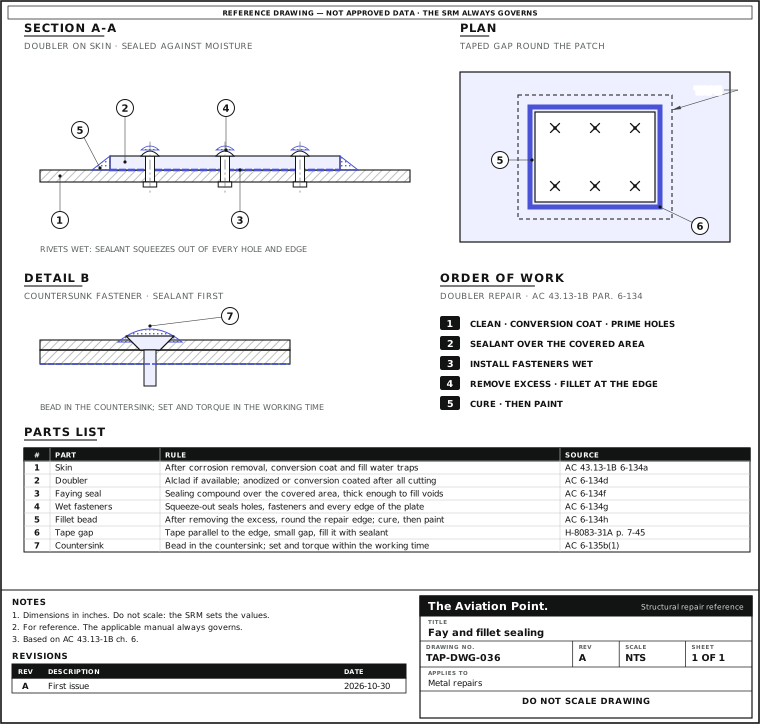
Seal a repair, one step at a time
| Step | Action | What to do |
|---|---|---|
| 1 | Prepare the holes | Drill, countersink, surface-treat and prime all rivet holes before the doubler goes on. |
| 2 | Prepare the doubler | Anodise it (preferred) or conversion-coat it after all cutting, drilling and countersinking. |
| 3 | Spread the compound | Apply it to the faying surface, thick enough to fill all voids. |
| 4 | Fit and fasten | Fit the doubler and install the fasteners wet, within the working time. |
| 5 | Clean up | Remove excess sealant and tool the fillet. |
| 6 | Cure, then paint | Let the sealant cure before any paint goes on. |
Why seal a repair
Aluminium and its alloys must be cleaned and protected: most metals touching aluminium form couples that attack it, and the alloys are subject to pitting and intergranular corrosion (AC 43.13-1B par. 6-132). A repair adds new faying surfaces and new fastener holes, and moisture gets into both unless they are sealed.
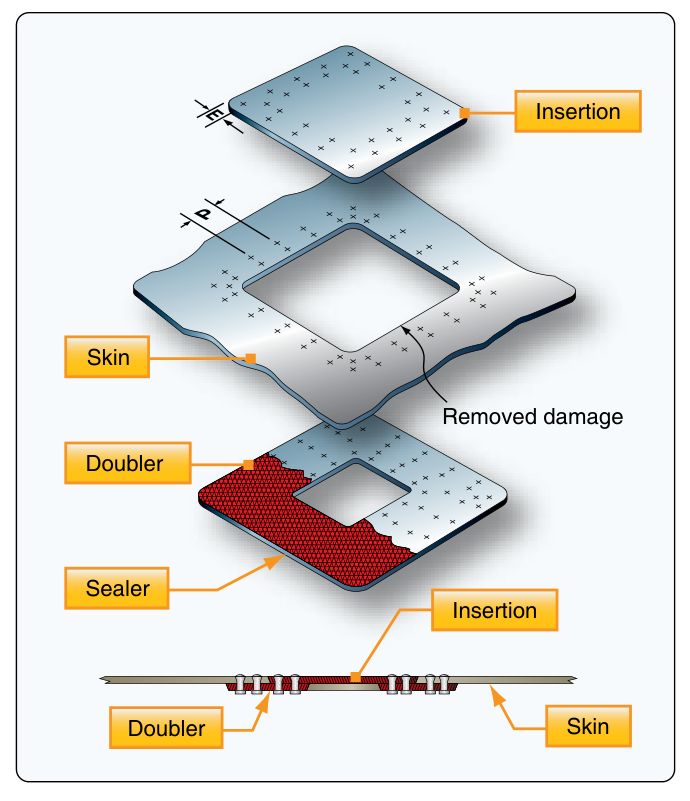
On a composite bolted repair the Handbook gives the aims of the sealant: prevent water and moisture intrusion, chemical damage, galvanic corrosion and fuel leaks, and give a smooth contour (p. 7-45).
What gets sealant, and when
| Place | What the sources say | Source |
|---|---|---|
| Faying surfaces | Apply sealing compound under the doubler thick enough to fill all voids. The Handbook: a thin layer on the doubler before cleco-ing it down | AC 6-134f; HB p. 4-101 |
| Fasteners | Install rivets wet with sealant; enough squeezes out of the holes to seal fasteners and every edge of the plate. Dip all fasteners in sealant | AC 6-134g; HB p. 4-101 |
| Edge of the repair | Remove the excess, then run a fillet bead round the edge. Paint after it cures | AC 6-134h |
| Countersinks | Start the fastener, put a bead of sealant in the countersink, set and torque within the sealant's working time (preferred method) | AC 6-135b(1) |
| Patch periphery | Mask round the patch, leave a small gap from the edge, and seal into that gap | HB p. 7-45 |
AC 43.13-1B pars. 6-134 to 6-135 (pp. 6-25 to 6-26); FAA-H-8083-31A pp. 4-101 and 7-45.
The order that works
Prepare first. Drill, countersink, surface-treat and prime all rivet holes before the doubler goes on (AC 6-134e). Make the doubler of alclad where available, and anodise it (preferred) or chemical-conversion-coat it after all cutting, drilling and countersinking (6-134d). See the finish guide.
Then seal. Spread the compound, fit the doubler, install fasteners wet within the working time. A fastener that has to be driven in the sealant's working time makes the pot life calculator and the mix ratio calculator useful. Quantity for a bead: sealant bead calculator.
Clean up and cure. Remove excess sealant, tool the fillet, let it cure, then paint (AC 6-134h).
Choosing the sealant
Non-corrosive type. AC 43.13-1B recommends non-corrosive sealant where an aluminium patch on magnesium needs both separation and sealing (par. 6-150), and when worn gaskets and sealants are replaced to keep water out (par. 6-50i). In salt-spray surroundings, use a non-corrosive sealant such as one conforming to MIL-S-8802 to seal dissimilar metals (AC Chapter 11, p. 11-75).
Do not block drains. Sealants, levelling compounds, debris or inhibitors must not block drain holes and passages (AC par. 6-50h).
Class, cure and tack-free times are properties of the product. The sources here give none: take them from the sealant's data sheet, and the SRM names the product. The AC says only that cure times vary between products. See sealant types for the classes.
Questions people actually ask
Can I seal after riveting?
The AC and the Handbook install fasteners wet, so the sealant is already in the hole. A bead over a dry fastener leaves the fay surface open.
Do I seal a repair on a fuel tank?
The sources here are for non-integral structure and external repairs. A fuel-tank repair follows the SRM, whose sealant and procedure are different.
Fillet bead before or after paint?
Before: cure the fillet, then paint (AC 6-134h).
Limits of this guide
What the sources support, and no further.
- No sealant class, thickness or cure time is given. Those come from the SRM and the product data sheet.
- Metal doubler repairs after corrosion removal, and bolted composite repairs; not integral tanks or pressurised seals.
- Typical only. The SRM's seal drawing governs.
Where to buy
Distributors coming soon.
Sources
- FAA AC 43.13-1B CHG 1, Chapter 6 — Par. 6-132, aluminium corrosion; par. 6-134, repair of aluminium sheet after corrosion removal, a to h (pp. 6-24 to 6-25); par. 6-135, countersunk fasteners (p. 6-26); par. 6-150, magnesium repaired with aluminium (p. 6-29); par. 6-50h and i, drains and sealants (p. 6-13). Chapter 11, p. 11-75.
- FAA-H-8083-31A, AMT Handbook — Airframe, Volume 1 — p. 4-101, sealant on the doubler, fasteners dipped; p. 4-108, fillet and head seals, faying surface seal to the SRM; p. 7-45, sealing of fasteners and patch.