Classes A, B and C, and the dash number
Where to buy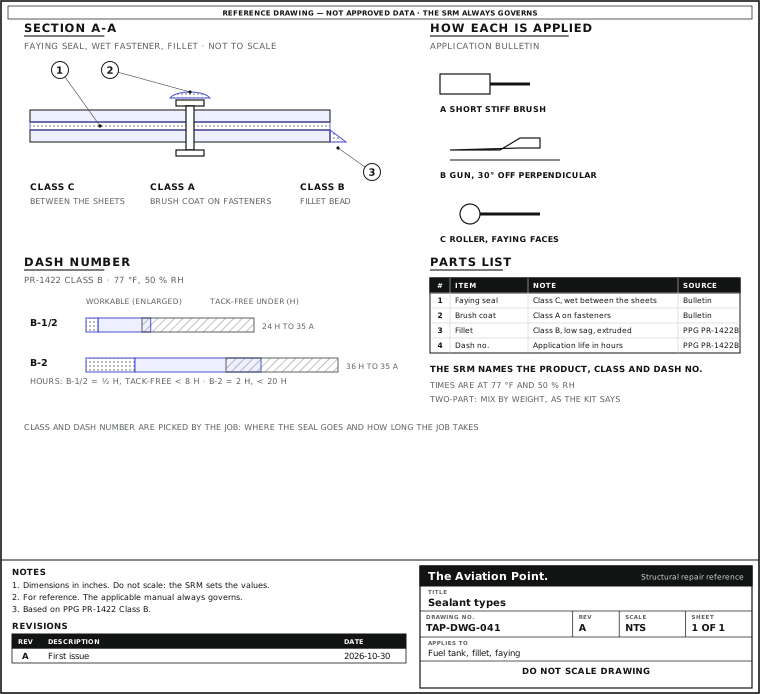
Class: how it is applied and what for
| Class | Applied by | Used for | How it behaves |
|---|---|---|---|
| A | Brush | Brush coats on fasteners and in crevices, holes and seams; a precoat under a Class B fillet | Flowable. A short, stiff brush works it into leak paths; a second coat goes on once the first is tack-free |
| B | Extrusion gun or spatula | Fillet seals, vertical and overhead seams | Thixotropic: a low-sag paste that does not run. Usually fewer volatile solvents, so less air and solvent is trapped |
| C | Roller or comb | Faying surfaces: the faces of mating parts, sealed before assembly | A rollable grade, thinner than Class B |
Sealant application bulletin, class and applications; PPG Aerospace, PR-1422 Class B data sheet. We give no viscosity ranges: the sources we have read disagree on them.
Compare the three classes
Class A
- Applied by
- Brush.
- Used for
- Brush coats on fasteners and in crevices, holes and seams; a precoat under a Class B fillet.
- How to apply
- Work the first coat into the leak paths with a short, stiff brush. The second coat goes on once the first is tack-free.
Class B
- Applied by
- Extrusion gun or spatula.
- Used for
- Fillet seals, and vertical and overhead seams.
- How to apply
- Hold the gun with the nozzle pointing in the direction of travel, so the bead is pushed into the joint.
Class C
- Applied by
- Roller or comb.
- Used for
- Faying surfaces: the faces of mating parts.
- How to apply
- Spread it before assembly, then fit and install the fasteners wet while it is workable.
The SRM names the sealant, class and dash number.
Dash number: one real sheet (PR-1422 Class B)
| Dash | Application life | Tack-free | Cure to 35 A | Slump, in (initial / 50 min / 90 min) |
|---|---|---|---|---|
| B-1/2 | ½ hour | under 8 hours | 24 hours | 0.15 initial |
| B-2 | 2 hours | under 20 hours | 36 hours | 0.10 / 0.15 / 0.20 |
PPG Aerospace, PR-1422 Class B Fuel Tank Sealant data sheet (issue 09/10, Lit 0157). At 77 °F (25 °C), 50 % RH. Tests in accordance with AMS-S-8802 Class B. The figures belong to this product: another sealant's sheet has its own.
Reading the dash number
The number is the application life in hours at the standard test conditions of 77 °F and 50 % humidity: ½ hour for B-1/2, 2 hours for B-2 on the sheet above. Choose by the job. A short life cures sooner (24 hours to 35 A for B-1/2 against 36 for B-2) and suits a small, quick task. A long life gives time to seal a large area or set many wet fasteners before it starts to stiffen.
The sheet lists its times at one temperature; for other temperatures take the figures from the sealant maker. The sealant bead calculator gives the amount of sealant a bead of a given size takes.
Applying each class
Class A, the brush coat. The first coat is worked in and around all leak-source areas with a short, stiff brush. The second goes on after the first is tack-free. It is also used as a precoat under a Class B fillet (application bulletin).
Class B, the fillet. Hold the gun about 30° off perpendicular, with the nozzle pointing in the direction of travel so that the bead is pushed into the joint. Do not point it against the direction of travel, and do not caulk as a building trade does, as air gets trapped under the bead (application bulletin).
Class C, the faying seal. Spread on the faying faces before assembly, then fit and install the fasteners wet while it is workable. The steps of a faying and fillet seal on a repair are in the fay and fillet sealing guide.
Two-part mixing. Mix part A and part B each to a uniform state, then the whole contents together, avoiding unmixed areas on the sides and bottom of the container. The PR-1422 B kit is mixed at 13.3 parts A to 100 parts B by weight; another product has another ratio (PPG data sheet).
Service, storage and the standards
The PR-1422 Class B sheet gives a service range of -65 °F to 250 °F, with brief excursions to 275 °F, and describes the sealant as a fuel tank fillet sealant that also suits other fuselage sealing. Unopened kits keep at least 9 months between 40 °F and 80 °F.
Two kinds of standard sit behind the data sheets. A material specification such as AMS-S-8802 sets the classes and requirements; the PPG sheet says its tests follow that specification for Class B. AS5127/1, published by SAE, gives the test methods for two-component sealing compounds, used with AS5127 and the material specification. A sealant approved for a given aircraft appears in the SRM or the maker's list: ask for the data sheet of the lot you are using.
For UAV, model and homebuilt work
Aerospace sealants come in kits sized for aircraft work. For a small build, the useful idea is the match between class and job: a brush coat on fastener heads, a bead for fillets and a roller or spreader for faying faces. Buy the sealant the airframe maker or the supplier names for the structure, read the sheet for its pot life, and clean the surfaces as the sheet says.
Questions people actually ask
What does B-2 mean?
Class B, application life of 2 hours: the mixed sealant stays workable for about 2 hours at 77 °F and 50 % humidity.
Which class goes between two sheets?
Class C is the faying grade. The sealing guide shows where a faying seal sits on a doubler.
Does a longer dash number mean a stronger seal?
No. It is the working time. Properties come from the sealant and the sheet.
Polysulfide or polythioether?
Both are two-part synthetic rubber sealants, and the AS5127/1 test standard covers two-component compounds. We have read only a polysulfide sheet: read the data sheet of the product the SRM names.
Limits — when NOT to use this
What the sources support, and no further.
- The manual governs. The SRM names the sealant, class, dash number and primer.
- One product sheet. The dash table is PR-1422 Class B. We have not read the data for Class A or C of any product, and we give none.
- No viscosity ranges. The sources do not agree on them.
- Polythioether sealants. We found no manufacturer's data sheet we could read, so no polythioether figures are given.
- Standards not read. We cite AMS-S-8802 and AS5127/1 as the data sheet and SAE's catalogue describe them; their text is paid and we have not quoted it.
Where to buy
Distributors coming soon.
Sources
- PPG Aerospace, PR-1422 Class B Fuel Tank Sealant, data sheet (issue date 09/10, Lit 0157) — Description, service temperature, mixing ratio, application life, tack-free and cure table, slump, storage life; tests per AMS-S-8802 Class B.
- Sealant application bulletin: class and applications (distributor document) — Class A brush, B fillet, C rollable; brush application; gun angle and direction of travel.
- SAE International, AS5127/1C: Test Methods for Aerospace Sealants, Two-Component Synthetic Rubber Compounds — Scope: test methods for two-component sealing compounds, used with AS5127 and the material specification; revision history to AS5127/1D (2020).
- FAA AC 43.13-1B CHG 1, Chapter 6 — Pars. 6-50h, 6-50i and 6-150, non-corrosive sealant and drains; see the sealing guide.