Key facts
Where to buy| Property | Value | Source |
|---|---|---|
| Density | 0.102 lb/in³ (2.83 g/cm³) | MIL-HDBK-5J; Teal Sheets |
| E / Ec / G | 10.3 / 10.6 / 3.9 × 10³ ksi | MIL-HDBK-5J Table 3.7.4.0(b1) |
| Arc / spot welding | C / B | MIL-HDBK-5J Table 3.1.3.4(a) |
| Stress corrosion, T74 plate | L: A · LT: A · ST: B | MIL-HDBK-5J Table 3.1.2.3.1(a) |
| Stress corrosion, T76 plate | L: A · LT: A · ST: C | MIL-HDBK-5J Table 3.1.2.3.1(a) |
| Rivet shear, driven 7050-T731 | 43 ksi | MIL-HDBK-5J Table 8.1.2(b) |
Sheet is not listed: MIL-HDBK-5J gives plate, forgings and extrusions.
Reading the alloy and temper code
Composition limits, weight percent
| Element | Limit |
|---|---|
| Si | 0.12 |
| Fe | 0.15 |
| Cu | 2.0–2.6 |
| Mn | 0.10 |
| Mg | 1.9–2.6 |
| Cr | 0.04 |
| Zn | 5.7–6.7 |
| Ti | 0.06 |
| Zr | 0.08–0.15 |
| Al | Remainder |
A single number is a maximum. Other elements: 0.05 each, 0.15 total, except where the Teal Sheets say otherwise. Source: Aluminum Association Teal Sheets (Aug 2018).
Design allowables, 7050-T7451 plate
| Property, ksi | 0.250–1.500 A | 0.250–1.500 B | 3.001–4.000 A | 3.001–4.000 B | 7.001–8.000 A | 7.001–8.000 B |
|---|---|---|---|---|---|---|
| Ftu, L | 74 (S) | 76 | 72 | 74 | 68 | 71 |
| Ftu, LT | 74 | 76 | 72 | 75 | 68 | 71 |
| Fty, L | 64 (S) | 67 | 62 (S) | 65 | 58 (S) | 63 |
| Fty, LT | 64 | 66 | 62 | 65 | 58 | 61 |
| Fcy, L | 63 | 64 | 60 | 63 | 55 | 57 |
| Fcy, LT | 66 | 68 | 65 | 68 | 59 | 62 |
| Fsu | 42 | 43 | 43 | 45 | 44 | 46 |
| Fbru, e/D = 1.5 | 107 | 110 | 107 | 111 | 103 | 108 |
| Fbru, e/D = 2.0 | 140 | 144 | 140 | 144 | 132 | 138 |
| Fbry, e/D = 1.5 | 86 | 89 | 90 | 94 | 83 | 87 |
| Fbry, e/D = 2.0 | 101 | 104 | 104 | 109 | 98 | 102 |
Thickness in inches, AMS 4050, MIL-HDBK-5J Table 3.7.4.0(b1), p. 3-324. (S) marks a value printed as S basis. S, A and B are the MIL-HDBK-5J statistical bases. L is the longitudinal grain direction, LT the long transverse. Bearing values are dry-pin values.
Tempers and uses
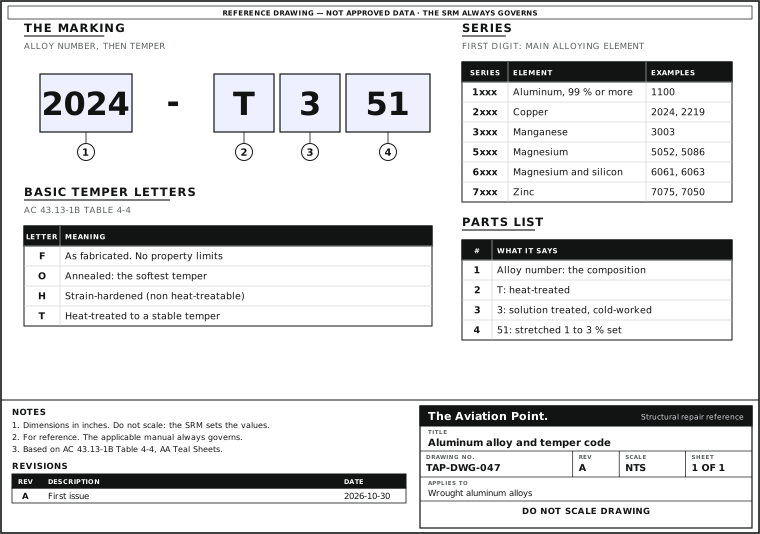
The T73 temper gives this alloy its highest stress-corrosion resistance, T76 gives good exfoliation resistance, and T74 sits between them (MIL-HDBK-5J 3.7.4.0).
T7451 plate has better stress-corrosion resistance than 7075-T7651. T76 is better in stress corrosion than the T6 tempers of 7075 and 7178.
The AMT Handbook lists 7050 among rivet alloys (p. 4-31), and says most DD rivets have been replaced by E-type rivets, which go in as received.
Specifications and product forms
| Specification | Form |
|---|---|
| AMS 4050, AMS 4201 | Bare plate |
| AMS 4107, AMS 4333 | Die forging |
| AMS 4108 | Hand forging |
| AMS 4340, AMS 4341, AMS 4342 | Extruded shape |
| AMS-A-22771 | Forging |
Specifications as listed by MIL-HDBK-5J. Federal QQ-A specifications passed to SAE as AMS-QQ-A. Check the current revision.
Questions people actually ask
7050 or 7075 for thick plate?
The handbook says 7050's low quench sensitivity gives high strength in thick sections. The drawing chooses, and neither replaces the other without approved data.
Limits — when NOT to use this
- Not a source of design allowables. Values are for reference. MMPDS and the SRM govern a repair.
- Not a substitution approval. A different alloy or temper needs approved data.
Where to buy
Distributors coming soon.
Sources
- FAA-H-8083-31B, AMT Handbook — Airframe, Volume 1, Chapter 4 — p. 4-31.
- MIL-HDBK-5J (31 Jan 2003), Chapter 3 — Section 3.7.4.0; Tables 3.1.2.3.1(a), 3.1.3.4(a), 3.7.4.0(a), (b1), 8.1.2(b). Cancelled and superseded by MMPDS: check current MMPDS before design use.
- Aluminum Association, International Alloy Designations (Teal Sheets), rev. Aug 2018 — chemical composition limits and nominal densities.
- MMPDS (formerly MIL-HDBK-5) — the current home of design allowables. A repair substantiation cites MMPDS or the SRM, not a website.