Key facts
Where to buy| Property | Value | Source |
|---|---|---|
| Type | Near-alpha titanium with solid-solution strengthening by tin and zirconium; molybdenum improves strength, creep and stability | MIL-HDBK-5J, par. 5.3.3.0 |
| Temperature | Creep resistant and relatively stable to about 1,050 °F | MIL-HDBK-5J, par. 5.3.3.0 |
| Silicon | About 0.08 % silicon improves creep strength | MIL-HDBK-5J, par. 5.3.3.0 |
| Sheet | AMS 4919 (duplex annealed) and AMS-T-9046 Comp. AB-4 (triplex annealed) | MIL-HDBK-5J, Table 5.3.3.0(b) |
| Forms | Bar, billet, plate, sheet, strip and extrusions | MIL-HDBK-5J, par. 5.3.3.0 |
| Welding | TIG or MIG fusion gives 100 percent joint efficiency, with limited weld-zone ductility | MIL-HDBK-5J, par. 5.3.3.0 |
Design allowables — Ti-6Al-2Sn-4Zr-2Mo sheet
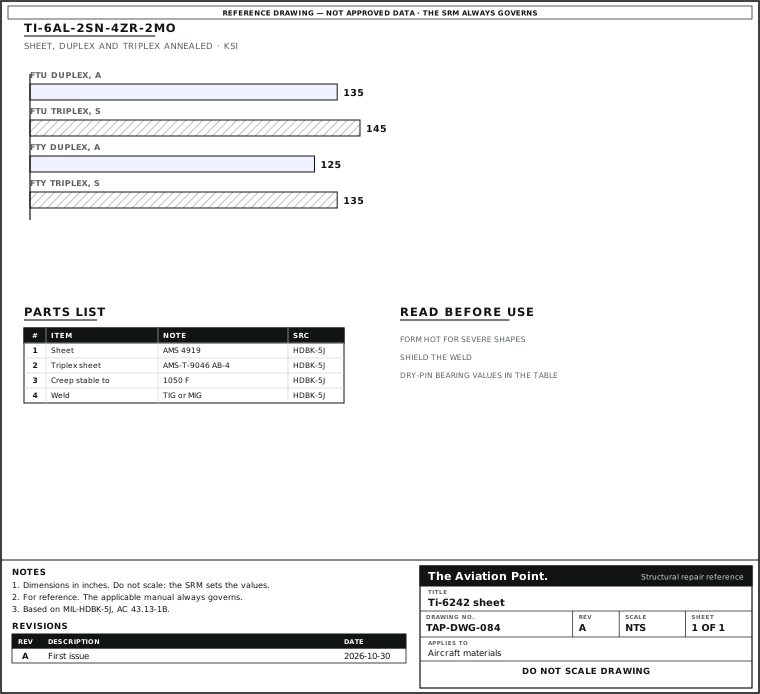
MIL-HDBK-5J Table 5.3.3.0(b), p. 5-45.
| Property | Duplex annealed, AMS 4919, 0.047–0.093 in, A basis | Triplex annealed, AMS-T-9046 AB-4, to 0.187 in, S basis | Unit |
|---|---|---|---|
| Ftu, L and LT | 135 | 145 | ksi |
| Fty, L and LT | 125 | 135 | ksi |
| Fcy, L and LT | 132 | — | ksi |
| E | 16.5 | 16.5 | 10³ ksi |
| G | 6.2 | 6.2 | 10³ ksi |
| Density | 0.164 | 0.164 | lb/in³ |
The table has columns for several thicknesses (to 0.046, 0.047–0.093, 0.094–0.140, 0.141–0.187 in) and A and B bases, with bearing values; only the 0.047–0.093 in A-basis column and the triplex S column are shown. Bearing values are dry-pin values.
Thicknesses and forms
Sheet 0.025 to 0.187 in in the handbook table; plate, bar, billet and extrusions also. Sheet is supplied duplex or triplex annealed.
Forming
Elevated temperatures may be used for severe sheet forming, while room-temperature forming is for mild contouring. Stress relief annealing may be combined with a final hot-sizing operation (MIL-HDBK-5J par. 5.3.3.0).
Titanium alloy forming is in three classes: cold forming with no stress relief, cold forming with stress relief, and elevated-temperature forming (built-in relief). The alloy sheet can be formed to a limited extent at room temperature (AMT Handbook, p. 4-85).
Quick check
What is Ti-6242 chiefly chosen for?
- Cold forming
Not this one. Heat is used for severe forming.
- Creep resistance and stability to about 1,050 °F
Best fit. Right.
- Low cost
Not this one. Not a handbook property.
On a real job, the SRM decides.
Welding
The material can be welded by TIG or MIG fusion for 100 percent joint efficiency with limited weld-zone ductility. As for any titanium alloy, shielding is required (MIL-HDBK-5J par. 5.3.3.0).
Corrosion
Titanium is highly corrosion resistant because an oxide film forms in air. Heated, it shows colour: blue at 700–800 °F, purple at 800–950 °F, gray or black at 1,000 °F or higher; these are protective discolorations and should not be removed (AC 43.13-1B par. 6-181a).
If corrosion occurs it is usually pitting and hard to detect. Titanium is susceptible to hydrogen embrittlement, so chlorinated solvents and chemical corrosion removers are prohibited, and fire-resistant hydraulic fluids must be controlled (AC par. 6-181b and c). Isolate titanium from magnesium, aluminum or alloy steel (AMT Handbook p. 4-85).
Where it is used on aircraft
Hot titanium structure, to about 1,050 °F; it was developed for gas turbine engines and later applications (MIL-HDBK-5J par. 5.3.3.0).
Data sheet
Questions people actually ask
How hot can Ti-6242 go?
Creep resistant and relatively stable to about 1,050 °F (MIL-HDBK-5J par. 5.3.3.0). Ti-6Al-4V, by contrast, is rated to 750 °F in the same handbook.
Limits — when NOT to use this
- Partial table. Open Table 5.3.3.0(b) for other thicknesses.
- Engine and nacelle repairs follow the manufacturer's manual.
Where to buy
Distributors coming soon.
Sources
- FAA AC 43.13-1B CHG 1 — par. 6-181.
- FAA-H-8083-31B, Aviation Maintenance Technician Handbook, Airframe, Volume 1 — pp. 4-85 and 4-86, titanium.
- MIL-HDBK-5J, Metallic Materials and Elements for Aerospace Vehicle Structures (31 Jan 2003) — par. 5.3.3.0 and Table 5.3.3.0(b), p. 5-45. Cancelled; superseded by MMPDS.
- MMPDS (formerly MIL-HDBK-5) — the current home of design allowables. A repair substantiation cites MMPDS or the SRM, not a website.