Key facts
Where to buy| Property | Value | Source |
|---|---|---|
| Composition | Carbon 0.07 %, chromium 16.5 %, nickel 4 %, copper, columbium or tantalum | AC 43.13-1B CHG 1, Table 4-3 |
| Class | Precipitation hardening, martensitic | AC 43.13-1B Table 4-3; MIL-HDBK-5J par. 2.6.9.0 |
| Temperature | Good corrosion and oxidation resistance up to 600 °F | MIL-HDBK-5J, par. 2.6.9.0 |
| Sheet, strip, plate | AMS 5604 | MIL-HDBK-5J, Table 2.6.9.0(b) |
| Forgings, tubing, rings | AMS 5643 | MIL-HDBK-5J, Table 2.6.9.0(d) |
| Machining | Best in H1150 and H1150M; precautions of austenitic stainless but work hardening is not a problem | MIL-HDBK-5J, par. 2.6.9.0 |
| Size change in aging | Contraction 0.0004–0.0006 in/in to H900, 0.0008–0.0010 in/in to H1150 | MIL-HDBK-5J, par. 2.6.9.0 |
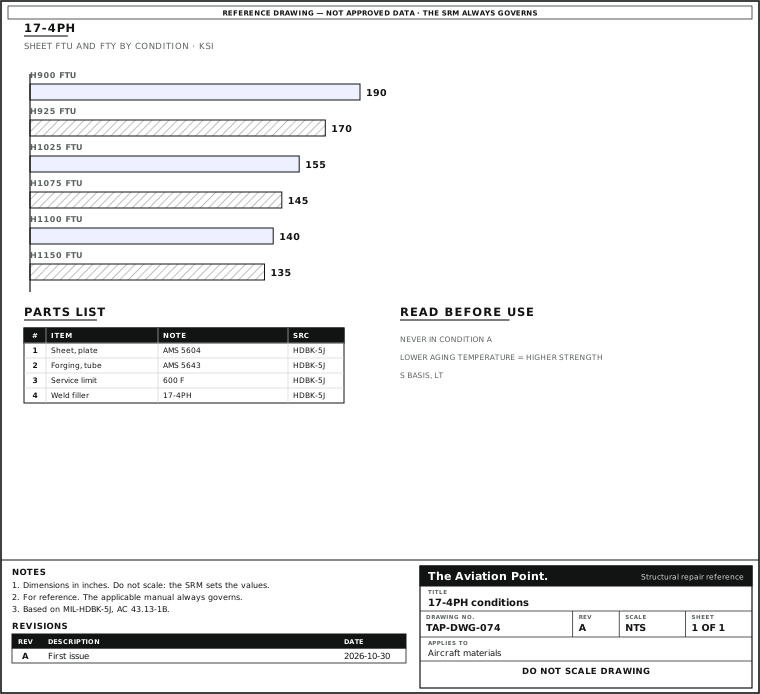
Design allowables — 17-4PH sheet, strip and plate, by condition (S basis)
AMS 5604, 4.000 in and under. Strengths in ksi, elongation in percent. MIL-HDBK-5J Tables 2.6.9.0(b) and (c).
| Condition | Ftu, LT | Fty, LT | Min. elongation, 0.015–0.186 in | Min. elongation, 0.187–0.625 in |
|---|---|---|---|---|
| H900 | 190 | 170 | 5 | 8 |
| H925 | 170 | 155 | 5 | 8 |
| H1025 | 155 | 145 | 5 | 8 |
| H1075 | 145 | 125 | 5 | 9 |
| H1100 | 140 | 115 | 5 | 10 |
| H1150 | 135 | 105 | 8 | 10 |
E = 28.5 × 10³ ksi, G = 11.2 × 10³ ksi, density 0.282 lb/in³ (H900), 0.283 (H1075), 0.284 (H1150). Forgings and rings (AMS 5643) reach H1150M at Ftu 115 / Fty 75 ksi. Fcy, Fsu and bearing values are in Table 2.6.9.0(b), p. 2-197. Source: MIL-HDBK-5J (31 Jan 2003).
Thicknesses and forms
All product forms: sheet, strip and plate (AMS 5604, design values to 4.000 in), forgings, tubing and rings (AMS 5643, under 8.000 in), bar and castings.
Minimum elongation falls with thinner sheet: 5 percent from 0.015 to 0.186 in in most conditions (Table 2.6.9.0(c)).
Forming
Precipitation-hardening (PH) stainless is supplied soft (Condition A) and aged to a strength level with a low-temperature heat treatment. Condition A is for fabrication, not for service.
When permanent deformation is done, such as cold straightening of hardened parts, re-aging is recommended to minimize internal stresses (MIL-HDBK-5J par. 2.6.9.0). Allow for the contraction on aging before finish machining.
Quick check
17-4PH sheet marked H1150. Compared with H900 it is…
- Stronger and tougher
Not this one. Not both.
- Lower in strength (135 vs 190 ksi) and better in toughness
Best fit. Right.
- Identical
Not this one. Different aging temperature, different properties.
On a real job, the SRM decides.
Welding
17-4PH can be fusion welded with any normal process using 17-4PH filler metal, without preheat. Up to one-half inch, Condition A is satisfactory before welding; for heavy sections an overaged condition (H1150) is recommended to prevent cracking. After welding, weldments should be aged or solution treated and aged (MIL-HDBK-5J par. 2.6.9.0).
Corrosion
Good corrosion and oxidation resistance to 600 °F (MIL-HDBK-5J par. 2.6.9.0). Magnetic stainless steels corrode more readily than the 300 series, and the AC treats their corrosion like high-strength steel (par. 6-164a, 6-165): mild abrasives, no power tools.
Where it is used on aircraft
Fittings, hardware and structural parts needing high strength with corrosion resistance, in all forms (MIL-HDBK-5J par. 2.6.9.0). The condition is on the drawing.
Data sheet
Questions people actually ask
What does H900 mean?
The aging temperature in °F: aged at 900 °F for the highest strength, 190 ksi in sheet. H1150 is aged at 1,150 °F for 135 ksi and better toughness.
Limits — when NOT to use this
- Never use in Condition A. It is a fabrication condition.
- H900 and H925 are not for parts needing fracture toughness (the handbook says this for 15-5PH, a close relative).
- Weld repair: the SRM.
Where to buy
Distributors coming soon.
Sources
- MIL-HDBK-5J, Metallic Materials and Elements for Aerospace Vehicle Structures (31 Jan 2003) — par. 2.6.9.0 and Tables 2.6.9.0(b), (c) and (d), pp. 2-197 and 2-198. Cancelled; superseded by MMPDS.
- FAA AC 43.13-1B CHG 1 — Table 4-3.
- MMPDS (formerly MIL-HDBK-5) — the current home of design allowables. A repair substantiation cites MMPDS or the SRM, not a website.