Key facts
Where to buy| Property | Value | Source |
|---|---|---|
| Composition | Chromium 0.80–1.10 %, molybdenum 0.15–0.25 %, carbon 0.38–0.43 % | AZoM AISI 4140 composition table; the 41 means Cr-Mo steel and 40 about 0.40 % carbon (AMT Handbook, p. 5-16) |
| Against 4130 | Can be heat treated in thicker sections and to higher strength levels than 4130 | MIL-HDBK-5J, par. 2.3.1.0 |
| Typical use | Structural machined and forged parts one-half inch and over in thickness | MIL-HDBK-5J, par. 2.3.1.0 |
| Sheet, strip, plate | AMS 6395 | MIL-HDBK-5J, Table 2.3.1.0(a) |
| Bars and forgings | AMS-S-5626, AMS 6382, AMS 6349, AMS 6529 | MIL-HDBK-5J, Table 2.3.1.0(a) |
| Tubing | AMS 6381 | MIL-HDBK-5J, Table 2.3.1.0(a) |
| Alternate | AISI 8740 is listed as the alternate to 4140 | MIL-HDBK-5J, par. 2.3.1.0 |
| Welding rod | 4140 rod, AMS 6452, AWS A5.28 | AC 43.13-1B CHG 1, Table 4-15 |
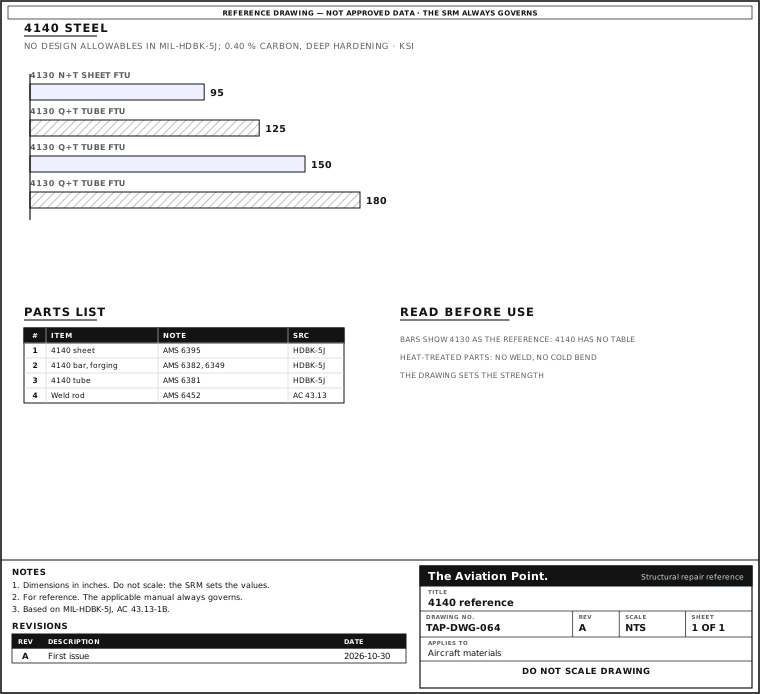
The handbook gives no design allowables for 4140: its Table 2.3.1.0(a) marks these specifications as not containing minimum mechanical properties. The strength depends on the heat treatment shown on the part drawing or certificate.
Thicknesses and forms
Forms in the sources: sheet, strip and plate (AMS 6395), bars and forgings (AMS 6382 and others) and tubing (AMS 6381). The handbook's own use note, parts one-half inch and over, tells you the usual form is bar and forging, not thin sheet.
No thickness limits are printed for 4140 because no allowables table exists. The heat-treatment response of a section is set by the spec and the certificate.
Forming
Sheet is formed annealed or normalized and heat treated afterward, as for any hardenable steel. The public FAA documents give no bend radius for steel (AC 43.13-1B Table 4-6 covers aluminum only), so the drawing or the SRM governs.
Heat-treated parts are not cold-bent or straightened. Mechanical properties of heat-treated steel are valid only for material quenched to a structure with 90 percent or more martensite at the centre (MIL-HDBK-5J, par. 2.3.1.0).
Quick check
A fitting made of heat-treated 4140 has a crack at a hole. A welder offers to fix it. What do you do?
- Let him weld it with 4140 rod, it is in the AC table
Not this one. The rod table says what rod welds 4140, not that a heat-treated part may be welded. The AC forbids welding heat-treated alloy parts such as bolts and turnbuckle ends.
- Stop, the part is heat-treated; engineering and the SRM decide
Best fit. Right. Welding destroys the heat treatment, and 4140 is the harder-to-weld grade.
- Drill a stop hole and carry on
Not this one. A stop hole is a sheet-metal answer. On a heat-treated steel fitting the crack means the part goes to engineering.
On a real job, the SRM decides.
Welding
MIL-HDBK-5J: 4140 can be welded but it is more difficult than the lower-carbon 4130 (par. 2.3.1.0). More carbon means harder, more crack-prone martensite beside the weld.
AC 43.13-1B Table 4-15 lists 4140 welding rod (AMS 6452, AWS A5.28) for 4140. The AC also says not to weld alloy steel parts that are heat treated for their mechanical properties, such as bolts and turnbuckle ends (par. 4-89c). Preheat and post-weld heat treatment come from engineering.
Corrosion
Any corrosion on a highly-stressed steel part (heat treated above Rockwell C40, 180,000 psi) is potentially dangerous. Remove it with mild abrasive mats, cloths or fine papers, never power tools or chemical removers without engineering authorization, because of hydrogen embrittlement (AC 43.13-1B, par. 6-165).
Where it is used on aircraft
Machined and forged fittings, shafts and pins one-half inch and thicker (MIL-HDBK-5J, par. 2.3.1.0).
On a repair you meet it as the original part, not as stock to choose. Identify it before touching it (see the material ID guide).
Data sheet
Questions people actually ask
Is 4140 the same as 4130?
No. Same chromium-molybdenum family, but 4140 carries about 0.40 % carbon against 0.30 %, so it heat treats deeper and higher and is harder to weld (MIL-HDBK-5J, par. 2.3.1.0).
Can I swap 4140 for 4130 or the reverse?
Not on your own authority. Strength, weldability and heat treatment differ; a substitution on structure needs approved data.
Limits — when NOT to use this
- No allowables on this page because the public handbook has none for 4140. Use MMPDS or the drawing.
- Not a welding recommendation. TIG weld only with the procedure the SRM or the drawing gives.
- Not a substitute for 4130 tube. Different carbon, different weld behaviour.
Where to buy
Distributors coming soon.
Sources
- MIL-HDBK-5J, Metallic Materials and Elements for Aerospace Vehicle Structures (31 Jan 2003) — par. 2.3.1.0 (4140 comment) and Table 2.3.1.0(a), specifications. Cancelled; superseded by MMPDS.
- FAA AC 43.13-1B CHG 1 — Table 4-15 (welding rod), par. 4-89c, par. 6-165.
- FAA-H-8083-31B, Aviation Maintenance Technician Handbook, Airframe, Volume 1 — p. 5-16, steel designation.
- MMPDS (formerly MIL-HDBK-5) — the current home of design allowables. A repair substantiation cites MMPDS or the SRM, not a website.
- AZoM, AISI 4140 alloy steel — Chemical composition table.