Aircraft aluminum alloys side by side
Where to buy| Alloy | Group | Ftu, ksi | Fty, ksi | lb/in³ | Arc weld | Mostly for |
|---|---|---|---|---|---|---|
| 2024-T3 sheet | 2xxx HT | 64 | 47 | 0.100 | C | Skins, doublers, general structure |
| Alclad 2024-T3 | 2xxx HT | 62 | 45 | 0.100 | C | Skins that must resist corrosion |
| 2024-T351 plate | 2xxx HT | 64 | 48 | 0.100 | C | Plate, machined parts |
| 2014-T6 sheet | 2xxx HT | 67 | 59 | 0.101 | B | Forgings, fittings, heavy parts |
| 2017 bar, rod | 2xxx HT | 55 (S) | 32 (S) | 0.101 | C | D rivets, fasteners |
| 2117 | 2xxx HT | — | — | 0.099 | — | AD rivets |
| 2219-T81 sheet | 2xxx HT | 61 | 47 | 0.103 | A | Weldable tanks, hot parts |
| 6061-T6 sheet | 6xxx HT | 42 | 36 | 0.098 | A | Tubing, brackets, weldments |
| 6063 | 6xxx HT | — | — | 0.097 | — | Extrusions, not in FAA sources |
| 7075-T6 sheet | 7xxx HT | 78 | 70 | 0.101 | C | Fittings, high-tension parts |
| Alclad 7075-T6 | 7xxx HT | 74 | 66 | 0.101 | C | High-strength clad sheet |
| 7075-O | 7xxx HT | — | — | 0.101 | C | Form, then heat-treat |
| 7050-T7451 plate | 7xxx HT | 74 (S) | 64 (S) | 0.102 | C | Thick plate, E rivets |
| 7178 | 7xxx HT | — | — | 0.102 | — | Older aircraft |
| 1100 | 1xxx | — | — | 0.098 | — | Tanks, cowlings, soft rivets |
| 3003 | 3xxx | — | — | 0.099 | — | Tanks, cowlings, tubing |
| 5052-H32 | 5xxx | 31 (S) | 23 (S) | 0.097 | A | Lines, tanks, formed parts |
| 5086-H32 | 5xxx | 40 | 28 | 0.096 | A | Tough, weldable plate |
| 5056 | 5xxx | — | — | 0.095 | — | Rivets for magnesium |
Ftu and Fty: L direction, A basis unless marked S, in the sheet or plate range shown on each alloy's page, from MIL-HDBK-5J (superseded by MMPDS). Densities are from MIL-HDBK-5J or the Aluminum Association. Arc weld: MIL-HDBK-5J ratings A to D, where A is routine and C is limited. The AC lists 2024 and 7075 as not to be welded. HT: heat-treatable. A dash means the sources used here print no value.
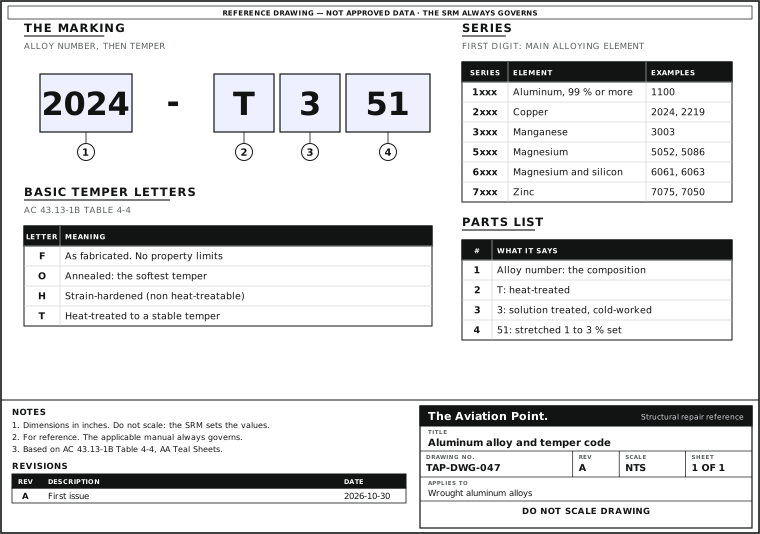
Reading the alloy and temper code
Choose by what the part must do
Skin or doubler
- Usual choice
- Whatever the SRM names: usually Alclad 2024-T3
- Why
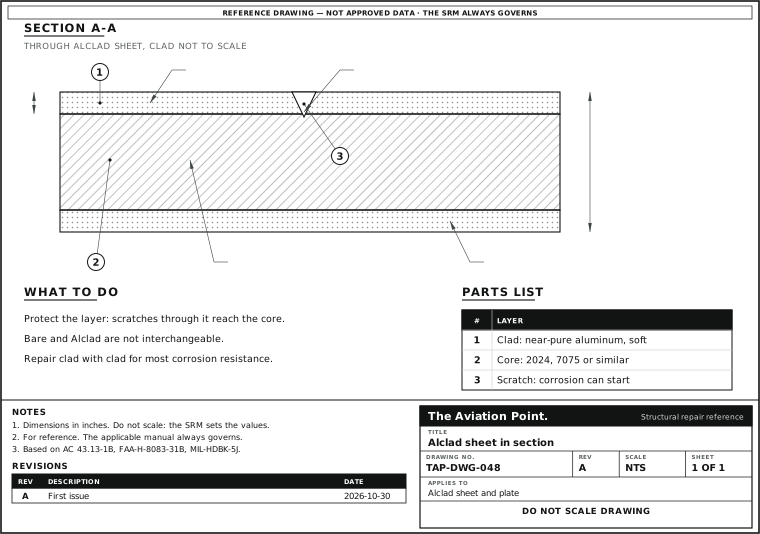
- Handles repeated loads; the clad resists corrosion
- Watch
- Bare and Alclad are not interchangeable
Bracket or tube
- Usual choice
- 6061-T6 or 5052
- Why
- They bend tightly and weld
- Watch
- Weaker than 2024 for the same gauge
Machined fitting
- Usual choice
- 7075, 7050 or 2014
- Why
- High strength; 7050 holds it in thick sections
- Watch
- T6 tempers: D stress-corrosion rating across the grain
Tank or cowling
- Usual choice
- 1100, 3003 or 5052
- Why
- Easy to form; may be repaired by welding
- Watch
- Not structural allowables
Rivet
- Usual choice
- 2117 (AD)
- Why
- Driven as received
- Watch
- 2017 and 2024 need cold storage; 5056 for magnesium
Starting points from the FAA handbooks. The drawing or SRM always names the material.
Alloy first, then temper
The number gives the composition. The letter after it gives the condition, and it changes the metal as much as the number: 7075-O bends to 0–1t at 0.064 in where 7075-T6 needs 4t–6t (AC Table 4-6). See the temper chart.
Alloys in the 2xxx, 6xxx and 7xxx series are heat-treatable. 1xxx, 3xxx and 5xxx harden only by cold work, which is why they use H tempers.
Bare or clad is the third choice: read Alclad 2024.
Alclad in section
Quick check
A drawing says 2024-T3 but stores only has 6061-T6 in that gauge. What do you do?
- Stop and get approved data
Best fit. Material changes need approved data. 6061-T6 is weaker.
- Use it: it is aluminum
Not this one. Lower allowables: it is not the same part.
- Use a thicker 6061 by judgment
Not this one. Any thickness change must come from approved data.
On a real job, the SRM decides.
Questions people actually ask
Which aluminum alloy is strongest on an aircraft?
Among those listed here, 7075-T6 has the highest sheet values. Strength is not the only test: toughness, fatigue and corrosion decide many jobs.
Which aluminum is best for bending?
Soft tempers: O tempers, then 5052 and 6061. Check the bend radius chart.
What is the most common aircraft aluminum?
The AMT Handbook lists 2024, with or without Alclad, for aircraft structures and skins (p. 4-30).
Limits — when NOT to use this
- The SRM or drawing names the material. This guide narrows the question: it does not answer it.
- Cancelled source. MIL-HDBK-5J is superseded by MMPDS.
- Thickness matters. Values in the table are for one range only.
Where to buy
Distributors coming soon.
Sources
- FAA AC 43.13-1B CHG 1, Chapters 4 and 7 — Tables 4-4, 4-5, 4-6, 4-8; pars. 4-89, 7-2, 8-32.
- FAA-H-8083-31B, AMT Handbook — Airframe, Volume 1, Chapter 4 — pp. 4-30, 4-31; Chart 204, p. 4-61.
- MIL-HDBK-5J (31 Jan 2003), Chapter 3 — Tables 3.1.3.4(a) and each alloy's design table, cited on its page. Cancelled and superseded by MMPDS: check current MMPDS before design use.
- Aluminum Association, International Alloy Designations (Teal Sheets), rev. Aug 2018 — chemical composition limits and nominal densities.
- MMPDS (formerly MIL-HDBK-5) — the current home of design allowables. A repair substantiation cites MMPDS or the SRM, not a website.