Key facts
Where to buy| Property | Value | Source |
|---|---|---|
| Composition | Chromium 16–18 %, nickel 6–8 %, carbon up to 0.15 % | ASTM A240/A240M Table 1 (UNS S30100) |
| Why it is used | The austenitic stainless used most at high strength levels in aircraft, because of its greater work-hardening | MIL-HDBK-5J, par. 2.7.1.0 |
| Strengthened by | Cold working. Cold-worked 301 held above 900 °F loses room-temperature strength | MIL-HDBK-5J, par. 2.7.1.0 |
| Do not | Hold 750–1,650 °F for long periods or cool slowly through that range | MIL-HDBK-5J, par. 2.7.1.0 |
| Specs by temper | AMS 5901 annealed, 5517 ¼ hard, 5518 ½ hard, 5902 ¾ hard, 5519 full hard | MIL-HDBK-5J, Table 2.7.1.0(b) |
| Catalog item | ½ hard 301, 0.025 in, 36 in wide, sold by the foot, listed with firewall metals | A distributor's listing |
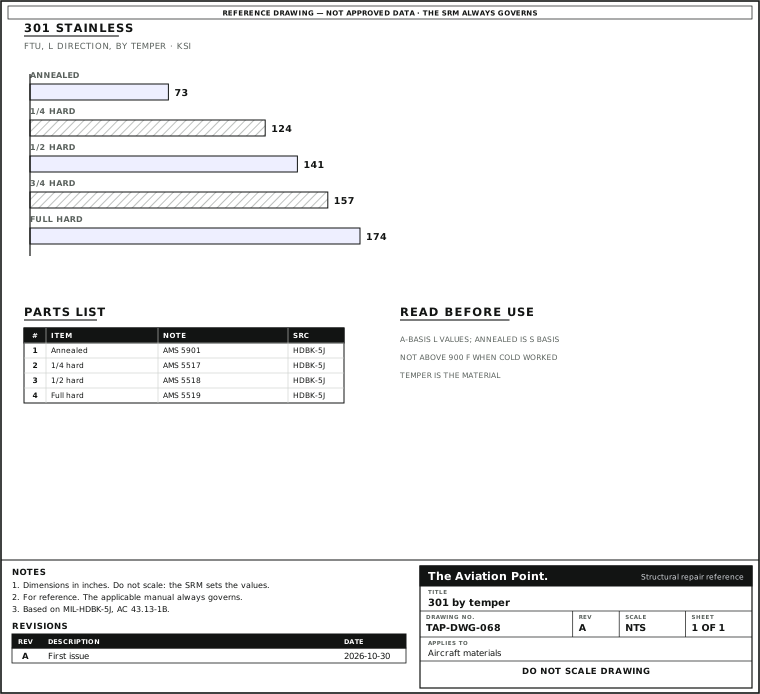
Design allowables — sheet and strip by temper (properties of AISI 301 table, applicable to 301)
0.187 in and under. MIL-HDBK-5J Table 2.7.1.0(b), L and LT as printed.
| Temper | Specification | Ftu L / LT, ksi | Fty L / LT, ksi | Fsu, ksi | Basis |
|---|---|---|---|---|---|
| Annealed | AMS 5901 | 73 / 75 | 26 / 30 | 50 | S |
| ¼ hard | AMS 5517 | 124 / 122 | 69 / 67 | 66 | A |
| ½ hard | AMS 5518 | 141 / 142 | 93 / 92 | 77 | A |
| ¾ hard | AMS 5902 | 157 / 163 | 118 / 113 | 88 | A |
| Full hard | AMS 5519 | 174 / 175 | 137 / 125 | 95 | A |
Properties of the 300-series alloys that the handbook ties to Table 2.7.1.0(b) by footnote. Fsu and Ftu: Table 2.7.1.0(b), p. 2-223; E 29.0 × 10³ ksi annealed (L and LT), falling to 26–28 ksi × 10³ in the hard tempers; density 0.286 lb/in³. Cold-worked tempers lose strength above 900 °F. Yield, particularly in compression, and longitudinal modulus can be raised appreciably by stress relieving at 500 to 800 °F. MIL-HDBK-5J (2003) is superseded by MMPDS.
Thicknesses and forms
Sheet and strip in five tempers: annealed, ¼, ½, ¾ and full hard. The full-hard temper is the AISI standard temper made by cold rolling 40 to 50 percent (MIL-HDBK-5J par. 2.7.1.5).
Handbook design values cover 0.187 in and under. Our catalog lists ½ hard 0.025 in firewall sheet.
Forming
Annealed sheet forms like other austenitic stainless; the harder tempers cost you formability and spring back. The public FAA documents give no stainless bend radius, so use the drawing or the SRM.
Strength moves with the temper you form from, and heat above 900 °F undoes cold-worked strength.
Quick check
What mainly sets the strength of a 301 sheet?
- Its alloy number alone
Not this one. 301 is one alloy but spans 73 to 174 ksi Ftu depending on temper.
- The temper: annealed to full hard
Best fit. Right. Cold work is how 301 gets its strength.
- The thickness only
Not this one. Thickness changes which values apply, but temper is the big lever.
On a real job, the SRM decides.
Welding
AISI 300-series austenitic steels are weldable with most processes except 303 and 303Se, which carry sulfur or selenium for machinability. They are slightly harder to weld than mild steel: lower melting temperature and conductivity, but higher expansion, so distortion needs skip or back-step welding, fixtures and twice the tack welds. Clean with a non-chlorinated solvent and a stainless wire brush; shield both sides with inert gas or flux (AMT Handbook, Chapter 5, p. 5-22).
AC 43.13-1B par. 4-104: spot-welded stainless structure is repaired to the manufacturer's instructions, and substituting bolted or riveted joints for spot welds needs approval from a DER or the FAA.
Corrosion
Austenitic steels get their corrosion resistance from an oxide film that should not be removed even if the surface is discoloured. If the film is broken by abrasion it may not restore itself without repassivation. If corrosion affects the part's structural integrity or serviceability, the part is removed (AC 43.13-1B, par. 6-164b).
Where it is used on aircraft
Firewall and engine-area sheet, and high-strength formed parts, are the typical aircraft uses; the temper and thickness are on the drawing.
Data sheet
Questions people actually ask
Why does 301 come in tempers?
It work-hardens strongly, so rolling it harder makes it stronger. MIL-HDBK-5J gives separate design values for annealed, ¼, ½, ¾ and full hard.
Is 301 magnetic?
Austenitic 300-series steels are nonmagnetic (AMT Handbook, Chapter 5, TIG welding stainless steel).
Limits — when NOT to use this
- Temper matters. The strength table is not interchangeable between tempers.
- Not for sustained heat in the 750–1,650 °F band.
- A weld or heat above 900 °F lowers cold-worked strength. Ask engineering.
Where to buy
Distributors coming soon.
Sources
- MIL-HDBK-5J, Metallic Materials and Elements for Aerospace Vehicle Structures (31 Jan 2003) — par. 2.7.1.0 and Table 2.7.1.0(b), p. 2-223. Cancelled; superseded by MMPDS.
- FAA AC 43.13-1B CHG 1 — par. 4-104 and par. 6-164.
- FAA-H-8083-31B, Aviation Maintenance Technician Handbook, Airframe, Volume 1 — Chapter 5, TIG welding stainless steel, p. 5-22.
- MMPDS (formerly MIL-HDBK-5) — the current home of design allowables. A repair substantiation cites MMPDS or the SRM, not a website.
- ASTM A240/A240M, Plate, Sheet, and Strip of Chromium and Chromium-Nickel Stainless Steel — Table 1, chemical requirements (edition 10b read).