Key facts
Where to buy| Property | Value | Source |
|---|---|---|
| Density | 0.097 lb/in³ (2.68 g/cm³) | Teal Sheets |
| Brinell hardness, O / H36 | 47 / 73 | AC 43.13-1B Table 4-5 |
| Arc welding | A (O and H tempers) | MIL-HDBK-5J Table 3.1.3.4(a) |
| Spot welding | B (O), A (H32 to H38) | MIL-HDBK-5J Table 3.1.3.4(a) |
| E / Ec | 10.1 / 10.2 × 10³ ksi | MIL-HDBK-5J Table 3.5.1.0(b1) |
Density is the Aluminum Association nominal figure.
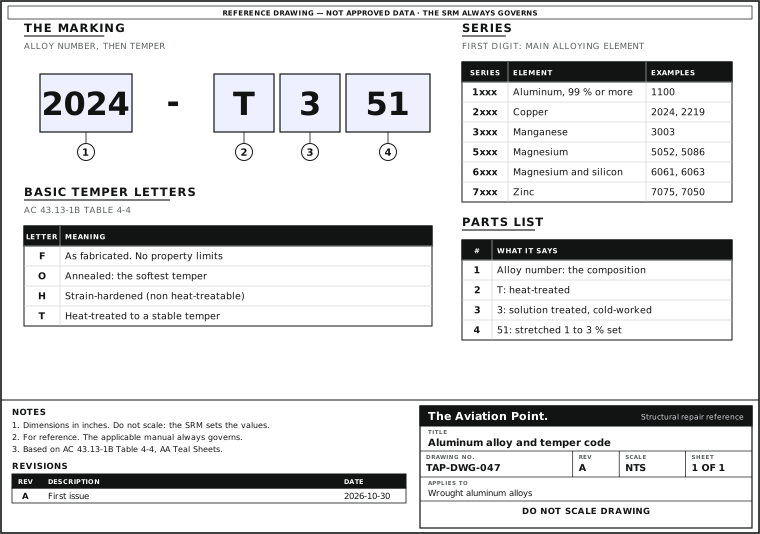
Reading the alloy and temper code
Composition limits, weight percent
| Element | Limit |
|---|---|
| Si | 0.25 |
| Fe | 0.40 |
| Cu | 0.10 |
| Mn | 0.10 |
| Mg | 2.2–2.8 |
| Cr | 0.15–0.35 |
| Zn | 0.10 |
| Al | Remainder |
A single number is a maximum. Other elements: 0.05 each, 0.15 total, except where the Teal Sheets say otherwise. Source: Aluminum Association Teal Sheets (Aug 2018).
Design allowables, 5052 sheet and plate (S basis)
| Property, ksi | O | H32 | H34 | H36 | H38 |
|---|---|---|---|---|---|
| Ftu, L | 25 | 31 | 34 | 37 | 39 |
| Ftu, LT | — | 31 | 34 | 37 | 39 |
| Fty, L | 9.5 | 23 | 26 | 29 | 32 |
| Fty, LT | — | 22 | 25 | 29 | 32 |
| Fcy, L | — | 22 | 25 | — | — |
| Fcy, LT | — | 23 | 26 | — | — |
| Fsu | 16 | 19 | 20 | 22 | 23 |
| Fbru, e/D = 1.5 | — | 50 | 54 | 59 | 62 |
| Fbru, e/D = 2.0 | — | 65 | 71 | 78 | 82 |
| Fbry, e/D = 1.5 | — | 32 | 37 | 41 | 44 |
| Fbry, e/D = 2.0 | — | 37 | 41 | 46 | 51 |
Thickness: O 0.006–3.000 in; H32 0.017–2.000; H34 0.009–1.000; H36 0.006–0.162; H38 0.006–0.128. MIL-HDBK-5J Table 3.5.1.0(b1), p. 3-220. H36 and H38 Fty L are from Aluminum Standards and Data, 1982. Dashes: not listed.
Bend radii (AC 43.13-1B Table 4-6)
| Alloy and temper | 0.016" | 0.032" | 0.064" | 0.128" | 0.182" | 0.258" |
|---|---|---|---|---|---|---|
| 5052-O | 0 | 0 | 0 – 1t | 0 – 1t | 0 – 1t | 0 – 1t |
| 5052-H32 | 0 | 0 | ½t – 1t | ½t – 1½t | ½t – 1½t | ½t – 1½t |
| 5052-H34 | 0 | 0 | ½t – 1½t | 1½t – 2½t | 1½t – 2½t | 2t – 3t |
| 5052-H36 | 0 – 1t | ½t – 1½t | 1t – 2t | 1½t – 3t | 2t – 4t | 2t – 4t |
| 5052-H38 | ½t – 1½t | 1t – 2t | 1½t – 3t | 2t – 4t | 3t – 5t | 4t – 6t |
Recommended radii for 90-degree bends, as multiples of sheet thickness t. Alclad sheet may go slightly tighter than bare (Table 4-6 note 1). The drawing or SRM governs.
Quick check
You are bending 0.064 in 5052. Which temper takes the tightest radius?
- 5052-O
Best fit. Table 4-6 gives 0 to 1t for O at 0.064 in.
- 5052-H34
Not this one. ½t to 1½t: harder, so a larger radius.
- 5052-H38
Not this one. 1½t to 3t, the largest of the group.
On a real job, the SRM decides.
Minimum bend radius, inches (AMT Handbook Chart 204)
| Alloy and temper | 0.020" | 0.032" | 0.040" | 0.063" | 0.125" | 0.190" |
|---|---|---|---|---|---|---|
| 5052-O, 6061-O, 5052-H32 | .03 | .03 | .06 | .06 | .12 | .19 |
| 7178-O, 2024-O, 5052-H34, 6061-T4, 7075-O | .03 | .03 | .06 | .09 | .25 | .38 |
Selected thicknesses from FAA-H-8083-31B Chart 204, p. 4-61. Chart 204 and AC Table 4-6 do not agree everywhere: where they differ, use the larger radius or the SRM.
Where it is used
The AMT Handbook says 5052 is used where good workability, very good corrosion resistance, high fatigue strength, weldability and moderate static strength are wanted, and for fuel, hydraulic and oil lines (p. 4-30).
MIL-HDBK-5J calls it a low-strength alloy, extremely tough at low and room temperature, and highly resistant to corrosion (3.5.1.0).
Tanks of 5052 may be repaired by welding (AC par. 8-32). Nonstructural parts of 5052 take 1100 rivets (AC par. 7-2c).
Specifications and product forms
| Specification | Form |
|---|---|
| AMS 4015, AMS 4016, AMS 4017 | Sheet and plate |
| AMS-QQ-A-250/8 | Sheet and plate |
Specifications as listed by MIL-HDBK-5J. Federal QQ-A specifications passed to SAE as AMS-QQ-A. Check the current revision.
Questions people actually ask
5052-H32 or H34?
H34 is stronger (Ftu 34 against 31 ksi) and needs a larger radius (AC Table 4-6: at 0.128 in, 1½t to 2½t against ½t to 1½t). The drawing decides.
Is 5052 heat-treatable?
No. It is hardened by strain, and its tempers are H tempers.
Limits — when NOT to use this
- Not a source of design allowables. Values are for reference. MMPDS and the SRM govern a repair.
- Not a substitution approval. A different alloy or temper needs approved data.
- Not a substitute for 2024 or 6061 in structure without approved data.
Where to buy
Distributors coming soon.
Sources
- FAA AC 43.13-1B CHG 1, Chapters 4 and 7 — Tables 4-5, 4-6; pars. 7-2, 8-32.
- FAA-H-8083-31B, AMT Handbook — Airframe, Volume 1, Chapter 4 — p. 4-30; Chart 204, p. 4-61.
- MIL-HDBK-5J (31 Jan 2003), Chapter 3 — Tables 3.1.3.4(a), 3.5.1.0(a), (b1). Cancelled and superseded by MMPDS: check current MMPDS before design use.
- Aluminum Association, International Alloy Designations (Teal Sheets), rev. Aug 2018 — chemical composition limits and nominal densities.
- MMPDS (formerly MIL-HDBK-5) — the current home of design allowables. A repair substantiation cites MMPDS or the SRM, not a website.