Key facts
Where to buy| Property | Value | Source |
|---|---|---|
| Density | 0.103 lb/in³ (2.84 g/cm³) | MIL-HDBK-5J; Teal Sheets |
| Arc welding, O and T6/T8 tempers | A (readily weldable) | MIL-HDBK-5J Table 3.1.3.4(a) |
| Spot welding, T6/T8 tempers | A | MIL-HDBK-5J Table 3.1.3.4(a) |
| Stress corrosion, T6, T85XX, T87 | A in L, LT and ST (plate) | MIL-HDBK-5J Table 3.1.2.3.1(a) |
| Stress corrosion, T351X, T37 | ST: D | MIL-HDBK-5J Table 3.1.2.3.1(a) |
| E / Ec / G | 10.5 / 10.8 / 4.0 × 10³ ksi | MIL-HDBK-5J Table 3.2.8.0(b1) |
Check the rating for the exact product in Table 3.1.2.3.1(a).
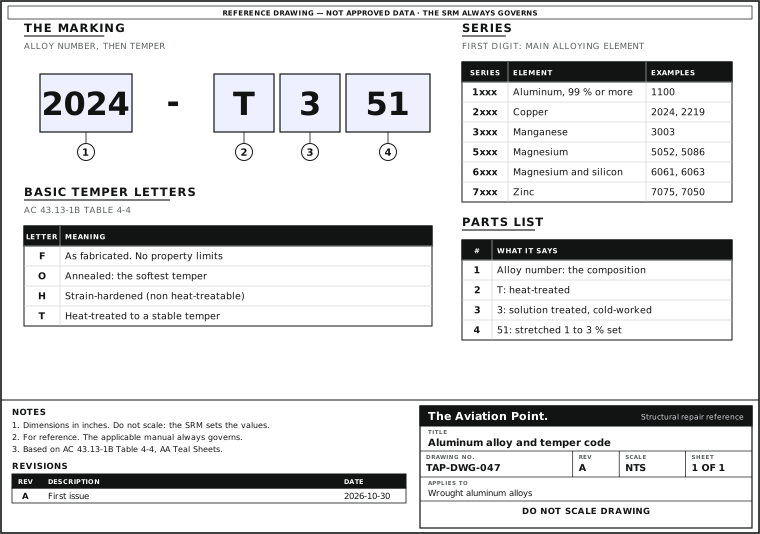
Reading the alloy and temper code
Composition limits, weight percent
| Element | Limit |
|---|---|
| Si | 0.20 |
| Fe | 0.30 |
| Cu | 5.8–6.8 |
| Mn | 0.20–0.40 |
| Mg | 0.02 |
| Zn | 0.10 |
| Ti | 0.02–0.10 |
| V | 0.05–0.15 |
| Zr | 0.10–0.25 |
| Al | Remainder |
A single number is a maximum. Other elements: 0.05 each, 0.15 total, except where the Teal Sheets say otherwise. Source: Aluminum Association Teal Sheets (Aug 2018).
Design allowables, 2219 sheet and plate
| Property, ksi | T62 A | T62 B | T81 A | T81 B |
|---|---|---|---|---|
| Ftu, L | 54 | 55 | 61 | 62 |
| Ftu, LT | 54 | 55 | 62 | 63 |
| Fty, L | 36 | 37 | 47 | 48 |
| Fty, LT | 36 | 37 | 46 | 47 |
| Fcy, L | 37 | 39 | 47 | 48 |
| Fcy, LT | 37 | 38 | 48 | 49 |
| Fsu | 31 | 32 | 35 | 35 |
| Fbru, e/D = 1.5 | 84 | 85 | 95 | 96 |
| Fbru, e/D = 2.0 | 107 | 109 | 121 | 123 |
| Fbry, e/D = 1.5 | 62 | 64 | 76 | 78 |
| Fbry, e/D = 2.0 | 79 | 81 | 92 | 94 |
T62: 0.020–2.000 in, AMS 4031 and AMS-QQ-A-250/30. T81: 0.020–0.249 in, AMS-QQ-A-250/30. MIL-HDBK-5J Table 3.2.8.0(b1), p. 3-168. For T62 the user's properties may be lower if the material was formed or worked before solution treatment. S, A and B are the MIL-HDBK-5J statistical bases. L is the longitudinal grain direction, LT the long transverse. Bearing values are dry-pin values.
Where it is used
The AMT Handbook lists fuel tanks, aircraft skin and structural components, with high fracture toughness and high resistance to stress corrosion cracking (p. 4-30).
MIL-HDBK-5J adds critical cryogenic applications, and applications needing strength and creep resistance from 400 to 600 °F (3.2.8.0).
A weld reduces strength in heat-treated material unless it is reheat-treated, and the loss must be established for each case (MIL-HDBK-5J 3.1.3.4).
Specifications and product forms
| Specification | Form |
|---|---|
| AMS 4031, AMS-QQ-A-250/30 | Sheet and plate |
| AMS 4162, AMS 4163 | Extrusion |
| AMS 4144 | Hand forging |
Specifications as listed by MIL-HDBK-5J. Federal QQ-A specifications passed to SAE as AMS-QQ-A. Check the current revision.
Questions people actually ask
Why can 2219 be welded when 2024 cannot?
The sources give the rating, not the reason: 2219 is A for arc welding, 2024 is C or D, and the AC lists 2024 among alloys not to be welded.
Is T81 stronger than T62?
Yes, in yield: 47 ksi against 36 ksi (A basis, L).
Limits — when NOT to use this
- Not a source of design allowables. Values are for reference. MMPDS and the SRM govern a repair.
- Not a substitution approval. A different alloy or temper needs approved data.
- Welding structure is approved-data work. A weld repair needs the SRM or an approval.
Where to buy
Distributors coming soon.
Sources
- FAA-H-8083-31B, AMT Handbook — Airframe, Volume 1, Chapter 4 — p. 4-30.
- MIL-HDBK-5J (31 Jan 2003), Chapter 3 — Sections 3.1.3.4, 3.2.8.0; Tables 3.1.2.3.1(a), 3.1.3.4(a), 3.2.8.0(a), (b1). Cancelled and superseded by MMPDS: check current MMPDS before design use.
- Aluminum Association, International Alloy Designations (Teal Sheets), rev. Aug 2018 — chemical composition limits and nominal densities.
- MMPDS (formerly MIL-HDBK-5) — the current home of design allowables. A repair substantiation cites MMPDS or the SRM, not a website.