Key facts
Where to buy| Property | Value | Source |
|---|---|---|
| Ftu, L, A basis, 0.063–0.187 in | 74 ksi (bare 7075-T6 sheet 0.040–0.125 in: 78 ksi) | MIL-HDBK-5J Tables 3.7.6.0(c1), (b1) |
| Density | 0.101 lb/in³ (2.81 g/cm³) | MIL-HDBK-5J |
| Cladding, plate | 1½ % nominal per side | MIL-HDBK-5J Table 3.7.6.0(c5) |
| Bend radius, 0.064" sheet | 4t – 6t, slightly less if clad | AC 43.13-1B Table 4-6 |
| Welding | Do not weld | AC 43.13-1B par. 4-89d |
The 1½ percent appears in the note to a plate table. For sheet, check the specification.
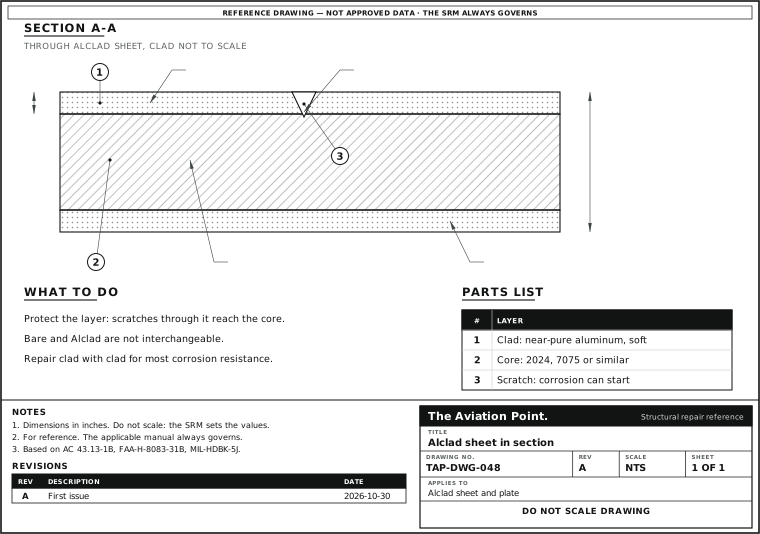
Alclad in section
Composition limits, weight percent
| Element | Limit |
|---|---|
| Si | 0.40 |
| Fe | 0.50 |
| Cu | 1.2–2.0 |
| Mn | 0.30 |
| Mg | 2.1–2.9 |
| Cr | 0.18–0.28 |
| Zn | 5.1–6.1 |
| Ti | 0.20 |
| Al | Remainder |
Limits for the core alloy. A single number is a maximum. Source: Aluminum Association Teal Sheets (Aug 2018).
Design allowables, Alclad 7075-T6 sheet
| Property, ksi | 0.040–0.062 A | 0.040–0.062 B | 0.063–0.187 A | 0.063–0.187 B |
|---|---|---|---|---|
| Ftu, L | 71 | 75 | 74 | 77 |
| Ftu, LT | 71 | 75 | 74 | 77 |
| Fty, L | 63 | 66 | 66 | 69 |
| Fty, LT | 61 | 64 | 64 | 67 |
| Fcy, L | 62 | 65 | 65 | 68 |
| Fcy, LT | 65 | 68 | 68 | 71 |
| Fsu | 42 | 45 | 44 | 46 |
| Fbru, e/D = 1.5 | 110 | 116 | 115 | 119 |
| Fbru, e/D = 2.0 | 142 | 150 | 148 | 154 |
| Fbry, e/D = 1.5 | 91 | 96 | 96 | 100 |
| Fbry, e/D = 2.0 | 106 | 112 | 112 | 117 |
T6, thickness in inches, AMS 4049, MIL-HDBK-5J Table 3.7.6.0(c1), p. 3-375. The 0.063–0.187 A value for Ftu LT is S basis. S, A and B are the MIL-HDBK-5J statistical bases. L is the longitudinal grain direction, LT the long transverse. Bearing values are dry-pin values.
Bend radii (AC 43.13-1B Table 4-6)
| Alloy and temper | 0.016" | 0.032" | 0.064" | 0.128" | 0.182" | 0.258" |
|---|---|---|---|---|---|---|
| 7075-O | 0 | 0 – 1t | 0 – 1t | ½t – 1½t | 1t – 2t | 1½t – 3t |
| 7075-T6 | 2t – 4t | 3t – 5t | 4t – 6t | 5t – 7t | 5t – 7t | 6t – 10t |
Recommended radii for 90-degree bends, as multiples of sheet thickness t. Alclad sheet may go slightly tighter than bare (Table 4-6 note 1). The drawing or SRM governs.
Minimum bend radius, inches (AMT Handbook Chart 204)
| Alloy and temper | 0.020" | 0.032" | 0.040" | 0.063" | 0.125" | 0.190" |
|---|---|---|---|---|---|---|
| 7075-T6 | .12 | .19 | .22 | .31 | .88 | 1.38 |
Selected thicknesses from FAA-H-8083-31B Chart 204, p. 4-61. Chart 204 and AC Table 4-6 do not agree everywhere: where they differ, use the larger radius or the SRM.
Use and care
The title of AC Table 4-9 lists 7075-T6 clad sheet among the materials in its splice tables. Clad-to-clad repair applies here too: for maximum corrosion resistance, use only clad on clad facings (AC, p. 3-9).
7075-T6 plate, rod, bar and extrusions are D rated in the short transverse direction. Fit parts without forcing them: stress from fit-up and clamping counts (MIL-HDBK-5J 3.7.6.0).
Cold straightening or forming can cause cracking (AC par. 4-58b). The Handbook's substitution figure sets factors for clad and bare 7075-T6: see Figure 4-168, and read it as an example for one aircraft type.
Specifications and product forms
| Specification | Form |
|---|---|
| AMS 4049 | Clad sheet and plate |
| AMS-QQ-A-250/13, /25 | Clad sheet and plate |
Specifications as listed by MIL-HDBK-5J. Federal QQ-A specifications passed to SAE as AMS-QQ-A. Check the current revision.
Questions people actually ask
Is Alclad 7075-T6 stronger than Alclad 2024-T3?
In yield, clearly: at 0.063 in, 66 against 45 ksi (A basis, L). But it bends far worse: 4t to 6t against 3t to 5t at 0.064 in.
Can I bend Alclad 7075-T6 cold?
Only within the drawing's radius. AC Table 4-6 wants 4t to 6t at 0.064 in, and warns of cracking in cold forming or straightening.
Limits — when NOT to use this
- Not a source of design allowables. Values are for reference. MMPDS and the SRM govern a repair.
- Not a substitution approval. A different alloy or temper needs approved data.
- Not for welding. AC par. 4-89d.
Where to buy
Distributors coming soon.
Sources
- FAA AC 43.13-1B CHG 1, Chapters 4 and 7 — Tables 4-6, 4-9; p. 3-9; pars. 4-58, 4-89.
- FAA-H-8083-31B, AMT Handbook — Airframe, Volume 1, Chapter 4 — Chart 204, p. 4-61; Figure 4-168, p. 4-87.
- MIL-HDBK-5J (31 Jan 2003), Chapter 3 — Tables 3.7.6.0(a), (b1), (c1), (c5). Cancelled and superseded by MMPDS: check current MMPDS before design use.
- Aluminum Association, International Alloy Designations (Teal Sheets), rev. Aug 2018 — chemical composition limits and nominal densities.
- MMPDS (formerly MIL-HDBK-5) — the current home of design allowables. A repair substantiation cites MMPDS or the SRM, not a website.