Key facts
Where to buy| Property | Value | Source |
|---|---|---|
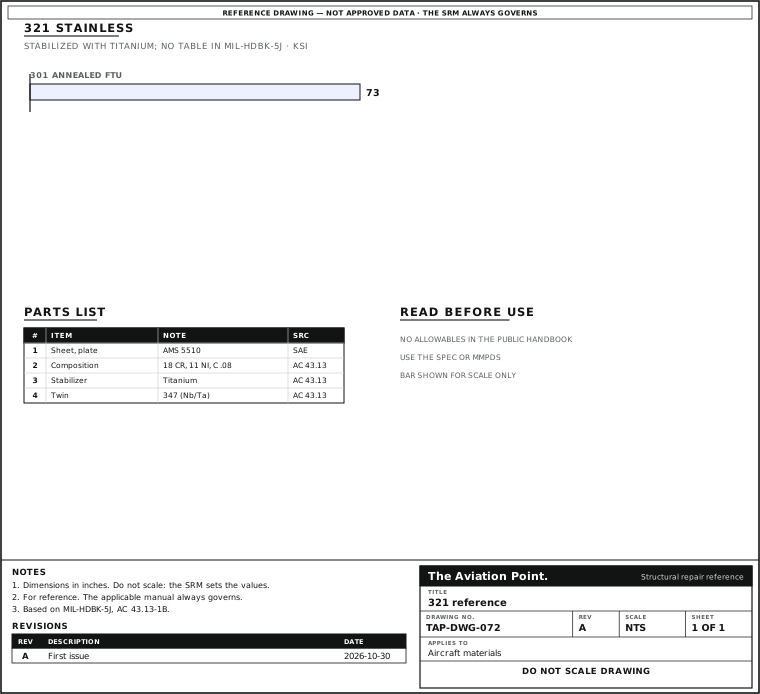
| Composition | Carbon 0.08 %, chromium 18 %, nickel 11 %, stabilized with titanium | AC 43.13-1B CHG 1, Table 4-3 |
| Class | Austenitic | AC 43.13-1B CHG 1, Table 4-3 |
| Sheet, strip, plate | AMS 5510 | SAE AMS 5510 (title) |
| Allowables | Not in MIL-HDBK-5J (checked); use the spec minimums, MMPDS or the manufacturer | MIL-HDBK-5J |
| Welding | Weldable like the other austenitic grades; the handbook lists 347 among fillers for austenitic types | AMT Handbook, p. 5-22 |
Thicknesses and forms
Sheet, strip and plate (AMS 5510); tube and bar to their own AMS specs. The public documents here give no thickness range.
Forming
Anneal for forming; no public stainless bend radius, the drawing or SRM governs.
Quick check
Why is titanium added to 321?
- To make it lighter
Not this one. Not the purpose.
- To stabilize it against sensitization in heat
Best fit. Right: it is the stabilized grade for hot service.
- To make it magnetic
Not this one. It remains austenitic.
On a real job, the SRM decides.
Welding
AISI 300-series austenitic steels are weldable with most processes except 303 and 303Se, which carry sulfur or selenium for machinability. They are slightly harder to weld than mild steel: lower melting temperature and conductivity, but higher expansion, so distortion needs skip or back-step welding, fixtures and twice the tack welds. Clean with a non-chlorinated solvent and a stainless wire brush; shield both sides with inert gas or flux (AMT Handbook, Chapter 5, p. 5-22).
Corrosion
Austenitic steels get their corrosion resistance from an oxide film that should not be removed even if the surface is discoloured. If the film is broken by abrasion it may not restore itself without repassivation. If corrosion affects the part's structural integrity or serviceability, the part is removed (AC 43.13-1B, par. 6-164b).
Where it is used on aircraft
Hot-section sheet metal: exhaust parts, collectors and heat shields, where the austenitic steels' high-temperature strength and corrosion resistance are wanted (AMT Handbook, Chapter 5).
Data sheet
Questions people actually ask
What does the titanium do?
It is the stabilizer in 321; AC 43.13-1B Table 4-3 lists it as the 'other' element, with columbium or tantalum doing the job in 347.
Limits — when NOT to use this
- No allowables here. Use the spec or MMPDS.
- No weld procedure. Follow the SRM.
Where to buy
Distributors coming soon.
Sources
- FAA AC 43.13-1B CHG 1 — Table 4-3, par. 6-164.
- FAA-H-8083-31B, Aviation Maintenance Technician Handbook, Airframe, Volume 1 — Chapter 5, TIG welding stainless steel, p. 5-22.
- SAE AMS 5510 — title of the sheet, strip and plate specification.
- MMPDS (formerly MIL-HDBK-5) — the current home of design allowables. A repair substantiation cites MMPDS or the SRM, not a website.