Key facts
Where to buy| Property | Value | Source |
|---|---|---|
| Composition | Chromium 14.0–15.5 %, nickel 3.5–5.5 %, copper 2.5–4.5 %, niobium plus tantalum 0.15–0.45 %, carbon 0.07 % max | Metal supplier's 15-5 PH datasheet, chemical composition (AMS 5659 / AMS 5862) |
| Use | Parts needing corrosion resistance and high strength to 600 °F; good transverse ductility and strength in large sections | MIL-HDBK-5J, par. 2.6.7.0 |
| Bar | AMS 5659 | MIL-HDBK-5J, Table 2.6.7.0(b) |
| Plate | AMS 5862, H1025 | MIL-HDBK-5J, Table 2.6.7.0(c) |
| Never | Use in Condition A; use H900 or H925 where good fracture toughness or impact is required | MIL-HDBK-5J, par. 2.6.7.0 |
| Best notch toughness | H1150M, recommended for cryogenic use | MIL-HDBK-5J, par. 2.6.7.0 |
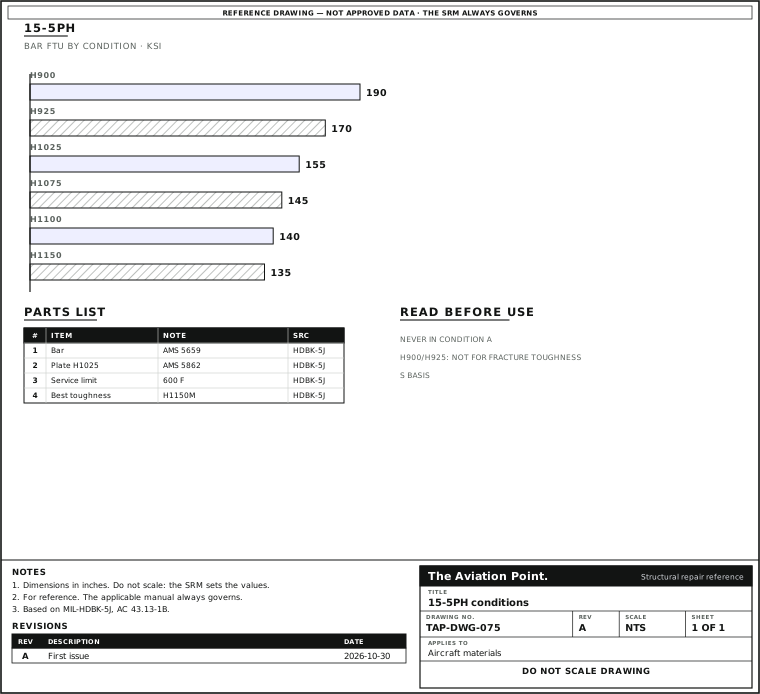
Design allowables — 15-5PH bar (AMS 5659) by condition, S basis
Bar up to 12 in. Strength in ksi. MIL-HDBK-5J Table 2.6.7.0(b), p. 2-169.
| Condition | Ftu | Fty | Elongation L, % | Elongation T, % |
|---|---|---|---|---|
| H900 | 190 | 170 | 10 | 6 |
| H925 | 170 | 155 | 10 | 7 |
| H1025 | 155 | 145 | 12 | 8 |
| H1075 | 145 | 125 | 13 | 9 |
| H1100 | 140 | 115 | 14 | 10 |
| H1150 | 135 | 105 | 16 | 11 |
Plate (AMS 5862), H1025, 0.187–0.625 in: Ftu 155 (LT), Fty 145, Fcy 150–152, Fsu 97, elongation 8 percent (Table 2.6.7.0(c), p. 2-170). E = 28.5 × 10³ ksi, G = 11.2 × 10³ ksi, density 0.283 lb/in³.
Thicknesses and forms
Bar (AMS 5659, to 12 in), plate (AMS 5862, 0.187 to 4.000 in) and forgings. Sheet is supplied to the same family of specs; thin-sheet design values are not in the handbook tables used here.
Forming
Precipitation-hardening (PH) stainless is supplied soft (Condition A) and aged to a strength level with a low-temperature heat treatment. Condition A is for fabrication, not for service.
Hot-worked material must be solution treated before hardening. Aging contracts the part 0.0004–0.0006 in/in (H900) to 0.0008–0.0010 (H1150).
Quick check
Which condition of 15-5PH has the best notch toughness?
- H900
Not this one. H900 and H925 are the ones to avoid for toughness.
- H1150M
Best fit. Right; recommended for cryogenic use.
- Condition A
Not this one. Never used in service.
On a real job, the SRM decides.
Welding
15-5PH is readily forged and welded (MIL-HDBK-5J par. 2.6.7.0). Its forgeability is better than 17-4PH in critical upset-forging and hot-flattening operations. Weld procedure and post-weld heat treatment come from the manufacturer or the SRM.
Corrosion
Corrosion resistance with high strength to 600 °F. H1150M is the most notch-tolerant condition; H900 and H925 should not be used where fracture toughness is needed.
Where it is used on aircraft
High-strength fittings and structural parts in the heat-treated conditions, to 600 °F, where 17-4PH's transverse ductility is not enough.
Data sheet
Questions people actually ask
17-4PH or 15-5PH?
The handbook describes 15-5PH as having good transverse ductility and strength in large sections; both are readily welded. The drawing names the one to use.
Limits — when NOT to use this
- Never Condition A in service.
- H900/H925 and toughness don't mix.
Where to buy
Distributors coming soon.
Sources
- MIL-HDBK-5J, Metallic Materials and Elements for Aerospace Vehicle Structures (31 Jan 2003) — par. 2.6.7.0 and Tables 2.6.7.0(b) and (c), pp. 2-169, 2-170. Cancelled; superseded by MMPDS.
- FAA AC 43.13-1B CHG 1 — Table 4-3 (17-4PH, for comparison).
- MMPDS (formerly MIL-HDBK-5) — the current home of design allowables. A repair substantiation cites MMPDS or the SRM, not a website.
- Metal supplier's 15-5 PH datasheet — Chemical composition table.