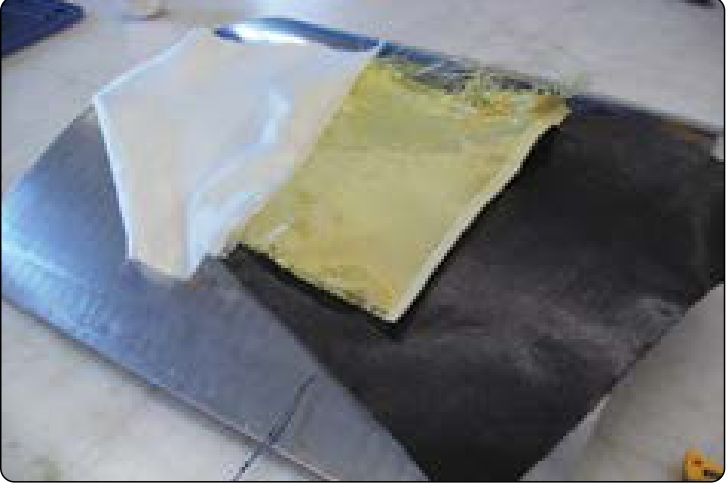
Typical yarn properties (DuPont Table II-1)
Where to buy| Property | Kevlar 29 | Kevlar 49 |
|---|---|---|
| Density | 0.052 lb/in³ (1.44 g/cm³) | 0.052 lb/in³ (1.44 g/cm³) |
| Yarn tensile strength | 424,000 psi (2,920 MPa) | 435,000 psi (3,000 MPa) |
| Yarn tensile modulus | 10.2 Msi (70,500 MPa) | 16.3 Msi (112,400 MPa), converted |
| Elongation at break | 3.6% | 2.4% |
| Impregnated strand strength | 525,000 psi (3,600 MPa) | 525,000 psi (3,600 MPa) |
| Impregnated strand modulus | 12.0 Msi (83,000 MPa) | 18.0 Msi (124,000 MPa) |
| Moisture, equilibrium from bone-dry | 4.5% | 3.5% |
| Decomposition in air | 800–900 °F (427–482 °C) | 800–900 °F (427–482 °C) |
| Recommended long-term maximum in air | 300–350 °F (149–177 °C) | 300–350 °F (149–177 °C) |
DuPont says the table gives typical values, "not product specifications". The Kevlar 49 yarn modulus line prints "6.3 × 10⁶" in the text copy used here, next to 112,400 MPa; 112,400 MPa converts to 16.3 Msi, which is the value shown. Kevlar does not melt; it decomposes.
A Kevlar fabric
| Fabric | Weave | Weight | Thickness | Count per in | Breaking strength |
|---|---|---|---|---|---|
| BGF aramid 195 denier, plain weave (listed Style 120) | Plain | 1.8 oz/yd² (61 g/m², converted) | 0.0039 in (0.10 mm) | 34 × 34 | 200 / 200 lbf/in |
BGF Industries data sheet via a distributor (see the carbon and aramid page).
What the FAA handbook warns about
Advantages: light weight, strength, toughness, and high resistance to impact damage, so it is used where impact is likely. Kevlar 49 has high stiffness; Kevlar 29 low stiffness.
Disadvantages: general weakness in compression, and hygroscopy. Service reports show some Kevlar parts absorb up to 8% of their weight in water, so parts must be protected from the environment. Kevlar is difficult to drill and cut; the fibers fuzz, and special scissors are needed (FAA-H-8083-31B, p. 7-5). Natural colour yellow; dry fabric or prepreg.
Kevlar against carbon and glass
Kevlar
- Strong point
- Impact resistance
- Weak point
- Compression; absorbs water
- Cutting
- Fuzzes; special scissors
- Colour
- Yellow
Carbon
- Strong point
- Stiffness and strength
- Weak point
- Cost; galvanic corrosion; lightning
- Cutting
- Cutters for carbon, glass and aramid differ
- Colour
- Gray or black
Glass
- Strong point
- Cost; corrosion and electrical properties
- Weak point
- Lower strength than carbon
- Cutting
- Easier than aramid
- Colour
- White
Limits — when NOT to use this
- Yarn data, not laminate data.
- Heat. DuPont warns tensile properties drop at or above 300–350 °F for extended periods.
- Moisture. The fiber properties are virtually unaffected by moisture, but the part still must be sealed against water (FAA).
Where to buy
Distributors coming soon.
Sources
- DuPont, Kevlar Aramid Fiber Technical Guide, Section II, Table II-1 (pp. 5-6) and thermal properties (p. 12) — typical yarn properties of Kevlar 29 and Kevlar 49.
- FAA-H-8083-31B, AMT Handbook — Airframe, Volume 1 (2023), Chapter 7 — aramid fiber, advantages, moisture, cutting (p. 7-5).
- BGF Industries aramid data sheet, Kevlar 120 — plain weave, 195 denier, 34 × 34, 1.8 OSY, 0.0039 in, 200 / 200 lbf/in.