Drilling a laminate: what holds the exit together
Where to buy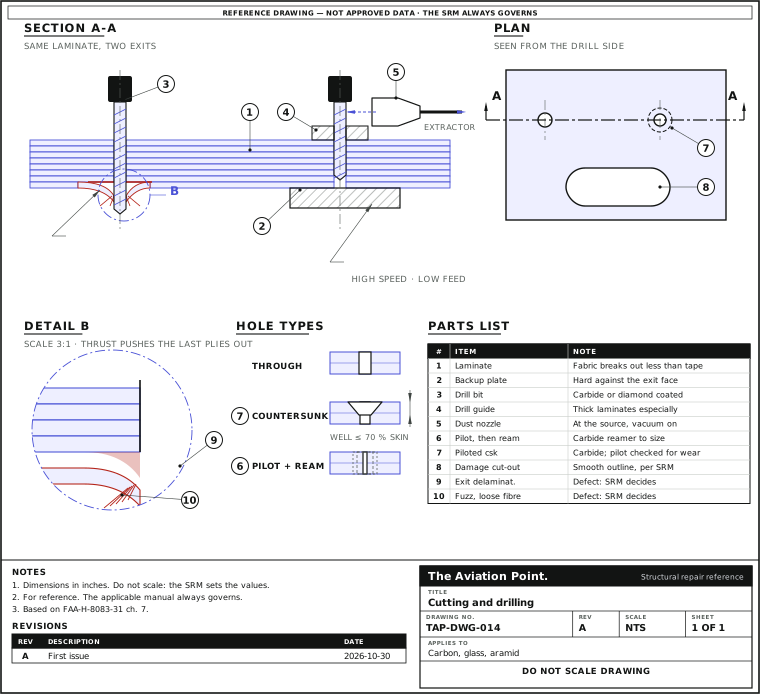
Drill a hole in composite, one step at a time
| Step | Action | What to do |
|---|---|---|
| 1 | Mark and guide | Fit a drill guide or bushing. Clamp the part and the backup plate together with no gap. |
| 2 | Protect yourself | Switch on the extraction and put on the respirator and eye protection before the first cut. |
| 3 | Drill the pilot hole | Use a small bit at speed, with a light and constant feed. Do not let the drill surge as it breaks through. |
| 4 | Enlarge the hole | Use the carbide or diamond bit. |
| 5 | Ream to size | Use a carbide reamer, and keep the exit supported. |
| 6 | Countersink if needed | Bring the piloted cutter to full speed in the hole before you feed it. Stop at the microstop. |
| 7 | Inspect the hole | Check it before anything goes in it. If the hole is bad, do not enlarge it to hide it: report it for disposition. |
Tool by fibre
| Task | Carbon and glass | Aramid (Kevlar) |
|---|---|---|
| Drill bit | Solid carbide or diamond coated, flat-flute or four-flute. Never standard HSS: it dulls at once, overheats and causes delamination and tear-out | Klenk-type sickle drill, or clothes-pin and fish-tail points, that pull the fibre and shear it. HSS is usable, but quality is poor. Between two metal parts, a standard twist drill works |
| Larger holes | Diamond-coated hole saw, or a fly cutter in a drill press only | Not covered separately; hole saws and fly cutters are listed for composites generally |
| Trim and cut | Diamond-grit cutters, solid carbide or diamond-coated router bits, toothless carbide or diamond bandsaw blade | HSS cutters work. Hold the part and cut with a shearing action, with a plastic backup plate cut through together |
| Sanding | Silicon carbide or aluminium oxide; silicon carbide lasts longer | Not covered by the Handbook; aramid frays rather than cuts |
| Countersink | Carbide cutter, straight flutes, piloted | Carbide, S-shaped positive-rake flutes. Straight flutes: a thick tape on the surface helps, but less |
| Exit support | Metal plate or sheet, or a firm board | Plastic backup plate |
FAA-H-8083-31 Vol. 1 pp. 7-49 to 7-52 (drilling, countersinking, cutting processes, cutting equipment). Aramid scissors need a shearing edge on one blade and a serrated one on the other.
Hole types
| Type | When | How | Where it goes wrong |
|---|---|---|---|
| Through | Fastener or pin in structure | Pilot hole, enlarge with carbide or diamond bit, ream with a carbide reamer to size | Exit splintering; hole oversize where metal chips drag through |
| Countersunk | Flush-head fastener | Piloted carbide cutter with a microstop. 100° tension head or 130° head; controlled radius under the head | Well deeper than 70 % of the skin; worn pilot, off-centre well; splintering if the cutter touches before full rpm |
| Stepped or pilot-then-ream | Precision holes; tape laminates break out most | Small pilot first, then size-up passes, final ream at about half the drilling speed | Reaming more than about 0.005 in off the diameter with the exit unsupported |
| Large (hole saw, fly cutter) | Access, inspection, cable pass | Diamond hole saw; fly cutter only in a drill press | A fly cutter in a hand drill |
| Damage cut-out | Removing damage before a repair | Smooth outline cut to the SRM's size and shape, then clean the edge | Sharp corners and undercuts; cut size from guesswork |
FAA-H-8083-31 Vol. 1 pp. 7-51 and 7-52 (pilot hole, reaming, back counterboring, countersinking). Cut-out size, shape and edge preparation come from the SRM or the repair design, not from this page.
Delamination, tear-out and fuzz: where they come from
A drill pushes the last plies ahead of it. When they run out of support they lift off the ply above (delamination), splinter (tear-out) or, in aramid, fray (fuzz) because the fibre was pulled, not cut. Parts made from tape are more exposed than fabric.
Support the exit. A metal plate or sheet pressed hard against the back face; a plastic plate under aramid. The Handbook asks for it, and the same support is needed when a reamer takes more than about 0.005 in (0.13 mm) off the diameter.
High speed, low feed. Composites are drilled between 2,000 and 20,000 rpm with a low feed. A power-feed or hydraulic dash-pot drill is preferred because it stops the drill surging as it breaks through; use a drill guide, especially on thick laminates.
Keep the cutter sharp. A dull bit heats and pushes. Carbide chips easily when handled, so treat it carefully; small HSS pilot drills (a No. 40, say) are used for hand pilot holes and may last one hole.
Back counterboring is the other exit damage: on carbon over a metal substructure, stringy metal chips pulled through scour the back edge of the hole. Fix it with feeds and speeds, cutter geometry, better clamp-up, a final reaming pass or a peck drill, alone or together.
Mixed stacks: the metal sets the speed. Titanium is drilled slow with a high feed, and a bit for titanium may not suit carbon.
Drilling a hole in composite, in order
1. Mark and guide. Fit a drill guide or bushing for the position, and clamp the part and backup plate together with no gap.
2. Switch on the extraction at the work and put on the respirator and eye protection before the first cut.
3. Pilot hole. Small bit at speed, light and constant feed. Let the drill break through the plate, not surge.
4. Enlarge with the carbide or diamond bit. Larger holes: diamond hole saw or, in a drill press only, a fly cutter.
5. Ream to size with a carbide reamer at about half the drilling speed, exit still supported.
6. Countersink if needed: bring the piloted cutter to full rpm in the hole before feeding. Stop at the microstop, never past 70 % of the skin depth.
7. Inspect the hole before anything goes in it, then fit the fastener as the repair scheme says.
Dust: collect it where it is made
Carbon dust floats. The Handbook: use a vacuum at the source and drill with extraction running; keep air moving where you work; use a dust mask or respirator when sanding.
A downdraft table for sanding and grinding should hold an average face velocity of 100 to 150 cubic feet per minute, and its filters need changing on a schedule.
Skin and eyes. Single fibres penetrate skin and lodge in it; wear gloves and covering clothes, wash before eating. Safety glasses at all times; contact lenses are not worn in the shop, because dust gets under them.
Fire. Sanding makes static; use air-driven tools, or enclosed electric ones. Solvents away from sparks.
Do not cross-contaminate. Cut nothing but composite on the equipment used for composites, and do not put honeycomb on a waterjet. Cutting fluids are not normally recommended for carbon/epoxy under 0.25 in (6.3 mm) thick.
The AC adds that sanding fiberglass laminate gives off a fine dust that can irritate skin and lungs, and that sanding raises static charges that attract dirt. Read the resin and fibre SDS.
Inspecting the hole
Look at both faces, with a torch at a low angle: entry edge, exit edge, hole wall. Reject as the SRM says if you see white (delaminated) rings round the hole, splintered or lifted plies, fuzz that cannot be trimmed clean, a hole wall with burnt resin, or a scoured, belled back edge.
Measure with a go/no-go pin or a gauge. A sharp drill with a slow, constant feed holds a 0.004 in (0.1 mm) tolerance through carbon/epoxy plus thin aluminium, especially with a guide; a hard tool holds tighter. Over titanium, chips can enlarge the hole and a final ream may be needed.
Tap test round the hole: a clear ring means solid, a dull thud means delamination. The Handbook warns tap testing is not reliable above about four plies, so for thick laminates use the method the SRM names. Any delamination, however small, is judged by the SRM and not by eye on the day.
The Handbook lists improper hole drilling among the manufacturing defects. It gives no acceptance limit for hole damage; the SRM, the structure drawing or the fastener maker does. If the hole is bad, do not enlarge it to hide it: report it for disposition.
For UAV, model and homebuilt work
Same fibres, same rules, smaller scale. A carbide or diamond bit, a sacrificial board under the exit, light constant pressure and a vacuum at the cut do most of the work. Check a small structure's laminate thickness before you pick a countersink: the 70 % limit leaves little in a thin skin.
Questions people actually ask
Can I use ordinary HSS drill bits on carbon?
No. The Handbook says standard high-speed steel is unacceptable for carbon and glass: it dulls immediately, overheats and causes delamination, fibre tear-out and a poor hole. Use carbide or diamond coated.
Why did the exit side go white and furry?
The last plies had no support and were pushed out, or the cutter was dull and pulled the fibre. Put a backup plate hard against the exit, use a sharp bit, lower the feed and, for aramid, use a bit that shears the fibre.
Do I use cutting fluid?
The Handbook does not normally recommend it for carbon/epoxy under 0.25 in (6.3 mm). Use a vacuum at the cut instead.
How deep can the countersink go?
Not more than 70 % of the skin depth; a deeper well weakens the laminate. Use a microstop and a piloted carbide cutter.
Can I drill with a hole saw in a hand drill?
Diamond-coated hole saws are listed for larger holes. Fly cutters are for a drill press only, never a drill motor.
Which rpm?
The Handbook gives a range, 2,000 to 20,000 rpm with a low feed, and a free speed up to 20,000 for air drills. It gives no single figure per bit size; the SRM or the bit maker does. Reaming runs at about half the drilling speed.
Limits of this guide
What the sources support, and no further.
- The manual governs. Hole size, edge distance, fastener, countersink, sealing and the acceptance limits for hole damage come from the SRM or the structure's drawing. The page explains the tooling and the hazards.
- No rpm per bit size. The Handbook gives ranges only, so the page gives none. Our drill-speed calculator is for metals.
- Edge distance and spacing in composites are not in the Handbook text used here; take them from the SRM.
- Step order and the inspection checklist are the usual shop order built on the Handbook's text; the Handbook does not print them as a list.
- Not covered: machining honeycomb core, metal-to-composite fastener corrosion, laser, ultrasonic and waterjet machining.
Where to buy
Distributors coming soon.
Sources
- FAA-H-8083-31, AMT Handbook, Airframe, Volume 1, Chapter 7 — p. 7-14, flawed fastener holes; p. 7-16, tap test; pp. 7-49 to 7-52, drilling, equipment, bits, hole processes, reaming, countersinking, vacuum while drilling; pp. 7-52 and 7-53, cutting processes and equipment; p. 7-53, repair safety, respiratory and skin protection, downdraft tables, fire protection.
- AC 43.13-1B with Change 1, Chapter 3, Fiberglass and Plastics — Para. 3-2, caution on fine dust and static charge when sanding fiberglass laminates (p. 3-1).