The repairs on one sheet
Where to buy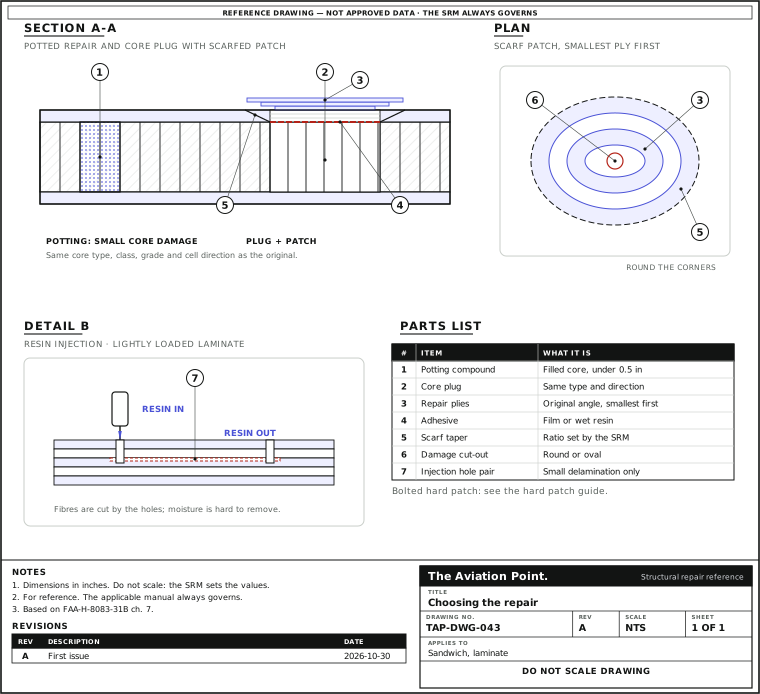
Which repair for which damage
| Damage | Repair | Source, and the catch |
|---|---|---|
| Scratch or erosion that stops at the first ply of a fibreglass laminate | Fill with putty (resin and short glass fibres), peel ply over it, sand | AC 43.13-1B 3-2b(1). Not for radomes, graphite or Kevlar. |
| Small core damage | Potting: epoxy and microballoons or similar in the cells; restores some strength only | Handbook p. 7-34 says under 0.5 in; AC 3-10g (metal-faced sandwich) allows 1 in or less. Heavier than the core: check balance. |
| Through one skin and into the core | Core plug of the same type, class, grade and cell direction, then the skin plies | Handbook pp. 7-34 to 7-37, eight steps; AC 3-2b(3) and 3-2c. Dry the core first. |
| Small delamination, lightly loaded solid laminate | Resin injection: drill two holes, inject low-viscosity resin until it comes out of the other | Handbook p. 7-39. It cuts fibres, moisture is hard to remove and filling may be incomplete. |
| Skin disbond on a sandwich | Resin injection is sometimes used | Handbook p. 7-39. |
| Hole or damage in a solid laminate, flush finish wanted | Scarf (tapered) or step; wet layup or prepreg; patch precured or cured in place | Handbook pp. 7-38, 7-39; AC 3-3. Taper in the scarf-step guide. |
| Trailing edge, control panel edge | As a sandwich repair, with the edge reinforcement | Handbook p. 7-39. The aft 4 in take ground and lightning damage. |
| Radome | As a sandwich repair, then a transmissivity test | Handbook p. 7-40. A repair can change radar performance. |
| Heavily loaded or thick solid laminate | Bolted patch | See the bolted patches guide. |
| Short-fibre mat parts | Non-structural use only | Handbook p. 7-40. |
Sources differ on limits: take the figure in your SRM. Bonded repairs are checked by tap test, NDI and the cure record.
Compare three common repairs
Potting
- Fits
- Small core damage.
- What you do
- Fill the cells with epoxy and microballoons or similar.
- The catch
- It restores some strength only, and it is heavier than the core, so check the balance.
Core plug
- Fits
- Damage through one skin and into the core.
- What you do
- Dry the core, fit a plug of the same type, class, grade and cell direction, then lay the skin plies.
- The catch
- Water left in the core boils and blows the skin off.
Scarf
- Fits
- A hole or damage in a solid laminate where you want a flush finish.
- What you do
- Taper the edge back and rebuild the plies.
- The catch
- A lot of sound material comes out, and the plies must be laid very accurately.
Orientation only. The SRM names the repair, the materials and the cure.
Which repair fits?
Damage goes through one skin of a sandwich panel and into the core. Which repair fits?
- Fill it with putty
Not this one. Putty is for a scratch or erosion that stops at the first ply of a fibreglass laminate.
- Core plug, then the skin plies
Best fit. Dry the core, fit a plug of the same type, class, grade and cell direction, then lay the plies.
- Resin injection
Not this one. Injection is for a small delamination or a skin disbond. It does not replace damaged skin and core.
On a real job, the SRM decides.
Scarf or step
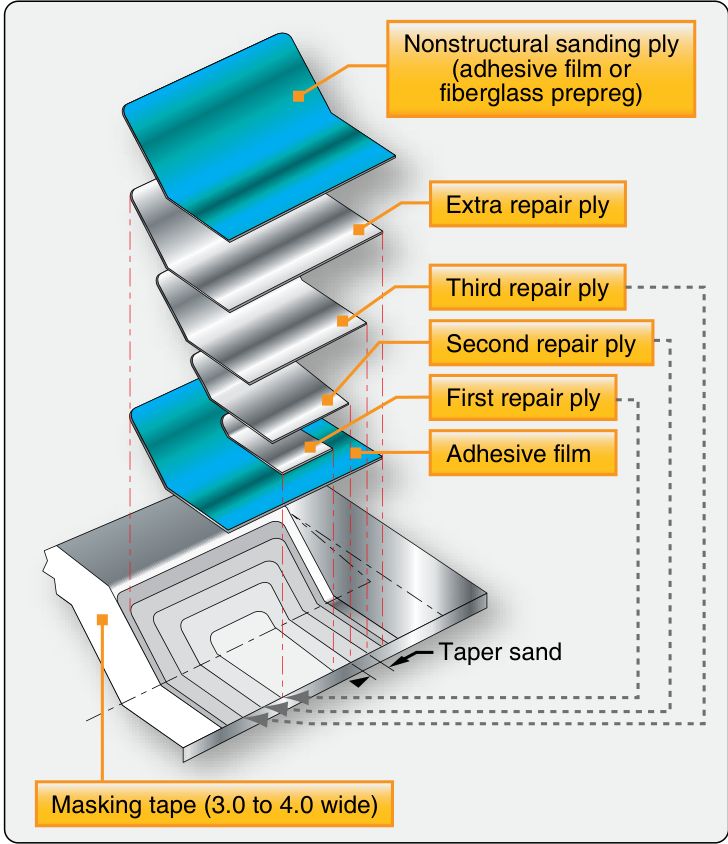
A flush repair is stepped or, more often, scarfed (tapered). The Handbook gives typical thickness-to-length ratios of 1:10 to 1:70, and says the scarf angle should be small to ease load into the joint and to keep adhesive from running out (p. 7-38). For a small hole in a thin fibreglass face sheet, AC 43.13-1B 3-3a scarfs back about 50 times the face-ply thickness.
The scarf joint lines up the neutral axes of parent and patch, so it transfers load better. Its costs, from the Handbook (p. 7-38): a lot of sound material is removed; the plies must be laid very accurately; cure out of an autoclave can cut strength; and the adhesive can run to the bottom of the joint. Cutting the scarf as a row of small steps relieves the last one.
Unless the part is lightly loaded, this repair is usually done where the part can go in an autoclave. A scarf, step and ply-count calculator is linked below.
Bonded or bolted
Bonded repairs are hard to inspect, so the Handbook asks for a higher commitment to quality control, trained people and cleanliness than for bolted ones (p. 7-38). A precured patch bonded on is the bonded repair nearest to a bolted one (p. 7-38).
Rules every bonded patch shares
The reinforcement is the same material as the original, and the plies go in the same fibre direction (pp. 7-36, 7-39). Typically one more ply than the original goes on (p. 7-36). Smallest-ply-first is common, but it leaves weak resin-rich edges; largest ply first gives a stronger interface joint, and the SRM says which (p. 7-39). Small patches are round or oval and large ones have rounded corners (AC 3-1b).
Water comes out of a sandwich before any cure, because it boils and blows the skin off the core (p. 7-35).
For UAV, model and homebuilt work
Most small-airframe damage is one skin and a little core. Dry the core, cut a clean round hole, put in a plug of the same foam or honeycomb and lay a scarfed patch with the same cloth and fibre direction. A hard landing that cracks a spar or a bolted joint is not a patching job.
Questions people actually ask
Which repair is strongest?
The one the SRM calls for. A scarf carries load best of the bonded types (Handbook p. 7-38), but potting restores only part of the strength (p. 7-34).
Why not just inject resin into a delamination?
It is for lightly loaded parts and small damage: drilling cuts fibres and moisture stays in (p. 7-39).
How big a hole can I pot?
Handbook: under 0.5 in. AC 43.13-1B 3-10g (metal-faced sandwich): 1 in or less. Use the figure in your SRM.
Can I use a wet-layup patch on carbon?
Whether it is allowed comes from the SRM. The AC 3-2 fibreglass repairs exclude graphite and Kevlar.
Limits of this guide
What the sources support, and no further.
- Orientation only. Taper, overlap, plies, resin and cure come from the SRM.
- Handbook and AC differ on the potting limit and on scarf ratios; both are shown.
- Not covered. Bonded repairs to metal, thermoplastics and bolted-joint sizing.
Where to buy
Distributors coming soon.
Sources
- FAA-H-8083-31B, AMT Handbook — Airframe, Volume 1 (2023), Chapter 7 — pp. 7-34 to 7-37, potting, core replacement and skin repair steps; pp. 7-38 to 7-39, flush repairs, scarf, step, trailing edge, resin injection; p. 7-40, bonded doublers, molded mat, radomes.
- AC 43.13-1B, Acceptable Methods, Techniques, and Practices — Aircraft Inspection and Repair (1998, with Change 1) — Chapter 3, paragraphs 3-1b, 3-2b, 3-2c, 3-3a and 3-10g.