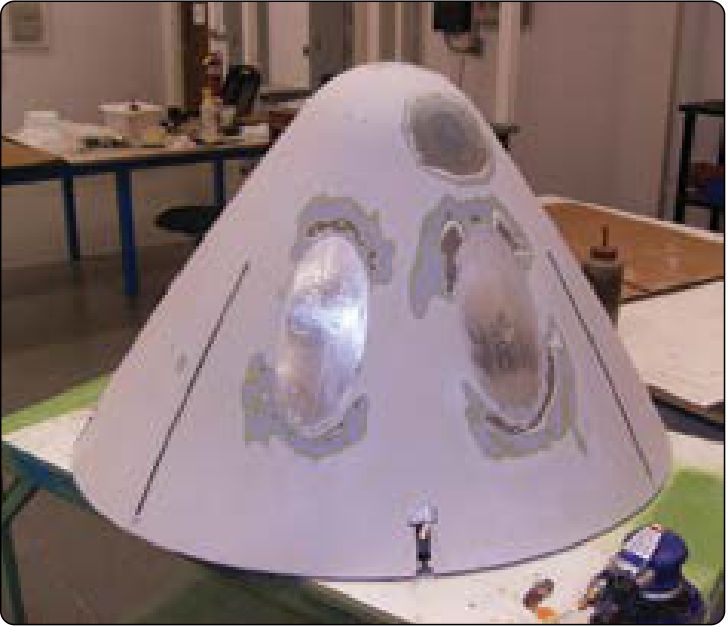
Seven damages on one panel
Where to buy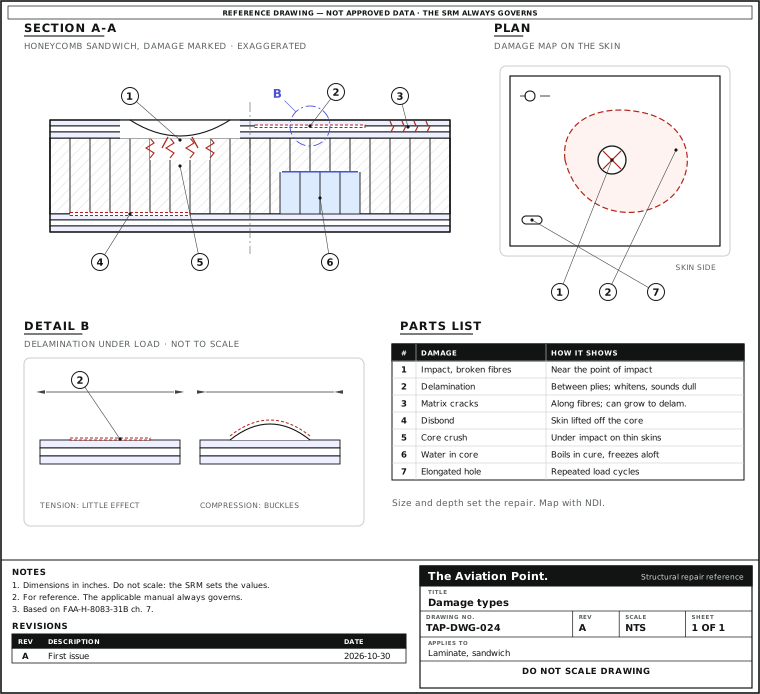
The damages: what, how it shows, why it matters
| Damage | What it is | How it shows | Why it matters |
|---|---|---|---|
| Broken fibres | Fibres cut near the point of impact, in a zone limited by the size and energy of the object | Dent, penetration, chips, abrasion | Critical: structures are designed so the fibres carry most of the load |
| Matrix cracks | Cracks in the resin or at the fibre-resin interface, parallel to the fibres | Often not visible; crazing needs NDI | Seldom critical unless widespread; cut interlaminar shear and compression strength; can grow into delamination |
| Delamination | Separation between plies, from matrix cracks that grow or from low-energy impact | Whitening in glass laminates; dull sound on a tap test | Grows under repeated load; can fail the part in compression or shear |
| Disbond | Non-adhesion or lost adhesion along a bondline, such as skin to core | Dull sound on a tap test; visible if the skin is thin | Can start a delamination in the adjacent plies |
| Core crush | Core collapsed under impact, common under thin face sheets | Dent in a thin skin | Hidden damage beyond the dent; liquid can enter |
| Water in the core | Water or hydraulic fluid in the cells through damage or poor edge close-outs | Moisture meter, X-ray, back light | Water boils during an elevated cure and disbonds the skin; frozen aloft it can do the same |
| Heat and lightning | Overheating or a strike; the lightning mesh can corrode at fastener holes | Scorch, discolouration, stains | Discolouration is a sign to investigate; corroded mesh breaks the electrical bonding (p. 7-14) |
| Erosion, UV | Edge and surface wear in the airstream; sunlight on unprotected resin | Roughened or worn surface | Composites erode more than aluminium; UV needs a top coat |
| Flawed fastener holes | Bad drilling, poor installation, missing fasteners; elongation from load cycling | Elongated or oversize hole | Loss of the load path at the joint |
FAA-H-8083-31B Vol. 1 pp. 7-12 to 7-15, 7-35. Manufacturing flaws also include resin-starved and resin-rich areas, voids, wrinkles, blisters, inclusions left between plies and thermal decomposition (pp. 7-12, 7-13).
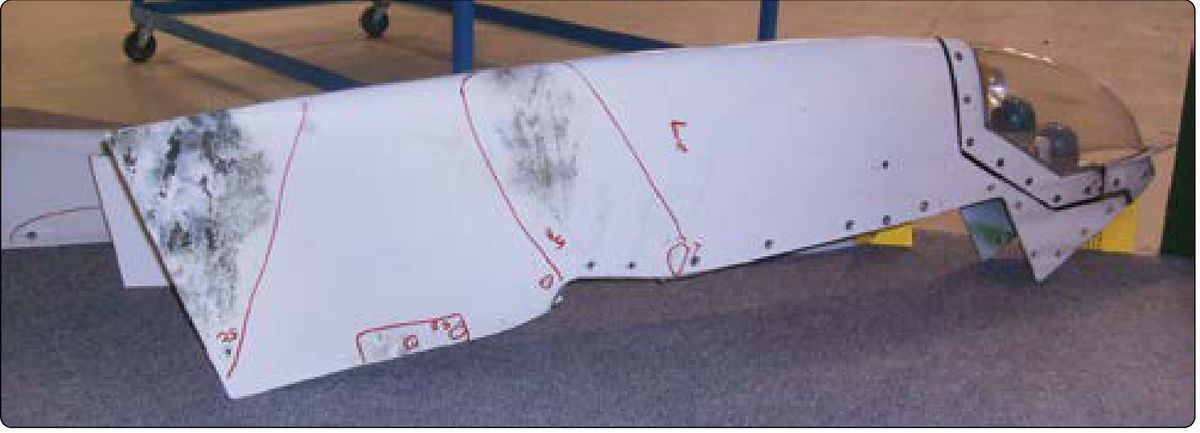
Delamination: the one that grows
A delamination forms between the layers, from a matrix crack that grows into the interface or from a low-energy impact. A debond from production non-adhesion can start one in the next layers (Handbook p. 7-13).
How serious it is depends on its size, how many there are at one place, where it sits (depth in the laminate, nearness to an edge, a stress concentration or a change of shape), and the load. In tension it has little effect. Under compression or shear the sublaminates beside it can buckle, redistribute the load and fail the structure, and repeated loading can make it grow (p. 7-13).
That is why a delamination found on a tap test is mapped and measured, not just noted.
Damage comes in combinations
An impact seldom makes one kind of damage. Low-energy impact is contained but can mix broken fibres, matrix cracks and several delaminations; high-energy impact can add broken elements, failed attachments and debonded parts (p. 7-13). The visible dent is the least of it.
Thin sandwich skins are the weak spot. On spoilers, flight controls and fairings the Handbook lists low impact resistance, liquid ingression and erosion as the three problems. Parts get crawled on and hit by dropped tools, and damage is easy to see but sometimes left unreported, then grows as liquid gets into the core (pp. 7-13, 7-14).
Wet cores break repairs. Most repair resins cure above the boiling point of water, which disbonds the skin wherever water is trapped, so drying cycles come first (p. 7-14). Water is removed before the repair, not after (p. 7-35).
What the eye finds and what it misses
A visual check finds scorch, stains, dents, penetration, abrasion, chips, wrinkles, blisters, resin starvation and discolouration from overheating or lightning. It cannot find internal flaws: delaminations, disbonds and matrix crazing need more than the eye (p. 7-15). The inspecting composites guide covers what finds each one.
For UAV, model and homebuilt work
Hard landings and crashes make the same damage: a dent in a thin skin hides a delamination and crushed core under it. Tap the area around any impact before you fill it, and treat a wet foam or honeycomb core as damaged until it has dried.
Questions people actually ask
What is the difference between a delamination and a disbond?
A delamination is a separation between the plies of a laminate. A disbond is a lost bond along a bondline, such as skin to core. Either can start the other (Handbook p. 7-13).
Does a delamination always need repair?
It depends on its size, number, location and the load, and the SRM gives the limits. In tension it has little effect; in compression or shear it can fail the part (Handbook p. 7-13).
Why dry the core before a repair?
Most repair materials cure above the boiling point of water, which can disbond the skin from the core wherever water is trapped (Handbook pp. 7-14, 7-35).
Can I see all composite damage?
No. Visual inspection cannot find internal delaminations, disbonds or matrix crazing (Handbook p. 7-15).
Limits of this guide
What the sources support, and no further.
- The manual governs. Allowable damage, damage limits and repair class come from the SRM, not from this page.
- No sizes. The Handbook gives no universal damage limits; neither does this guide.
- Not covered. Thermoplastic damage, fatigue life of a particular structure and ballistic damage.
Where to buy
Distributors coming soon.
Sources
- FAA-H-8083-31B, AMT Handbook — Airframe, Volume 1 (2023), Chapter 7 — pp. 7-11 to 7-12, thin face sheets; pp. 7-12 to 7-13, manufacturing defects, fibre breakage, matrix imperfections, delamination and debonds, combinations; pp. 7-13 to 7-15, in-service defects, liquid ingression, erosion, corrosion of lightning mesh, UV; p. 7-15, visual inspection; p. 7-35, water in the core.