A honeycomb sandwich panel, from fibre to core
Where to buy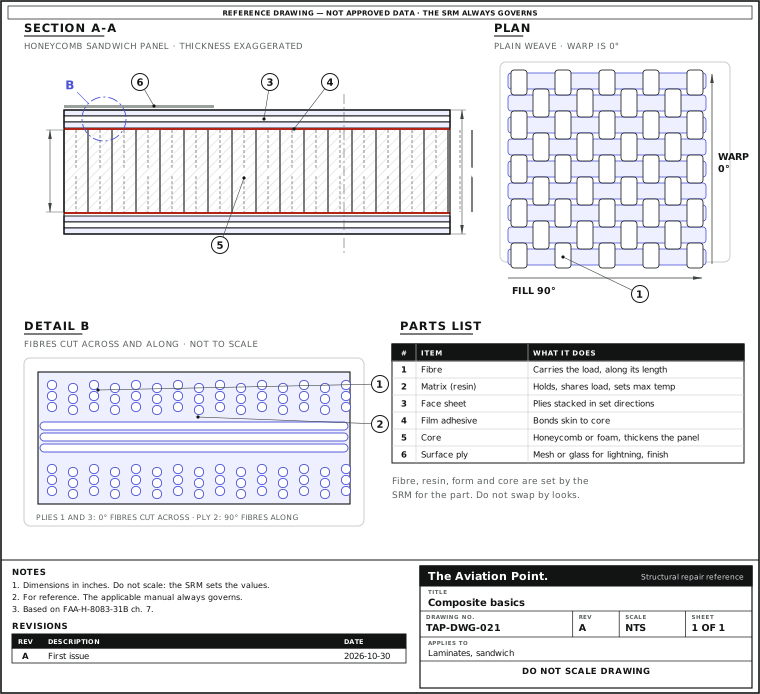
What each part does
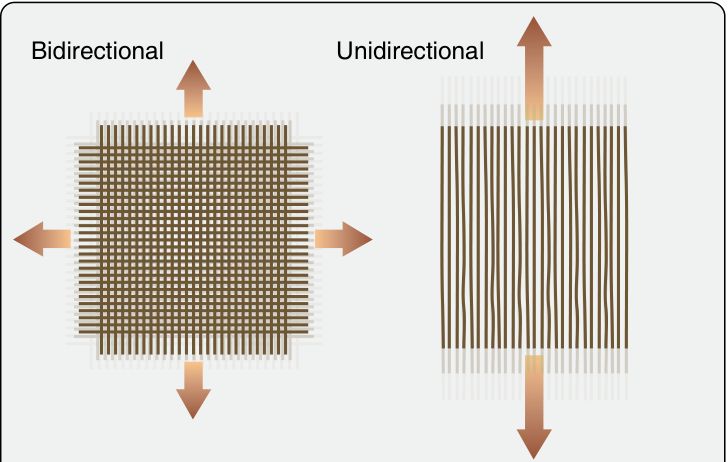
Fibre. It is the main load-carrying element. A composite is strong and stiff only in the direction of its fibres, so it is anisotropic: properties change with direction. Metal such as aluminium is isotropic (Handbook p. 7-2).
Matrix. The Handbook gives it four jobs: it supports the fibres and bonds them, transfers applied loads to them, keeps them in their position and chosen orientation, and gives the part its environmental resistance. It also sets the maximum service temperature (p. 7-2).
Core. Two thin face sheets bonded to a thick, light core. The core holds the faces against buckling and carries out-of-plane shear, so it needs high shear strength and compression stiffness (p. 7-10). A thicker core adds stiffness for very little weight, so a sandwich needs no stringers or frames (p. 7-11).
The practical rule that follows: fibre direction is strength direction. Replace a ply with the same material and the same direction, or an approved substitute (p. 7-2, p. 7-29).
The fibres: what each is for and what to watch
| Fibre | Look | Typical use | Watch for |
|---|---|---|---|
| Fiberglass (E-glass; S-glass and S2-glass for higher strength) | White | Secondary structure: fairings, radomes, wing tips, rotor blades | Lowest cost; does not conduct electricity; resists chemical and galvanic corrosion |
| Aramid (Kevlar) | Yellow | Areas prone to impact damage | Weak in compression; absorbs water (service reports up to 8 % of its weight), so seal it; fuzzes when cut, needs special scissors |
| Carbon / graphite | Grey or black | Floor beams, stabilisers, flight controls, primary fuselage and wing | 3 to 10 times stiffer than glass; galvanic corrosion with metal fasteners and structure; needs lightning-strike mesh or coating; costly |
| Boron | Prepreg tape only | Repair of cracked aluminium skins; mainly military | Stiff, thick, will not follow contours; costly and hazardous to handle |
FAA-H-8083-31B Vol. 1 pp. 7-4 to 7-5. Carbon fiber face sheets cannot go on aluminium honeycomb core: it makes the aluminium corrode (p. 7-11). Fibre grades and strengths come from the material specification, not from colour.
The resins: what each is for
| Resin | What the Handbook says | Where you meet it |
|---|---|---|
| Polyester | Cheap, fast processing, for low-cost applications | Wet layup, cabin and fairing parts |
| Vinyl ester | Handles like polyester; better corrosion resistance and mechanical properties | Where polyester is not enough |
| Phenolic | Low smoke and low flammability | Interior parts |
| Epoxy | High strength and modulus, low volatiles, good adhesion, low shrinkage; brittle, loses properties with moisture; slower to cure than polyester | Prepreg, structural adhesives, most repairs. Cure from room temperature to about 350 °F; most common 250 to 350 °F |
| Bismaleimide (BMI), polyimide | Higher temperature capability than epoxy; polyimide cures above 550 °F | Engines and hot structure |
| Thermoplastics | Soften again when heated; no chemical cure in processing | Some secondary and primary structure |
FAA-H-8083-31B Vol. 1 pp. 7-6 to 7-7. The Handbook says to use the maintenance manual to pick the correct epoxy for a repair: epoxies differ a lot.
Compare prepreg and dry fabric
Prepreg
- What it is
- Fabric or tape impregnated at the factory, with the resin partly cured.
- Storage
- In a freezer, thawed in its sealed bag before use.
- Cure
- At an elevated temperature.
Dry fabric
- What it is
- Fabric impregnated in the shop with a two-part resin: a wet layup.
- Storage
- At room temperature.
- Cure
- It can cure without heat, but it is messy and its properties are lower than prepreg.
Prepreg or dry fabric
Prepreg is fabric or tape already impregnated at the factory, with the resin partly cured (B stage). It lives in a freezer below 0 °F, is thawed in its sealed bag before use, and is cured at an elevated temperature, commonly 250 or 350 °F (Handbook p. 7-25).
Dry fabric is impregnated in the shop with a two-part resin (wet layup). It stores at room temperature and can cure without heat, but it is messy and its properties are lower than prepreg (pp. 7-8, 7-25). A room-temperature wet layup does not restore the strength and durability of a part cured at 250 or 350 °F when it was built.
Adhesive comes as film (frozen like prepreg) or as paste. Paste is often used to secondary-bond a repair patch; foaming adhesive bonds core plugs and splices core (pp. 7-9, 7-10).
Fabric weight and count: carbon is sold as 3K, 6K or 12K, K being 1,000 filaments per tow; a 12 × 12 plain weave has twelve tows per inch each way (pp. 7-3, 7-4).
Cores in one paragraph
Honeycomb is the usual core: aramid paper (Nomex) is the most common; fiberglass is used for higher strength; aluminium has the best strength-to-weight ratio and is machinable. Smaller cells support the face sheets better; denser core is stronger and stiffer. The direction parallel to the sheets is the ribbon direction, and the replacement core must keep it (pp. 7-11, 7-12).
Foam is common on homebuilt and light aircraft: PVC and polymethacrylimide (Rohacell) for compound shapes; polyurethane must not be hot-wire cut; polypropylene must not meet polyester resin (pp. 7-11 to 7-12). Balsa is also used.
Facings are very thin on spoilers and flight controls, sometimes only 3 or 4 plies; field reports say they resist impact poorly (p. 7-11).
For UAV, model and homebuilt work
The same fibres and cores are what you buy in small rolls. The same cautions apply: carbon against aluminium is a galvanic couple, and aramid takes up water. Keep the materials you buy for a model separate from certified repair stock, whose batch records and shelf life must be traceable.
Questions people actually ask
Is carbon fibre the same as graphite?
The Handbook says the two words are often used interchangeably, but strictly graphite has three-dimensional order in its planes and takes longer, hotter processing, which makes graphite fibres dearer (p. 7-5).
Can I repair a carbon part with fiberglass because it is cheaper?
No, not on your own. Each repair ply replaces a ply of the same material and orientation, or a substitute the manufacturer approves (Handbook p. 7-29; AC 43.13-1B para. 3-1a).
Why does the resin matter if the fibre does the work?
Because it sets the maximum service temperature, carries the load into the fibres and fixes their direction (Handbook p. 7-2). A wrong resin can fail at a temperature the fibre would survive.
Why is prepreg kept in a freezer?
Its resin is only partly cured; cold stops it curing further. It is thawed in its sealed bag so moisture does not condense on it (Handbook p. 7-25).
Limits of this guide
What the sources support, and no further.
- The manual governs. Fibre, resin, core and cure for each part are in the SRM. This page does not choose materials.
- No strength numbers. Strengths and stiffnesses come from the material specification, not from this guide.
- Not covered. Ceramic and boron work, thermoplastic repair, and resin chemistry beyond what the Handbook states.
Where to buy
Distributors coming soon.
Sources
- FAA-H-8083-31B, AMT Handbook — Airframe, Volume 1 (2023), Chapter 7 — pp. 7-2 to 7-3, strength characteristics, fibre orientation, warp clock, fibre forms; pp. 7-4 to 7-5, fibre types; pp. 7-6 to 7-7, matrix materials; pp. 7-8 to 7-10, prepreg, dry fibre, adhesives; pp. 7-10 to 7-12, sandwich, facings and cores; p. 7-25, wet layup and prepreg.