A potted insert, the three groups and a replacement, in section
Where to buy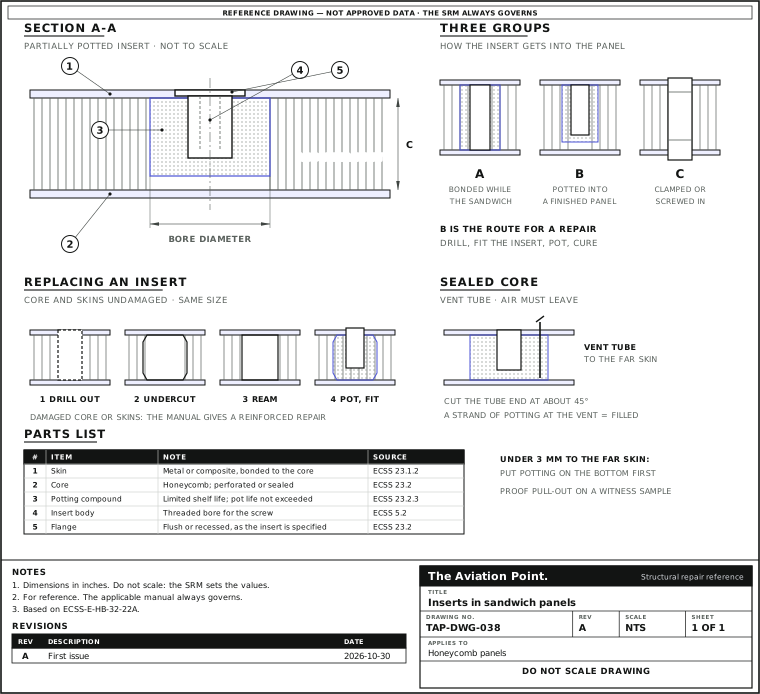
Fit a potted insert, one step at a time
| Step | Action | What to do |
|---|---|---|
| 1 | Drill the bore | The insert goes in only after the bore is machined. |
| 2 | Inspect the bore | Put right any bent or displaced cell walls. They block the flow of compound and the escape of air. |
| 3 | Fit the insert | Keep it square to the panel. A sealed core needs a vent, so the air can leave. |
| 4 | Inject the compound | Fill the cavity without passing the stated pot life. |
| 5 | Cure | Cure the compound as the SRM or the insert maker says. |
| 6 | Finish and proof-test | Finish the insert, then prove it. The handbook's checks include the position of the insert and both holes filled with compound. |
Three ways an insert goes into a panel
| Group | How it is fitted | Where it fits |
|---|---|---|
| A | Bonded with a core filler while the sandwich is made; the bore is drilled and threaded afterwards | Thin sandwiches with a low core only; hard to place exactly, so the insert is large to allow for misalignment |
| B | Potted into an existing panel with a thermosetting resin, or by an equivalent bonding process | The common route, and the one a repair uses. Partially or fully potted |
| C | Clamped mechanically or screwed into the finished panel | Where potting is not wanted |
ECSS-E-HB-32-22A, 20 March 2011, para. 5.2 and Table 5-1. A space-engineering handbook: it describes inserts in general, and the SRM governs for an aircraft.
Fitting a potted insert
The handbook sets the order: drill the bore, inspect it, fit the insert, inject the potting compound, cure, finish and proof-test. Inserts go in only after the bore is machined and inspected, and any bent or displaced cell walls are put right, since they block the flow of compound and the escape of air (para. 23.2).
Fully or partially potted. A fully potted insert is as tall as the core (through the thickness), and the cavity fills from the bottom up. A partially potted one is shorter than the core, and the compound has to fill both under the insert and around it. If it runs round faster than under, the volume below stays empty; if it runs under faster, the space beneath the flange stays empty (para. 23.3.3).
Venting. A perforated core lets air out through the cells. A sealed core does not, and the compound seals the cells before the air has gone, so a vent is needed: a thin tube through one of the insert holes to the far skin, its end cut at about 45° (para. 23.2.4). A strand of compound about 0.24 in (6 mm) long at the vent hole shows the cavity and the cells around it are filled (para. 23.3.2).
Bottom gap. If the insert ends less than 0.12 in (3 mm) from the far skin, put some compound on the bottom of the bore before inserting, so that the loose skin is supported (para. 23.2.3).
Time. Potting compounds are limited shelf-life materials and the stated pot life cannot be exceeded (paras 23.2.3 and 23.3.3.1). The pot life calculator gives how long a mix stays workable, and the core potting calculator the volume to mix.
What goes wrong, and what it costs
| Fault | What the handbook reports |
|---|---|
| Compound stored badly | Lower insert capability. In the handbook's single-insert test (1.57 in (40 mm) honeycomb, 0.039 in (1 mm) 7075-T6 skins) the average tensile load fell from 6,830 N to 5,575 N, and the lowest result from 6,080 N to 4,190 N |
| Compound badly distributed | Voids; with bad injection the adhesive may be only between flange and skin, and the tensile load falls sharply |
| Insert not flush or angled | Uneven load transfer; shear and tensile capability reduced or inconsistent |
| Bore oversized | The shear capability falls as the bore grows |
ECSS-E-HB-32-22A, 20 March 2011, paras 23.10.1 to 23.10.4 and Tables 23-1, 23-3 and 23-4. One test, on one core, skin, compound and insert: it shows the direction, not a figure to design with.
Replacing a damaged insert
If the core and skins around the insert are undamaged, a damaged insert can be replaced by one of the same dimensions (para. 23.9.2). The handbook's sequence: drill out the old insert without overheating or heavy force; widen the bore with a milled undercut, or by breaking out the cured compound; remove what is left of the old flange; ream the bore; put in enough compound to fill the bore and carry the new flange; fit and pot the new insert as above.
If the core or skin is damaged, the handbook reinforces the zone first, for example by injecting liquid resin into the cells through small holes in the skin, and may replace the insert with a larger one (paras 23.9.3, 23.9.4). That is a repair design: take it from the SRM or from the airframe maker.
Check, then prove. The handbook lists the checks as bore diameter and depth, skins still bonded to the core, a clean bore, the insert position, and both injection and vent holes filled with compound. It also describes a witness sample made with the same materials, cured with the part, whose insert is pulled out to test the potting (paras 23.6 and 23.8).
Hard points without an insert
A repair that only needs a place to screw into does not always call for an insert. The Handbook says potting compound is used in honeycomb panels as hard points for bolts and screws, that it is heavier than the core, and that on a flight control the repair weight must be compared with the balance limits in the SRM (FAA-H-8083-31B, p. 7-34). The fillers and adhesives guide has the potting limits.
Another answer is a stronger local core. Hexcel's HexWeb Rigicell is a high-density aluminium corrugated honeycomb that the maker offers as an alternative to epoxy potting, in fastener inserts, details and closeouts, bonded into low-density core by wrapping the plug with a foaming core splice adhesive (Rigicell Product Data).
For UAV, model and homebuilt work
The same ideas hold at small scale. A flange insert in a foam or honeycomb sandwich is a fitting in a bore with cured resin round it: the bore has to be clean, the insert square to the panel and vented, and the resin filled to the flange. Test one on scrap of the same panel before you trust it to carry a servo or a wing bolt. A nutplate or helical insert in plate or solid laminate is a different part: see the threaded insert data sheets.
Questions people actually ask
Is a potted insert as strong as the original panel?
The sources do not say so, and the Handbook says potted repairs do not restore full strength. An insert is designed for a stated load; the SRM or the insert maker gives it.
Do I need to vent the core?
With a perforated core the air leaves through the cells. With a sealed core the handbook calls for a vent tube so that air does not stay trapped under the insert.
Can I reuse the old potting?
The handbook's replacement drills the old insert out, widens the bore and fills it again with fresh compound that fills the bore and carries the new flange.
Which compound?
The one the SRM or the insert maker names. Compounds have a limited shelf life and a pot life that cannot be exceeded.
Limits of this guide
What the sources support, and no further.
- The manual governs. Insert part number, bore size, compound, cure and proof load come from the SRM or the insert maker.
- A space handbook. The ECSS handbook is written for spacecraft panels. We use it for the process, the order and the faults, which are the same in principle, and we give none of its load or size values.
- No capacity values. Pull-out and shear capacity depend on the insert, core, skin and compound. We list none.
- One test. The storage figures come from one test series quoted by the handbook; they show how much quality matters, not a rule.
Where to buy
Distributors coming soon.
Sources
- ECSS-E-HB-32-22A, Space engineering: Insert design handbook (20 March 2011) — Para. 5.2 and Table 5-1, groups A, B and C; paras 23.1 to 23.3, fitting, venting and injection; paras 23.6 and 23.8, witness sample and inspection; para. 23.9, replacing an insert; paras 23.10.1 to 23.10.4, faults and Tables 23-1, 23-3, 23-4.
- FAA-H-8083-31B, AMT Handbook — Airframe, Volume 1, Chapter 7 — p. 7-34, potting compounds as hard points for bolts and screws; weight and balance of potted repairs.
- Hexcel, HexWeb Rigicell Corrosion Resistant Aluminum Corrugated Honeycomb, Product Data — Applications: alternative to epoxy potting compounds for fastener inserts and closeouts; plug bonded with foaming core splice adhesive.