Potted repair and the three adhesive forms
Where to buy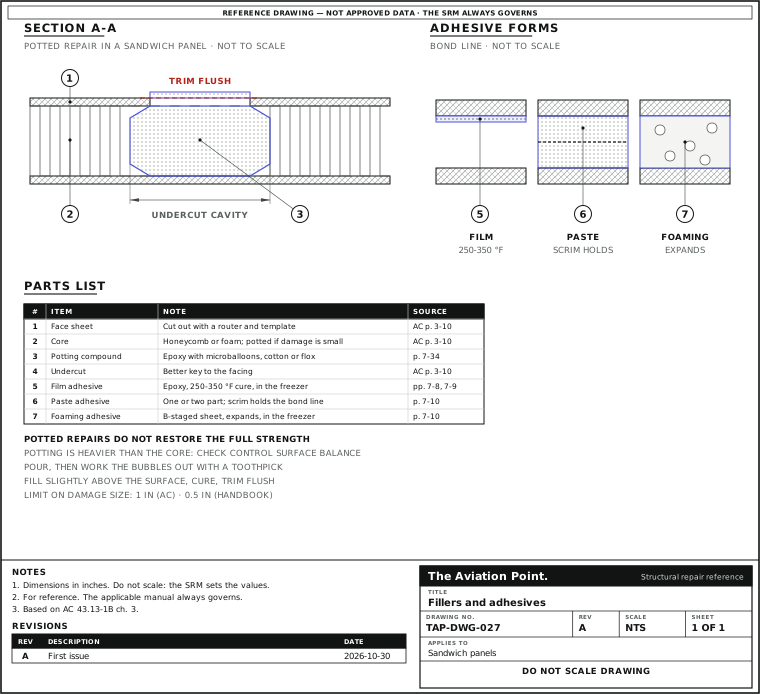
Pot a small core cavity, one step at a time
| Step | Action | What to do |
|---|---|---|
| 1 | Rout the face sheet | Use a template, so the undamaged skin is safe. |
| 2 | Mix | Use the potting adhesive the manufacturer recommends. Mix enough to fill the hole in one go. |
| 3 | Fill | Pour it in, filling all cells, and work the bubbles out with a toothpick. Fill slightly above the surface. |
| 4 | Cure and trim | Cure as the manufacturer says, then trim flush. |
| 5 | Check the weight | On a flight control surface, calculate the repair weight and compare it with the balance limits in the SRM. |
Fillers: what goes into the resin
| Filler or putty | What the sources say | Where it is used |
|---|---|---|
| Microballoons (hollow glass, phenolic or plastic) | Lower the density of the resin and give more flexibility | Potting compound, resin fills for small core damage |
| Cotton, flox and similar | Named as potting-compound fillers; the handbook does not rate them | Potting, edge and cosmetic fills |
| Short glass fibres in room-temperature resin | A putty for damage no deeper than the first ply; peel ply over it before it sets | Surface damage in fibreglass laminate |
| Viscous epoxy, unfilled | Fills dents, scratches or fractures up to 1/4 in in aluminium facings; delaminated dents are repaired, not filled | Aluminium-faced sandwich |
FAA-H-8083-31B Vol. 1 p. 7-34; AC 43.13-1B Chapter 3, pp. 3-2 and 3-9. The compound is epoxy resin filled; the maker's sheet gives the amount.
Adhesive forms compared
| Form | Cure | Storage | Used for | Watch for |
|---|---|---|---|---|
| Film | Epoxy; 250 to 350 °F | Freezer | Bonding patches and skins; core plugs | Carrier (mat or woven cloth) controls flow and thickness; woven carriers can slightly lower environmental properties |
| Paste | One or two part epoxy; some cure at room temperature | Room temperature, long shelf life | Secondary bonding of patches; where film is hard to place | Bond line thickness is hard to control; scrim cloth keeps adhesive in the bond line |
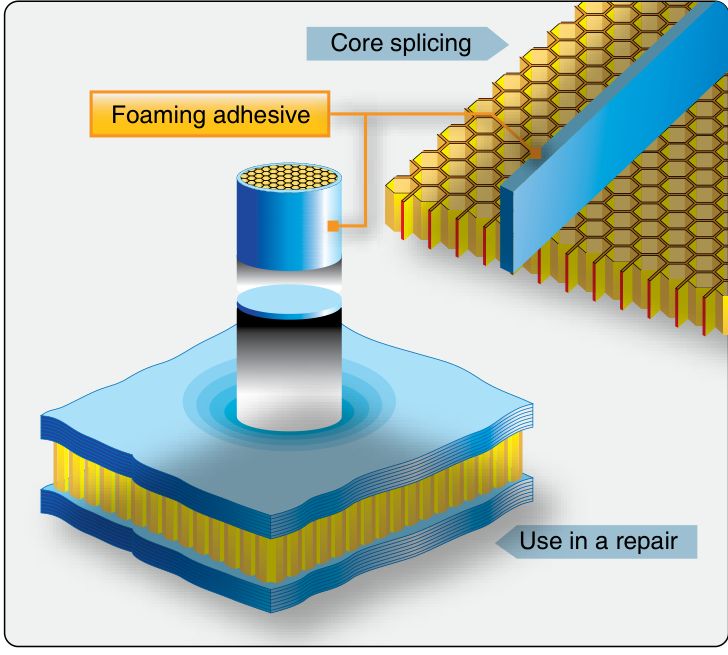
| Foaming | B-staged epoxy sheet 0.025 to 0.10 in; 250 or 350 °F | Freezer, limited storage life | Splicing honeycomb; bonding repair plugs to the core | Expands during the cure |
FAA-H-8083-31B Vol. 1 pp. 7-8 to 7-10 and 7-26. Which adhesive and grade a repair needs is in the SRM.
Potting a small core cavity
A potted repair fills a small core cutout with a curable paste. The handbook uses it for damage smaller than 0.5 in and says it does not restore the full strength; AC 43.13-1B allows potting instead of a core plug when the damaged area is 1 in or less. The two limits are not the same: work to the one in your SRM.
The AC steps: rout out the face sheet with a template, so the undamaged skin is safe; use the potting adhesive the manufacturer recommends; mix enough to fill the hole in one go and add microballoons if they serve as the filler; pour it in, filling all cells, and work the bubbles out with a toothpick; fill slightly above the surface; cure as the manufacturer says; then trim flush. If the core was already potted, the new core is potted too.
Weight. Potting is heavier than the core it replaces. On a flight control surface the repair weight is calculated and compared with the balance limits in the SRM. The core potting calculator gives the volume to mix.
Bond line, carriers and cold storage
Film adhesives are supported by fibres (short random mat or woven cloth of polyester, nylon or glass), which help handling, control flow during bonding and set the bond line thickness. Paste has no carrier, so the bond line is yours to control: a scrim cloth keeps adhesive in the joint when a patch is bonded with paste.
Film and foaming adhesive are stored in a freezer like prepreg, and have a limited storage life. Paste can sit at room temperature; the handbook also lists refrigerators near 40 °F for laminating and paste adhesives, so follow the label. See storing and handling.
For UAV, model and homebuilt work
The same logic applies, with a weight penalty: hollow microballoons give a lighter fairing or pot than a heavy filler, but they also give less strength. Do not use a thickened mix as a structural adhesive unless the resin maker rates it that way. A filled fairing is cosmetic; a bond is structural.
Questions people actually ask
Does microballoon filler make the resin stronger?
No. Microballoons lower density and add flexibility. They make a filler or fairing, not a structural bond.
Film or paste adhesive for a patch?
The SRM decides. Film is usual for elevated-temperature repairs and needs the freezer; paste is the room-temperature alternative and the bond line is harder to control.
Why does the core plug need foaming adhesive?
It expands during the cure and fills the gap between the plug and the existing core, so the plug is bonded to the cell walls.
How much filler goes in?
The resin maker's sheet gives it. The FAA sources name the fillers but give no ratios.
Limits of this guide
What the sources support, and no further.
- No filler ratios. Neither the handbook nor AC 43.13-1B gives amounts of microballoons, flox or silica; use the resin maker's sheet for your system.
- Not covered. Fumed silica (thixotropic thickener), which neither source describes, and adhesive grades and specifications, which are the SRM's.
- Size limits conflict: 0.5 in (handbook) against 1 in (AC 43.13-1B) for potting. The aircraft's SRM governs.
Where to buy
Distributors coming soon.
Sources
- FAA-H-8083-31B, AMT Handbook — Airframe, Volume 1 (2023), Chapter 7 — pp. 7-8 and 7-9, film adhesives and their carriers; p. 7-10, paste and foaming adhesives; p. 7-26, freezer and refrigerator storage; p. 7-34, minor core damage, filler and potting repairs.
- AC 43.13-1B, Change 1, Chapter 3, Fiberglass and Plastics — p. 3-2, putty of resin and short glass fibres for first-ply damage; p. 3-9, viscous epoxy filler for aluminium facings, resin fills with phenolic microballoons; pp. 3-10 and 3-11, paragraph 3-10 g, core potting.