What a filler does to cured epoxy
Where to buy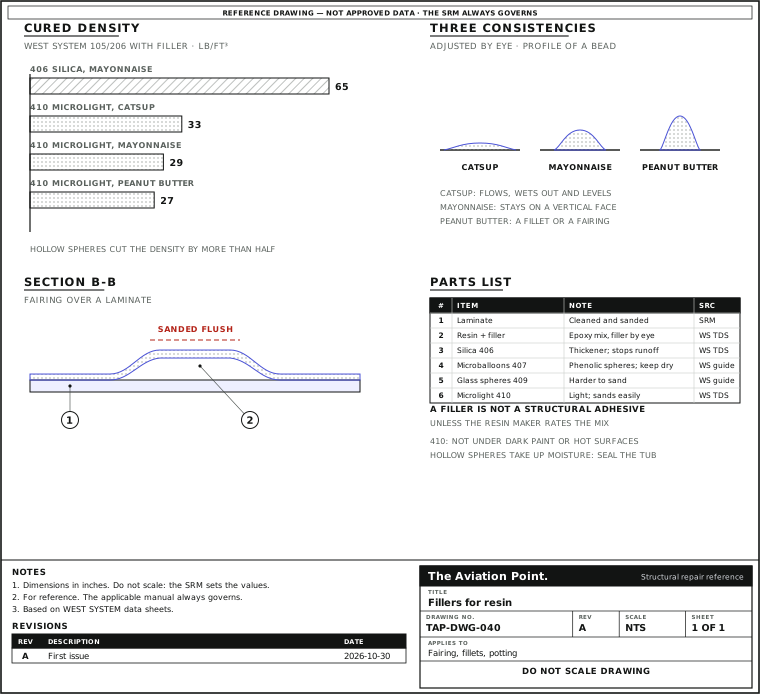
The common fillers
| Filler | What it is | What it does to the mix | Typical use |
|---|---|---|---|
| Colloidal silica (406) | Silicon dioxide powder; bulk density about 50 g/L | Thickens and controls viscosity; stops runoff on vertical and overhead joints; raises abrasion resistance. The most versatile filler | Bonding, gap filling, fillets; blended with other fillers in fairing mixes |
| Microfibres (403) | Milled cotton fibre | Holds resin in the joint, so porous surfaces do not starve it | Bonding wood and glass fibre; gap filling |
| High-density filler (404) | Mineral powder | For the highest properties where hardware is bonded under cyclic load | Bonding hardware; strong fillets |
| Filleting blend (405) | Wood pulp fibre, brown | Smooth fillets that need little sanding; colours other fillers | Fillets on wood with a natural finish |
| Low-density filler (407) | Phenolic microballoons, about 50 microns; bulk density about 100 g/L | Lower density; cosmetic fillets and fills; takes up moisture, so keep the tub airtight | Fillets and fairing; softer adhesives only |
| Microspheres (409) | Hollow glass spheres, 40 to 80 microns | Lower density, but harder; the mix is noticeably harder to sand | Fairing where hardness matters |
| Microlight (410) | Hollow glass spheres, about 50 g/L | Lightest; mixes easily and is about 30 % easier to sand than 407; feathers to a fine edge | Fairing large areas. Not under dark paint or on hot surfaces |
WEST SYSTEM, Filler Descriptions and Uses (Version A, 05/04) and the 406 and 410 technical data sheets. WEST SYSTEM groups 403 to 406 as high-density fillers that add strength, and 407, 409 and 410 as low-density fillers for fairing.
Which filler fits?
A fillet keeps running down a vertical joint. Which filler fits?
- Colloidal silica
Best fit. It thickens the mix and stops runoff on vertical and overhead joints.
- Microlight (410)
Not this one. It is the lightest filler, for fairing large areas.
- Filleting blend (405)
Not this one. It gives smooth fillets and colours other fillers. Stopping runoff is the job of silica.
A repair uses the filler the SRM or the resin maker names.
Consistency: add the powder by eye
There is no strict formula. The data sheet says to thicken until the mix looks right, and gives three reference points: catsup (pours and levels, wets a surface), mayonnaise (holds on a vertical face, fills a gap) and peanut butter (stands as a fillet or fairing). Neat resin is the unthickened case (406 data sheet).
Mix the resin and hardener first, to the maker's ratio, then add the filler. The mix ratio calculator gives resin and hardener by weight, and the pot life calculator the working time.
The 410 sheet gives a buying guide: the initial volume of epoxy times 2.6 is the volume of fairing compound it makes.
What it does to the cured weight
| Mix (105 resin / 206 hardener) | Cured density | Notes |
|---|---|---|
| 406 colloidal silica, mayonnaise | 65 lb/ft³ | Shore D hardness 80; compression strength 8,500 psi (406 data sheet) |
| 410 Microlight, catsup | 33 lb/ft³ (0.53 g/cm³) | 410 data sheet |
| 410 Microlight, mayonnaise | 29 lb/ft³ (0.46 g/cm³) | 410 data sheet |
| 410 Microlight, peanut butter | 27 lb/ft³ (0.43 g/cm³) | Sands and carves like basswood (410 data sheet) |
WEST SYSTEM 406 Colloidal Silica Technical Data Sheet (2 October 2009) and 410 Microlight Filler Technical Data Sheet. Typical values for these mixes only.
Potting, fairing and bonding
The FAA sources name the same families for aircraft work. A potting compound is epoxy resin filled with hollow glass, phenolic or plastic microballoons, cotton, flox or similar (FAA-H-8083-31B p. 7-34), and it is heavier than the core it replaces. The fillers and adhesives guide has the potting limits, the steps and the film, paste and foaming adhesives; this page does not repeat them. The core potting calculator gives the volume.
For a fairing, a light filler sands easily but does not carry load. For a fillet or bond, a fibre or silica mix gives gap fill with better properties. Which is allowed on a given joint is an SRM or adhesive-maker question: a thickened mix is not a structural adhesive unless the maker rates it.
For UAV, model and homebuilt work
This is where fillers earn their keep: a light microballoon mix to fair a foam wing core, silica to stop a fillet running, and flox or fibres to join parts. Keep the powders dry and the tub sealed, mix small batches (the safety guide covers dust and handling). Test the mix on scrap before it goes on the part.
Questions people actually ask
Does a filler make epoxy stronger?
Not by itself. Silica and fibres thicken the mix and fill gaps; the hollow spheres lower weight. The resin maker's sheet says what a mix is rated for.
Microballoons or Microlight?
Both are hollow spheres for fairing. The maker lists Microlight as lighter and about 30 % easier to sand, but not for use under dark paint or on hot surfaces.
How much filler do I add?
Until the mix reaches the consistency you need: catsup, mayonnaise or peanut butter. There is no fixed ratio on the data sheet.
Colloidal silica or fumed silica?
WEST SYSTEM's product is described as colloidal silica, a silicon dioxide powder. Sheets from other makers use their own names: read the sheet of the powder you buy.
Limits — when NOT to use this
What the sources support, and no further.
- The manual governs. A repair uses the filler the SRM or the resin maker names.
- One maker's sheets. Density, strength and consistency figures are typical values for WEST SYSTEM 105 resin with 206 hardener and the stated filler. Other makers' resins and fillers differ.
- No ratios. The sources give none for aircraft potting or fairing mixes.
- Hot service. The 410 sheet says it is not recommended on surfaces that get hot. We have no data on any filler's temperature limit.
Where to buy
Distributors coming soon.
Sources
- WEST SYSTEM, Filler Descriptions and Uses, Version A (05/04) — Filler groups; 403 to 410 descriptions, composition, particle size and bulk density; 407 moisture; 409 harder to sand; 410 about 30 % easier to sand and not for dark paint or hot surfaces.
- WEST SYSTEM, 406 Colloidal Silica Technical Data Sheet (2 October 2009) — Use, consistencies, no strict formula, cured properties of a 105/206/406 mayonnaise mix.
- WEST SYSTEM, 410 Microlight Filler Technical Data Sheet — Cured density by consistency; buying guide (volume times 2.6).
- FAA-H-8083-31B, AMT Handbook — Airframe, Volume 1, Chapter 7 — p. 7-34, potting compound fillers, hard points, weight and balance.