Key facts
Where to buy| Property | Value | Source |
|---|---|---|
| Ftu, L, A basis, T3 sheet | 60 ksi to 0.062 in · 62 ksi 0.063–0.128 in (bare: 64 ksi) | MIL-HDBK-5J Tables 3.2.3.0(e1), (b1) |
| Sheet tensile stress behind the AN-3 bolt count in a splice | 70,000 psi in Table 4-9 · 55,000 psi in Table 4-10 | AC 43.13-1B Tables 4-9, 4-10, engineering note d |
| Density | 0.100 lb/in³ (2.78 g/cm³) | MIL-HDBK-5J |
| Cladding, plate from 0.250 in | 2½ % nominal | MIL-HDBK-5J Table 3.2.3.0(e1) |
| Bending | Slightly smaller radii than bare | AC 43.13-1B Table 4-6, note 1 |
The handbook gives the cladding percentage in a note to thick material. Thin sheet follows the specification: check AMS-QQ-A-250/5. The two psi figures are the basis of the AC's AN-3 bolt rows, not strengths of the sheet: clad 2024-T3 is named in the title of both tables, and the AC does not say which governs it.
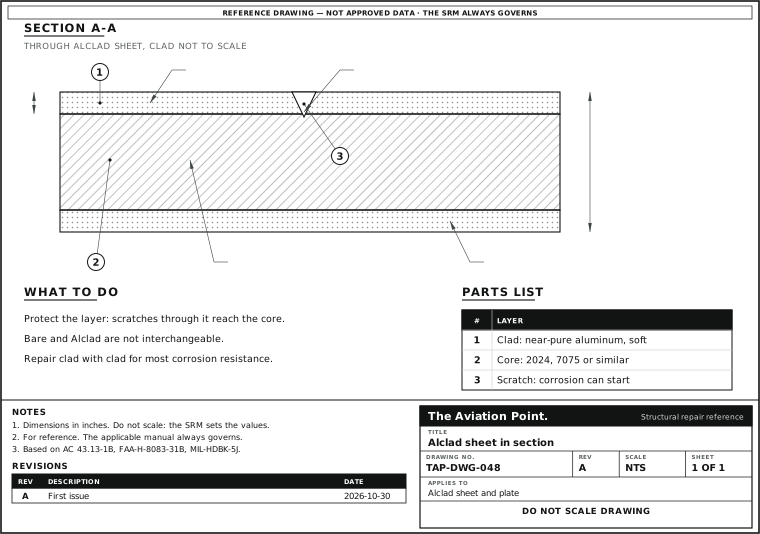
Alclad in section
Quick check
A scratch goes through the clad layer. What is the concern?
- Corrosion can start in the core
Best fit. The layer no longer covers the alloy beneath (AMT Handbook, p. 4-89).
- The sheet loses most of its strength
Not this one. The clad is thin and soft. The concern is corrosion.
- Nothing: the clad heals
Not this one. The sources do not say so. Treat it per the SRM.
On a real job, the SRM decides.
Composition limits, weight percent
| Element | Limit |
|---|---|
| Si | 0.50 |
| Fe | 0.50 |
| Cu | 3.8–4.9 |
| Mn | 0.30–0.9 |
| Mg | 1.2–1.8 |
| Cr | 0.10 |
| Zn | 0.25 |
| Ti | 0.15 |
| Al | Remainder |
Limits for the core alloy. A single number is a maximum. Source: Aluminum Association Teal Sheets (Aug 2018).
Design allowables, Alclad 2024-T3 flat sheet
| Property, ksi | 0.010–0.062 A | 0.010–0.062 B | 0.063–0.128 A | 0.063–0.128 B |
|---|---|---|---|---|
| Ftu, L | 60 | 61 | 62 | 63 |
| Ftu, LT | 59 | 60 | 61 | 62 |
| Fty, L | 44 | 45 | 45 | 47 |
| Fty, LT | 39 | 40 | 40 | 42 |
| Fcy, L | 36 | 37 | 37 | 39 |
| Fcy, LT | 42 | 43 | 43 | 45 |
| Fsu | 37 | 38 | 38 | 39 |
| Fbru, e/D = 1.5 | 97 | 99 | 101 | 102 |
| Fbru, e/D = 2.0 | 121 | 123 | 125 | 127 |
| Fbry, e/D = 1.5 | 68 | 70 | 70 | 73 |
| Fbry, e/D = 2.0 | 82 | 84 | 84 | 88 |
Flat sheet, T3, thickness in inches, AMS-QQ-A-250/5, MIL-HDBK-5J Table 3.2.3.0(e1), p. 3-75. S, A and B are the MIL-HDBK-5J statistical bases. L is the longitudinal grain direction, LT the long transverse. Bearing values are dry-pin values. Clad sheet has a primary and a secondary modulus: see the handbook table.
Bend radii (AC 43.13-1B Table 4-6)
| Alloy and temper | 0.016" | 0.032" | 0.064" | 0.128" | 0.182" | 0.258" |
|---|---|---|---|---|---|---|
| 2024-O | 0 | 0 – 1t | 0 – 1t | 0 – 1t | 0 – 1t | 0 – 1t |
| 2024-T3 | 1½t – 3t | 2t – 4t | 3t – 5t | 4t – 6t | 4t – 6t | 5t – 7t |
| 2024-T6 | 2t – 4t | 3t – 5t | 3t – 5t | 4t – 6t | 5t – 7t | 6t – 10t |
Recommended radii for 90-degree bends, as multiples of sheet thickness t. Alclad sheet may go slightly tighter than bare (Table 4-6 note 1). The drawing or SRM governs.
When to use Alclad
Sheet that stays unpainted must be clad (AC, p. 4-12). For maximum corrosion resistance, repair clad sandwich facings with clad (AC, p. 3-9).
The Handbook's material substitution figure notes that replacing clad with bare may need more corrosion protection (Figure 4-168, p. 4-87).
Alclad 2024-T3 reinforcement is what the AMT Handbook shows in its example patches. Thickness and rivets still come from the SRM.
Looking after the clad layer
Scratches that go through the surface layer allow corrosion in the alloy beneath (AMT Handbook, p. 4-89). Handle sheet with care and recoat bare spots at once.
To tell whether a piece is clad, look at a cut edge under a glass: three distinct layers show (AC 43.13-1B Chapter 4, next to Table 4-5).
Glass-bead or grain abrasive blasting on clad uses a lower nozzle pressure than on non-clad: 30 to 40 psi against 40 to 45 psi on direct pressure machines (AC Chapter 6). Read the paragraph for its approval condition.
Specifications and product forms
| Specification | Form |
|---|---|
| AMS-QQ-A-250/5 | Clad sheet and plate |
Specifications as listed by MIL-HDBK-5J. Federal QQ-A specifications passed to SAE as AMS-QQ-A. Check the current revision.
Questions people actually ask
Can I replace bare 2024-T3 with Alclad of the same gauge?
Not by default. Alclad allowables are lower. The SRM or approved data decides the gauge.
Does Alclad need paint?
The AC accepts clad for parts left unpainted (p. 4-12). The aircraft's finish specification still governs.
Limits — when NOT to use this
- Not a source of design allowables. Values are for reference. MMPDS and the SRM govern a repair.
- Not a substitution approval. A different alloy or temper needs approved data.
- Not bare. Values on this page do not apply to bare 2024.
Where to buy
Distributors coming soon.
Sources
- FAA AC 43.13-1B CHG 1, Chapters 4 and 7 — Tables 4-6, 4-9, 4-10; pp. 3-9, 4-12; Chapter 6 on blasting.
- FAA-H-8083-31B, AMT Handbook — Airframe, Volume 1, Chapter 4 — p. 4-89; Figure 4-168, p. 4-87.
- MIL-HDBK-5J (31 Jan 2003), Chapter 3 — Tables 3.2.3.0(a), (b1), (e1). Cancelled and superseded by MMPDS: check current MMPDS before design use.
- Aluminum Association, International Alloy Designations (Teal Sheets), rev. Aug 2018 — chemical composition limits and nominal densities.
- MMPDS (formerly MIL-HDBK-5) — the current home of design allowables. A repair substantiation cites MMPDS or the SRM, not a website.