Key facts
Where to buy| Property | Value | Source |
|---|---|---|
| Density | 0.098 lb/in³ (2.71 g/cm³) | Teal Sheets |
| Brinell hardness, O / H18 | 23 / 44 | AC 43.13-1B Table 4-5 |
| Rivet code and head | A, plain | AC 43.13-1B Table 4-8 |
| Weldable | Yes | FAA-H-8083-31B, p. 4-30 |
1100 is not in MIL-HDBK-5J, and no strength value is given here.
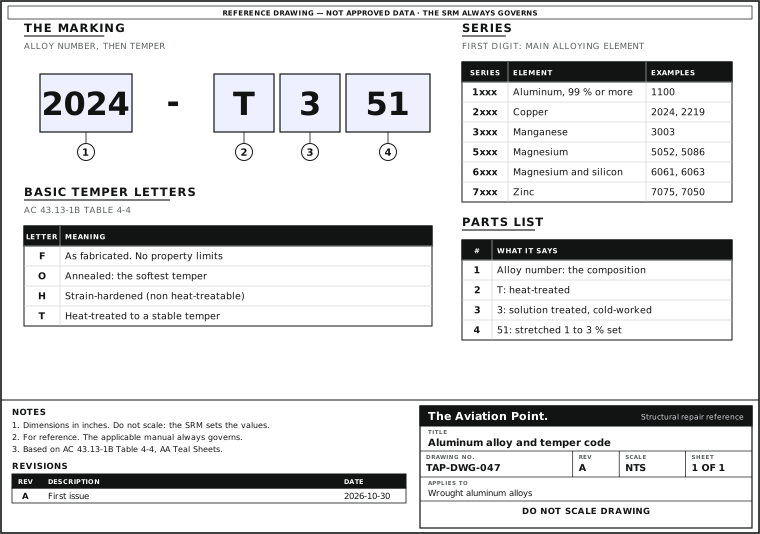
Reading the alloy and temper code
Composition limits, weight percent
| Element | Limit |
|---|---|
| Si + Fe | 0.95 |
| Cu | 0.05–0.20 |
| Mn | 0.05 |
| Zn | 0.10 |
| Al | 99.00 min |
A single number is a maximum. Si + Fe is a combined maximum. Source: Aluminum Association Teal Sheets (Aug 2018).
Where it is used
The AMT Handbook lists fuel tanks, cowlings and oil tanks, and repair of wingtips and tanks (p. 4-30).
1100 rivets are for nonstructural parts of soft alloys such as 1100, 3003 and 5052 (AC par. 7-2c). Tubing under ¼ in may be bent by hand (AC, p. 9-18).
Questions people actually ask
Can I use an 1100 rivet in structure?
No. The AC keeps them to nonstructural parts of soft alloys.
Limits — when NOT to use this
- Not a source of design allowables. Values are for reference. MMPDS and the SRM govern a repair.
- Not a substitution approval. A different alloy or temper needs approved data.
Where to buy
AmericaDistributor coming soonOur partner for this region is on its way
EuropeDistributor coming soonOur partner for this region is on its way
OceaniaDistributor coming soonOur partner for this region is on its way
Distributors coming soon.
Sources
- FAA AC 43.13-1B CHG 1, Chapters 4 and 7 — Tables 4-5, 4-8; par. 7-2; p. 9-18.
- FAA-H-8083-31B, AMT Handbook — Airframe, Volume 1, Chapter 4 — p. 4-30.
- Aluminum Association, International Alloy Designations (Teal Sheets), rev. Aug 2018 — chemical composition limits and nominal densities.
Educational reference only. not approved data. Always consult the applicable SRM, AMM, or AC 43.13-1B and your certifying authority.