Key facts
Where to buy| Property | Value | Source |
|---|---|---|
| Type | Solid-solution, matrix-strengthened nickel-base alloy; no precipitation hardening needed | MIL-HDBK-5J, par. 6.3.3.0 |
| Composition | Nickel 58 % min, chromium 20–23 %, molybdenum 8–10 %, niobium plus tantalum 3.15–4.15 %, iron 5 % max | Special Metals, Inconel alloy 625 bulletin, limiting chemical composition |
| Temperature | Corrosion and oxidation resistance to about 1,800 °F | MIL-HDBK-5J, par. 6.3.3.0 |
| Condition | Annealed at 1,700 to 1,900 °F | MIL-HDBK-5J, par. 6.3.3.0 |
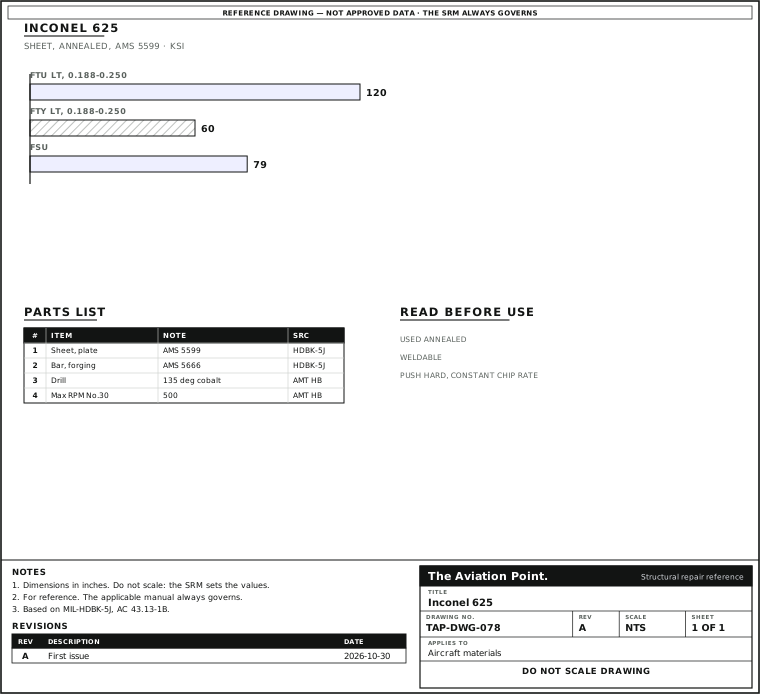
| Sheet, strip, plate | AMS 5599, annealed | MIL-HDBK-5J, Table 6.3.3.0(a) |
| Bar, forging, ring | AMS 5666, annealed | MIL-HDBK-5J, Table 6.3.3.0(a) |
| Welding | Can be welded by common industrial practices | MIL-HDBK-5J, par. 6.3.3.0 |
Design allowables — Inconel 625 sheet and plate, annealed (AMS 5599)
Strength in ksi. MIL-HDBK-5J Table 6.3.3.0(b), p. 6-35.
| Thickness, in | Basis | Ftu LT | Fty LT | Fsu |
|---|---|---|---|---|
| 0.062 and under | A | 120 | 57 | 79 |
| 0.063–0.109 | A | 120 | 56 | 79 |
| 0.110–0.140 | A | 120 | 55 | 79 |
| 0.141–0.187 | A | 119 | 54 | 79 |
| 0.188–0.250 | S | 120 | 60 | 79 |
| 0.251–1.000 | S | 120 | 60 | — |
Elongation 30 percent (S basis, LT). E = 29.8 × 10³ ksi, G = 11.8 × 10³ ksi, density 0.305 lb/in³. B-basis values and L-direction values are in the table.
Thicknesses and forms
Sheet, strip and plate (AMS 5599), design values from 0.062 in and under to 1.000 in; bar, forging and ring (AMS 5666).
Density 0.305 lb/in³ is nearly 8 percent above steel: weigh the part (sheet weight calculator, with the density entered by hand).
Forming
Inconel 625 and 718 can be cold formed by the standard procedures used for steel and stainless steel (AMT Handbook, p. 4-82).
The strength is greatly affected by the amount of cold work prior to annealing and by the annealing temperature (MIL-HDBK-5J par. 6.3.3.0). It resists deformation hot, but can be fabricated with adequate equipment.
Quick check
You hand-drill Inconel 625. What do you do?
- Light pressure, high speed, plenty of oil
Not this one. Light pressure rubs and work-hardens. The handbook says push hard at a constant chip rate; cutting fluid is not necessary.
- 135° cobalt bit, push hard at a constant chip rate, max RPM per the chart
Best fit. Right.
- Use a 118° HSS bit
Not this one. The handbook recommends a 135° cobalt bit.
On a real job, the SRM decides.
Welding
The alloy's combination of strength, corrosion resistance and ability to be welded by common industrial practices is its stated outstanding feature (MIL-HDBK-5J par. 6.3.3.0). Filler and procedure come from the manufacturer or SRM.
Corrosion
Designed for good corrosion and oxidation resistance (MIL-HDBK-5J). The public FAA sources give no cleaning rules for it; follow the SRM.
Where it is used on aircraft
Aircraft powerplant structures where corrosion resistance and strength at temperature are needed (AMT Handbook, p. 4-82); the repair manual lists where it is used.
Data sheet
Questions people actually ask
How do you drill Inconel 625?
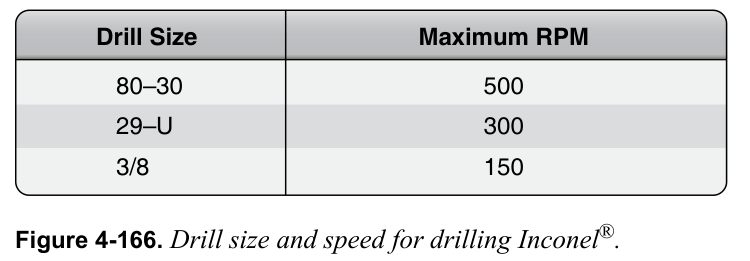
Hand drilling: use a 135° cobalt drill bit, push hard at a constant chip rate (about 50 lb for a No. 30 hole), at the RPM in the chart below; cutting fluid is not necessary by hand. Autofeed drilling equipment is preferred; drill pilot holes in loose repair parts with power feed, preassemble, then drill the pilot holes in the mating structure and enlarge them to size (AMT Handbook, p. 4-82).
What RPM?
Drill size 80–30: 500 rpm maximum; 29–U: 300 rpm; 3/8 in: 150 rpm (AMT Handbook Figure 4-166).
Limits — when NOT to use this
- Annealed values only. Cold work before annealing changes them.
- Powerplant material. The engine manufacturer's manual governs any repair.
Where to buy
Distributors coming soon.
Sources
- MIL-HDBK-5J, Metallic Materials and Elements for Aerospace Vehicle Structures (31 Jan 2003) — par. 6.3.3.0 and Tables 6.3.3.0(a), (b), pp. 6-34 and 6-35. Cancelled; superseded by MMPDS.
- FAA-H-8083-31B, Aviation Maintenance Technician Handbook, Airframe, Volume 1 — Working Inconel Alloys 625 and 718, p. 4-82, Figure 4-166.
- MMPDS (formerly MIL-HDBK-5) — the current home of design allowables. A repair substantiation cites MMPDS or the SRM, not a website.
- Special Metals, Inconel alloy 625 — Limiting chemical composition.