Key facts
Where to buy| Property | Value | Source |
|---|---|---|
| Type | Unalloyed titanium, annealed; excellent formability, readily welded or brazed | MIL-HDBK-5J, par. 5.2.1.0 |
| MIL-HDBK-5J name | CP-3 under AMS-T-9046, equal in strength to ASTM Grade 2 | MIL-HDBK-5J, Table 5.2.1.0(b); ASTM B265 grade strengths |
| Specification | AMS 4902 and AMS-T-9046 (CP-3) | MIL-HDBK-5J, Table 5.2.1.0(a) |
| Oxygen limit | 0.25 % max (interstitials set the grade) | ASTM B265-10 Table 2 (Grade 2) |
| Full anneal | 1,000 to 1,300 °F for 10 to 30 minutes | MIL-HDBK-5J, par. 5.2.1.0 |
| Stress relief | 900 to 1,000 °F for 30 minutes | MIL-HDBK-5J, par. 5.2.1.0 |
| Density | 0.163 lb/in³ (about 4.51 g/cm³, converted) | MIL-HDBK-5J, Table 5.2.1.0(b) |
Design allowables — CP titanium Grade 2 sheet, strip and plate, annealed
Annealed, 1.000 in and under, MIL-HDBK-5J Table 5.2.1.0(b), p. 5-7.
| Property | S basis | Unit |
|---|---|---|
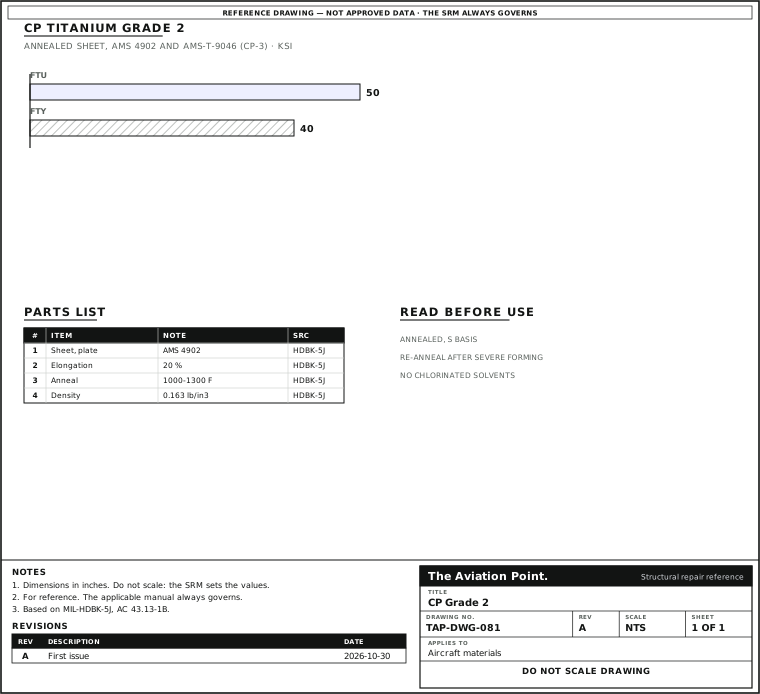
| Ftu, L and LT | 50 | ksi |
| Fty, L and LT | 40 | ksi |
| Elongation, L and LT (0.025 in and over) | 20 | % |
| E | 15.5 | 10³ ksi |
| G | 6.5 | 10³ ksi |
| Density | 0.163 | lb/in³ |
The handbook labels the four sheet strength levels CP-4 to CP-1, with minimum Ftu of 35, 50, 65 and 80 ksi; this page assigns them to Grades 1 to 4 by strength, as ASTM B265 does. Check the spec on your certificate: the handbook yield figures are the AMS and MIL-T-9046 minimums and may differ from ASTM B265 minimums.
Thicknesses and forms
Sheet, strip and plate to MIL-T-9046 and the AMS 49xx specification above; bar (MIL-T-9047, AMS 4921, 80 ksi level) and extruded bars and shapes (AMS-T-81556).
Handbook values are for annealed material, 1.000 in and under.
Forming
Unalloyed titanium is supplied annealed, permitting extensive forming at room temperature; severe forming can also be done at 300 to 900 °F. After severe forming, properties may degrade unless restored by re-annealing (MIL-HDBK-5J par. 5.2.1.0).
Commercially pure titanium sheet may be formed by hydropress, stretch press, brake, roll forming or drop hammer; it is more difficult to form than annealed stainless steel (AMT Handbook p. 4-85).
Quick check
CP titanium sheet is formed hard and loses properties. How are they restored?
- They cannot be
Not this one. Re-annealing restores them.
- By re-annealing
Best fit. Right (MIL-HDBK-5J par. 5.2.1.0).
- By painting
Not this one. No.
On a real job, the SRM decides.
Welding
Commercially pure titanium welds readily by the usual titanium joining methods. Atmospheric shielding is preferable, though spot or seam welding can be done without it. Brazing needs protection from the atmosphere (MIL-HDBK-5J par. 5.2.1.0).
Filler ERTi-5 (AMS 4954, AWS A5.16) is the titanium rod in AC 43.13-1B Table 4-15; match the rod to the base grade per the manufacturer.
Corrosion
Titanium is highly corrosion resistant because an oxide film forms in air. Heated, it shows colour: blue at 700–800 °F, purple at 800–950 °F, gray or black at 1,000 °F or higher; these are protective discolorations and should not be removed (AC 43.13-1B par. 6-181a).
If corrosion occurs it is usually pitting and hard to detect. Titanium is susceptible to hydrogen embrittlement, so chlorinated solvents and chemical corrosion removers are prohibited, and fire-resistant hydraulic fluids must be controlled (AC par. 6-181b and c). Isolate titanium from magnesium, aluminum or alloy steel (AMT Handbook p. 4-85).
Above 1,050 °F titanium has a high affinity for oxygen, nitrogen and hydrogen and becomes embrittled. Contact with cadmium, silver or mercury can embrittle it (MIL-HDBK-5J par. 5.2.1.0).
Where it is used on aircraft
Titanium parts where corrosion resistance and low weight matter more than strength; unalloyed grades have been used primarily where strength is not the main requirement (MIL-HDBK-5J par. 5.2.1.0).
Data sheet
Questions people actually ask
What is the difference between CP Grades 1 to 4?
Strength and ductility. Minimum Ftu rises from 35 ksi (Grade 1) to 80 ksi (Grade 4) while elongation falls from 24 to 15 percent (MIL-HDBK-5J Table 5.2.1.0(b)).
How do you drill it?
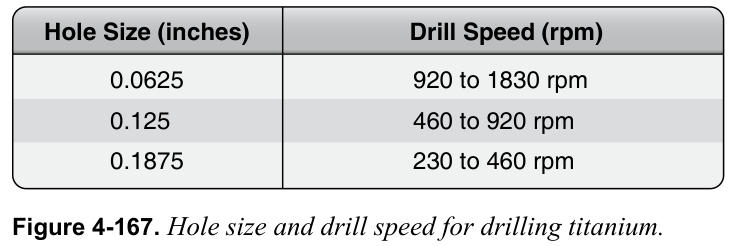
Hand-drill holes of 0.1875 in and larger only from a 0.1563 in start, stepping 0.0313 or 0.0625 in at a time. Cobalt vanadium bits outlast HSS. Do not let a blunt bit rub: the surface work-hardens and is very hard to restart (AMT Handbook, p. 4-86).
Limits — when NOT to use this
- Annealed values. Forming and heat change them.
- Not a substitute for an alloy grade or for aluminum; the drawing names the grade.
Where to buy
Distributors coming soon.
Sources
- FAA AC 43.13-1B CHG 1 — par. 6-181.
- FAA-H-8083-31B, Aviation Maintenance Technician Handbook, Airframe, Volume 1 — pp. 4-85 and 4-86, titanium.
- MIL-HDBK-5J, Metallic Materials and Elements for Aerospace Vehicle Structures (31 Jan 2003) — par. 5.2.1.0 and Tables 5.2.1.0(a), (b), pp. 5-6 and 5-7. Cancelled; superseded by MMPDS.
- FAA AC 43.13-1B CHG 1 — Table 4-15.
- MMPDS (formerly MIL-HDBK-5) — the current home of design allowables. A repair substantiation cites MMPDS or the SRM, not a website.
- ASTM B265, Titanium and Titanium Alloy Strip, Sheet, and Plate — Table 1 (tensile) and Table 2 (chemical), edition 10 read.