Glass fabric styles at a glance
Where to buy| Style | Yarn (warp = fill) | Weave | Weight, oz/yd² | Weight, g/m² | Dry thickness | Count, warp × fill per in | Breaking strength warp / fill, lbf/in |
|---|---|---|---|---|---|---|---|
| 108 | ECD 900 1/2 (E) | Plain | 1.43 | 48 | 2.5 mil (0.06 mm) | 60 × 47 | 80 / 70 |
| 1080 | ECD 450 1/0 (E) | Plain | 1.41 | 48 | 2.2 mil (0.06 mm) | 60 × 47 | 120 / 90 |
| 120 | E | 4 harness satin | 3.16 | 107 | 3.5 mil (0.09 mm) | 60 × 58 | 160 / 160 |
| 7580 | ECG 75 1/2 (E) | Plain | 6.20 | 210 | 7.8 mil (0.20 mm) | 24 × 14 | 300 / 200 |
| 1581 | E | 8 harness satin | 8.79 | 298 | 8.50 mil (0.22 mm) | 57 × 54 | 450 / 380 |
| 7781 | ECDE 75 1/0 (E) | 8 harness satin | 8.81 | 299 | 8.6 mil (0.22 mm) | 57 × 54 | 570 / 450 |
| 6781 | SCG 75 1/0 (S) | 8 harness satin | 8.92 | 302 | 9.50 mil (0.24 mm) | 57 × 54 | 550 / 450 |
| 7500 | ECG 37 1/2 (E) | Plain | 9.41 | 319 | 11.80 mil (0.30 mm) | 16 × 14 | 420 / 400 |
| 7587 | ECG 37 1/2 (E) | Mock leno | 19.70 | 668 | 27.20 mil (0.69 mm) | 40 × 21 | 750 / 450 |
Source for every row: the Hexcel HexForce product data sheet of the same number (links below), US-system column; g/m² and mm as printed by Hexcel. Warp and fill yarns are the same except on 7580 (fill ECG 37 1/0) and 1581 (see the Hexcel sheet). Thickness is dry fabric, not cured ply thickness.
How to read a style number
Four digits, one fabric. The number is an industry style code, so 7781 from one weaver is the same construction as 7781 from another, but the finish (the surface treatment on the glass) is separate and the resin system decides which finish is right.
Weight per area is the lever. Divide a thickness target by the dry thickness here to estimate plies, then let the resin content and the SRM correct it. The laminate plies calculator does that arithmetic.
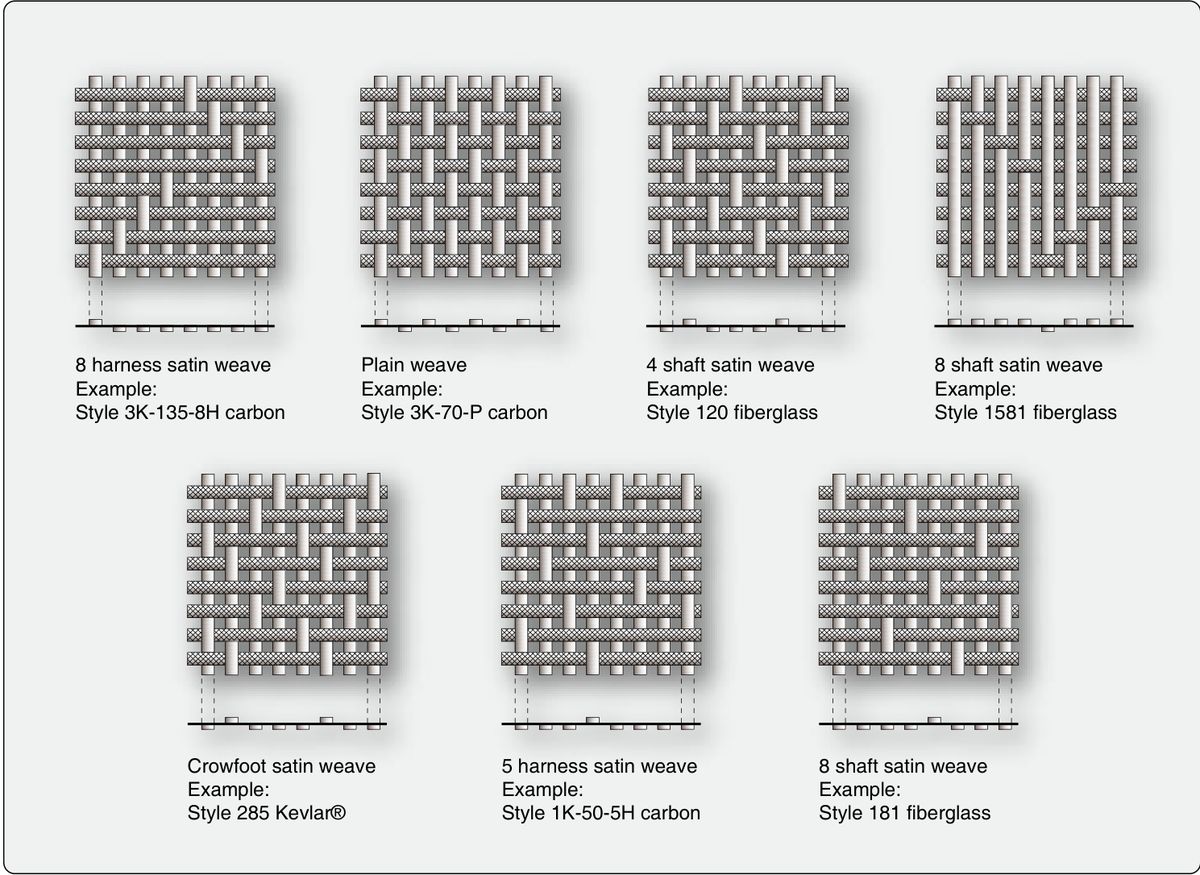
Weave drives drape. Plain weave is the most stable; the 4- and 8-harness satins of 120, 1581, 7781 and 6781 conform better to curves (FAA-H-8083-31B, Figure 7-5, p. 7-5).
Which glass. Hexcel’s yarn codes on these sheets begin with E for the E-glass styles and with S for 6781. See E-glass and S-glass.
Light, medium or heavy cloth
1080
- Weight
- 1.41 oz/yd² (48 g/m²)
- Weave
- Plain
- Dry thickness
- 2.2 mil (0.06 mm)
120
- Weight
- 3.16 oz/yd² (107 g/m²)
- Weave
- 4 harness satin
- Dry thickness
- 3.5 mil (0.09 mm)
7781
- Weight
- 8.81 oz/yd² (299 g/m²)
- Weave
- 8 harness satin
- Dry thickness
- 8.6 mil (0.22 mm)
7587
- Weight
- 19.70 oz/yd² (668 g/m²)
- Weave
- Mock leno
- Dry thickness
- 27.20 mil (0.69 mm)
Quick check
The repair schedule calls for 7781 and the shop only has 1581 on the shelf. Their weight and count are nearly equal. What is the right move?
- Use 1581, it is practically the same cloth.
Not this one. Nearly equal numbers do not make a substitution. They are different styles with different yarn.
- Use 1581 and add a ply to make up the difference.
Not this one. Changing ply count is changing the repair design, which the SRM sets.
- Stop and get the 7781 the SRM names, or approved data allowing the change.
Best fit. A style change is a material change. Only the SRM or approved data can allow it.
On a real job, the SRM decides.
Questions people actually ask
Is 7781 the same as 1581?
Almost the same weight, count and thickness (8.81 against 8.79 oz/yd²) and both 8 harness satin, but they are different styles. A repair calls for the one the SRM names.
Which glass cloth is thinnest?
In this data 1080 at 2.2 mil (0.06 mm), then 108 at 2.5 mil. Style 120 is 3.5 mil (0.09 mm).
Why does 7587 weigh so much?
It is a mock leno weave of 134-count double yarns, 19.70 oz/yd² (668 g/m²) and 27.20 mil (0.69 mm) thick on the Hexcel sheet, about 2.2 times the weight of 7781.
Limits — when NOT to use this
- Not a substitution table. A different style, weave or finish is a material change that approved data must allow.
- Dry values only. Cured ply thickness depends on resin content and compaction.
- One manufacturer. Other weavers’ sheets for the same style will be close but not identical.
Where to buy
Distributors coming soon.
Sources
- Hexcel HexForce Style 108 Fiber Glass Fabric Product Data (DSF_108) — 1.43 oz/yd², plain, 60 × 47, 2.5 mil, 80 / 70 lbf/in.
- Hexcel HexForce Style 1080 Fiber Glass Fabric Product Data (DSF_1080) — 1.41 oz/yd², plain, 60 × 47, 2.2 mil, 120 / 90 lbf/in.
- Hexcel HexForce Style 120 Fiber Glass Fabric Product Data (DSF_120) — 3.16 oz/yd², 4 harness satin, 60 × 58, 3.5 mil, 160 / 160 lbf/in.
- Hexcel HexForce Style 7580 Fiber Glass Fabric Product Data (DSF_7580) — 6.20 oz/yd², plain, 24 × 14, 7.8 mil, 300 / 200 lbf/in.
- Hexcel HexForce Style 1581 Fiber Glass Fabric Product Data (DSF_1581) — 8.79 oz/yd², 8 harness satin, 57 × 54, 8.50 mil, 450 / 380 lbf/in.
- Hexcel HexForce Style 7781 Fiber Glass Fabric Product Data (DSF_7781) — 8.81 oz/yd², 8 harness satin, 57 × 54, 8.6 mil, 570 / 450 lbf/in.
- Hexcel HexForce Style 6781 Fiber Glass Fabric Product Data (DSF_6781) — 8.92 oz/yd², 8 harness satin, 57 × 54, 9.50 mil, 550 / 450 lbf/in, S-type yarn.
- Hexcel HexForce Style 7500 Fiber Glass Fabric Product Data (DSF_7500) — 9.41 oz/yd², plain, 16 × 14, 11.80 mil, 420 / 400 lbf/in.
- Hexcel HexForce Style 7587 Fiber Glass Fabric Product Data (DSF_7587) — 19.70 oz/yd², mock leno, 40 × 21, 27.20 mil, 750 / 450 lbf/in.
- FAA-H-8083-31B, AMT Handbook — Airframe, Volume 1 (2023), Chapter 7 — weave styles (Figure 7-5, p. 7-5); fiberglass types and use (p. 7-5).