Key facts
Where to buy| Property | Value | Source |
|---|---|---|
| Type | Vacuum-melted, precipitation-hardened nickel-base alloy | MIL-HDBK-5J, par. 6.3.5.0 |
| Composition | Nickel 50–55 %, chromium 17–21 %, niobium 4.75–5.5 %, molybdenum 2.8–3.3 %, titanium 0.65–1.15 %, aluminum 0.2–0.8 %, iron balance | Special Metals, Inconel alloy 718 bulletin, limiting chemical composition |
| Use range | Creep and stress rupture to 1,300 °F, strength at cryogenic temperature, oxidation resistance to 1,800 °F | MIL-HDBK-5J, par. 6.3.5.0 |
| Welding and forming | Welded easily, excels in resistance to strain-age cracking, readily formable | MIL-HDBK-5J, par. 6.3.5.0 |
| Sheet | AMS 5596 (sheet), 5597 (plate), 5589 (sheet and plate) | MIL-HDBK-5J, Table 6.3.5.0(b) |
| Tubing | AMS 5590 | MIL-HDBK-5J, Table 6.3.5.0(b) |
Design allowables — Inconel 718 sheet, solution treated and aged (AMS 5596)
Sheet 0.010–0.187 in. MIL-HDBK-5J Table 6.3.5.0(b), p. 6-52.
| Property | A basis | B basis | Unit |
|---|---|---|---|
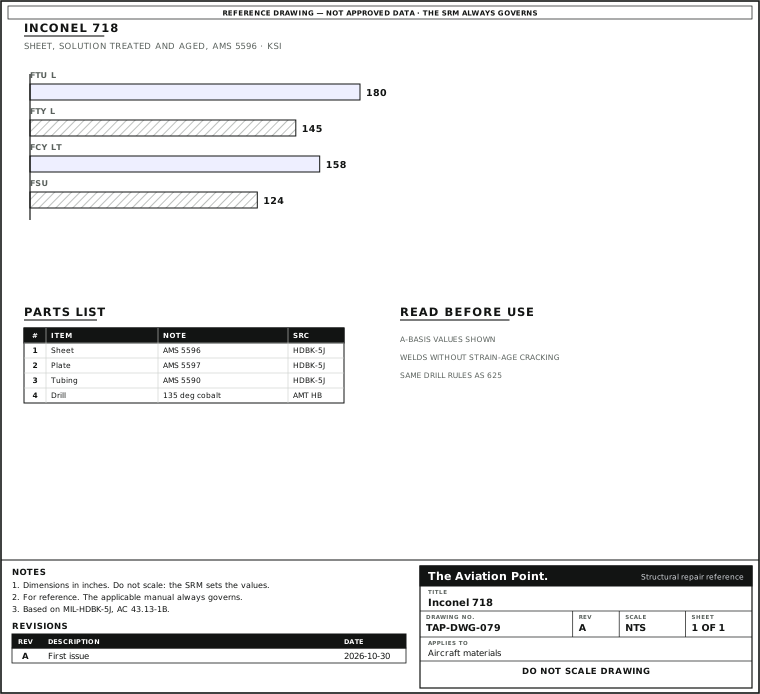
| Ftu, L | 180 | 192 | ksi |
| Ftu, LT | 180 | 191 | ksi |
| Fty, L | 145 | 156 | ksi |
| Fty, LT | 147 | 158 | ksi |
| Fcy, LT | 158 | 170 | ksi |
| Fsu | 124 | 132 | ksi |
| Elongation LT (S basis) | 12 | — | % |
| E | 29.4 | 29.4 | 10³ ksi |
| Density | 0.297 | 0.297 | lb/in³ |
Design allowables come from material supplied solution treated and aged by the suppliers to show heat-treatment response; properties of material formed or cold worked may be different. Plate and AMS 5589 columns carry S-basis values around 180 ksi; G = 11.4 × 10³ ksi.
Thicknesses and forms
Sheet 0.010 to 0.187 in (AMS 5596), plate 0.188 to 1.000 in (AMS 5597), sheet and plate (AMS 5589) and tubing (AMS 5590). Available in all wrought forms and investment castings.
Forming
Inconel 625 and 718 can be cold formed by the standard procedures used for steel and stainless steel (AMT Handbook, p. 4-82).
The properties on the page apply to material aged after forming as in the spec; formed or cold-worked material may differ (table footnote).
Quick check
Which statement about Inconel 718 is true per MIL-HDBK-5J?
- It cannot be welded
Not this one. It can be welded easily.
- It excels in resistance to strain-age cracking
Best fit. Right.
- It is only for cryogenic use
Not this one. It serves creep to 1,300 °F and cryogenic strength.
On a real job, the SRM decides.
Welding
It can be welded easily and excels in resistance to strain-age cracking (MIL-HDBK-5J par. 6.3.5.0). Filler and post-weld treatment follow the manufacturer or SRM.
Corrosion
Good oxidation resistance up to 1,800 °F (MIL-HDBK-5J). No cleaning rules in the public FAA sources; follow the SRM.
Where it is used on aircraft
Aircraft powerplant structures: exhaust and hot-section sheet metal. For sheet-metal workers the practical content is drilling and forming.
Data sheet
Questions people actually ask
How do you drill Inconel 718?
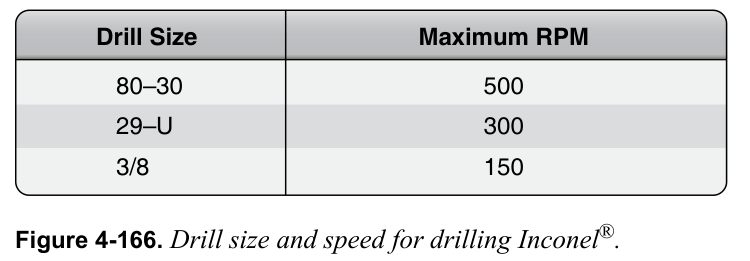
Hand drilling: use a 135° cobalt drill bit, push hard at a constant chip rate (about 50 lb for a No. 30 hole), at the RPM in the chart below; cutting fluid is not necessary by hand. Autofeed drilling equipment is preferred; drill pilot holes in loose repair parts with power feed, preassemble, then drill the pilot holes in the mating structure and enlarge them to size (AMT Handbook, p. 4-82).
Limits — when NOT to use this
- Heat-treated design values. They do not apply after welding or hot work without the correct treatment.
- The engine or airframe manual governs repairs.
Where to buy
Distributors coming soon.
Sources
- MIL-HDBK-5J, Metallic Materials and Elements for Aerospace Vehicle Structures (31 Jan 2003) — par. 6.3.5.0 and Table 6.3.5.0(b), p. 6-52. Cancelled; superseded by MMPDS.
- FAA-H-8083-31B, Aviation Maintenance Technician Handbook, Airframe, Volume 1 — Working Inconel Alloys 625 and 718, p. 4-82, Figure 4-166.
- MMPDS (formerly MIL-HDBK-5) — the current home of design allowables. A repair substantiation cites MMPDS or the SRM, not a website.
- Special Metals, Inconel alloy 718 — Limiting chemical composition.