Key facts
Where to buy| Property | Value | Source |
|---|---|---|
| Density | 0.101 lb/in³ (2.80 g/cm³) | MIL-HDBK-5J; Teal Sheets |
| Brinell hardness, O / T6 | 45 / 135 | AC 43.13-1B Table 4-5 |
| Arc / spot welding, T6 | B / B | MIL-HDBK-5J Table 3.1.3.4(a) |
| Arc / spot welding, O | C / D | MIL-HDBK-5J Table 3.1.3.4(a) |
| Stress corrosion, 2014-T6 | ST: D in all forms | MIL-HDBK-5J Table 3.1.2.3.1(a) |
A D rating means failures have occurred in service or would be expected under any sustained stress.
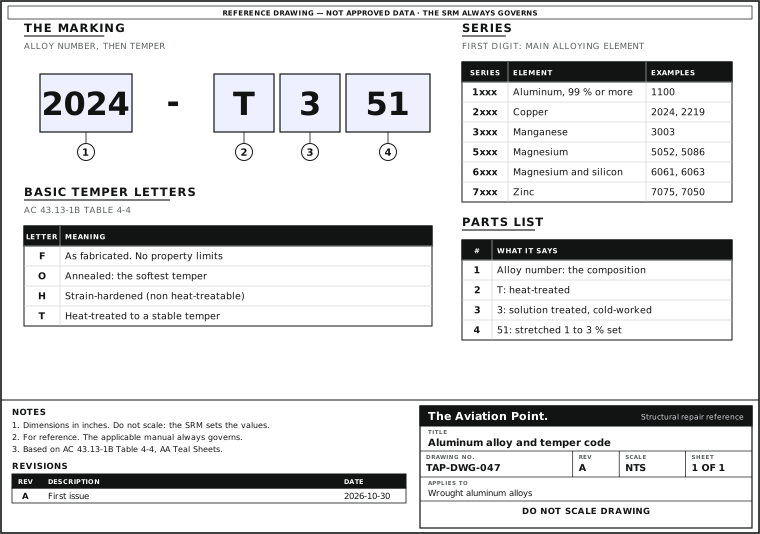
Reading the alloy and temper code
Composition limits, weight percent
| Element | Limit |
|---|---|
| Si | 0.50–1.2 |
| Fe | 0.7 |
| Cu | 3.9–5.0 |
| Mn | 0.40–1.2 |
| Mg | 0.20–0.8 |
| Cr | 0.10 |
| Zn | 0.25 |
| Ti | 0.15 |
| Al | Remainder |
A single number is a maximum. Other elements: 0.05 each, 0.15 total, except where the Teal Sheets say otherwise. Source: Aluminum Association Teal Sheets (Aug 2018).
Design allowables, 2014-T6 sheet, bare and clad, 0.040–0.249 in
| Property, ksi | Bare A | Bare B | Clad A | Clad B |
|---|---|---|---|---|
| Ftu, L | 67 | 68 | 65 | 67 |
| Ftu, LT | 66 | 67 | 64 | 66 |
| Fty, L | 59 | 60 | 57 | 59 |
| Fty, LT | 58 | 59 | 56 | 58 |
| Fcy, L | 59 | 60 | 57 | 59 |
| Fcy, LT | 60 | 61 | 58 | 60 |
| Fsu | 40 | 41 | 39 | 40 |
| Fbru, e/D = 1.5 | 100 | 102 | 97 | 100 |
| Fbru, e/D = 2.0 | 127 | 129 | 123 | 127 |
| Fbry, e/D = 1.5 | 83 | 84 | 80 | 83 |
| Fbry, e/D = 2.0 | 94 | 96 | 91 | 94 |
Bare: AMS 4028, Table 3.2.1.0(b1), p. 3-28. Clad: AMS-QQ-A-250/3, Table 3.2.1.0(c1), p. 3-30. S, A and B are the MIL-HDBK-5J statistical bases. L is the longitudinal grain direction, LT the long transverse. Bearing values are dry-pin values.
Where it is used
The AMT Handbook lists 2014 for heavy-duty forgings, plate, extrusions for aircraft fittings, wheels and major structural components, and for service at raised temperatures (p. 4-30).
Clad 2014-T6 sheet appears in the AC's splice tables (Table 4-9). The bend radius tables used here do not list 2014: the radius comes from the drawing or SRM.
Specifications and product forms
| Specification | Form |
|---|---|
| AMS 4028, AMS 4029 | Bare sheet and plate |
| AMS-QQ-A-250/3 | Clad sheet and plate |
| AMS 4121, AMS-QQ-A-225/4 | Bar and rod |
| AMS 4153, AMS-QQ-A-200/2 | Extrusion |
| AMS-A-22771, AMS-QQ-A-367, AMS 4133 | Forging |
Specifications as listed by MIL-HDBK-5J. Federal QQ-A specifications passed to SAE as AMS-QQ-A. Check the current revision.
Questions people actually ask
Is 2014 stronger than 2024?
In yield, in T6 sheet, yes: 59 ksi against 47 ksi for 2024-T3 (A basis, L, 0.040–0.128 in). Toughness and corrosion are different questions.
Should extrusion properties use the final machined thickness?
No. MIL-HDBK-5J says to use the thickness at the time of quenching: the machined thickness can be unconservative.
Limits — when NOT to use this
- Not a source of design allowables. Values are for reference. MMPDS and the SRM govern a repair.
- Not a substitution approval. A different alloy or temper needs approved data.
- Not for sustained tension across the grain. See the D rating above.
Where to buy
Distributors coming soon.
Sources
- FAA AC 43.13-1B CHG 1, Chapters 4 and 7 — Tables 4-5, 4-9.
- FAA-H-8083-31B, AMT Handbook — Airframe, Volume 1, Chapter 4 — p. 4-30.
- MIL-HDBK-5J (31 Jan 2003), Chapter 3 — Tables 3.1.2.3.1(a), 3.1.3.4(a), 3.2.1.0(a), (b1), (c1). Cancelled and superseded by MMPDS: check current MMPDS before design use.
- Aluminum Association, International Alloy Designations (Teal Sheets), rev. Aug 2018 — chemical composition limits and nominal densities.
- MMPDS (formerly MIL-HDBK-5) — the current home of design allowables. A repair substantiation cites MMPDS or the SRM, not a website.