Reading the stock, view by view
Where to buy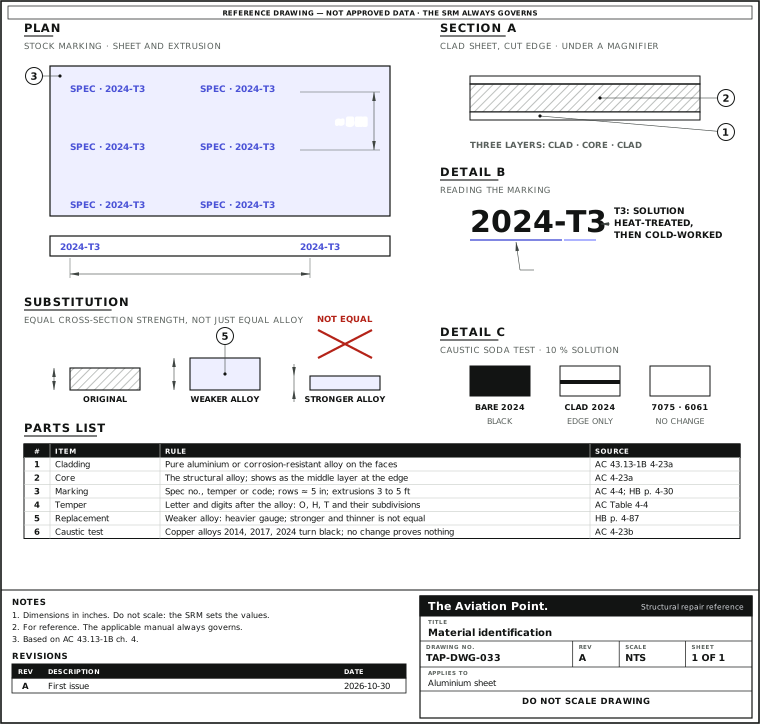
Identify the sheet, one step at a time
| Step | Action | What to do |
|---|---|---|
| 1 | Read the marking | Look for the specification number, the temper or the commercial code. |
| 2 | Keep the mark | Cut your part from the marked area, or copy the mark onto it before you cut. |
| 3 | Check clad or bare | Look at the cut edge under a magnifier. Clad sheet shows three layers. |
| 4 | If the mark is gone | Tests give hints. Only chemical or spectro-analysis settles it. |
| 5 | Check the SRM | It names the permitted alloy and any substitute. |
Read the marking first
Proper identification of the structural material is the first step in not making an improper repair with the wrong one (AC 43.13-1B par. 4-1).
What is stamped. Aluminium stock carries a government specification number, the temper, or a commercial code. Sheet and plate are marked in rows about 5 in apart. Tube, bar, rod and extrusions are marked every 3 to 5 ft along the length (AC par. 4-4; Handbook p. 4-30). Cut your part from the marked area, or copy the mark onto it before you cut.
The code is a number for the alloy composition; the letters after it give the temper. In 2024-T3, 2024 is the alloy and T3 means solution heat-treated, then cold-worked (AC Table 4-4).
The tempers you will see
| Mark | Meaning |
|---|---|
| -O | Annealed, the softest temper |
| -H1x, H3x | Strain-hardened (H1 only; H3 and then stabilised); the digit after gives the hardness, such as H14 half-hard |
| -T3 | Solution heat-treated and cold-worked by flattening or straightening |
| -T4 | Solution heat-treated |
| -T6 | Solution heat-treated and artificially aged |
| -T351, -T651 | Heat-treated and stress-relieved by stretching 1 to 3 percent (T651 also aged) |
| -F | As fabricated; no mechanical-property limits |
AC 43.13-1B Table 4-4 (p. 4-4). The table lists every subdivision; these are the usual ones. See the temper chart.
Clad or bare
Clad sheet has faces of pure aluminium or a corrosion-resistant alloy bonded to the core. At the cut edge, under a magnifier, it shows three layers (AC par. 4-23a). Alclad is the trade name (Handbook p. 4-30).
Replace like with like. For the best corrosion resistance use clad sheet to repair clad sheet (AC par. 3-10). Do not sand the cladding away to blend a scratch: the damage guides cover it.
Caustic soda test when the mark is gone: a sample in a 10 percent sodium hydroxide solution turns black if it is a high-copper heat-treatable alloy (2014, 2017, 2024). Clad copper alloys stay bright on the face but blacken at the exposed core of the edge. No change proves nothing: 6061 and 7075 are heat-treatable without turning black, and only chemical or spectro-analysis settles it (AC par. 4-23b).
Hardness separates annealed, cold-worked, heat-treated and heat-treated-and-aged material. It says little about strength or the quality of the heat treatment (AC par. 4-23).
Quick check
You test a sample in caustic soda and nothing changes. What does that tell you?
- It is 6061
Not this one. 6061 stays unchanged, but so does 7075.
- It is 7075
Not this one. 7075 stays unchanged, but so does 6061.
- Nothing yet
Best fit. No change proves nothing. Only chemical or spectro-analysis settles it.
On a real job, the SRM decides.
What the Handbook says each alloy is for
| Alloy | Typical use |
|---|---|
| 1100 | Weight economy and corrosion resistance where strength is unimportant: tanks, cowlings, wingtips |
| 3003 | Like 1100, stronger and harder |
| 2014 | Heavy forgings, plate, extrusions, fittings; high strength and hardness |
| 2024 | Structures, skins, rivets, hardware, fittings; clad or bare |
| 5052 | Workability, corrosion resistance, fatigue strength: fuel, hydraulic and oil lines |
| 6061 | Weldable; extruded and used for hydraulic and pneumatic tubing |
| 7075 | Stronger than 2024, lower fracture toughness; tension where fatigue is not critical. T6 avoided in corrosive surroundings; T7351 resists stress corrosion |
FAA-H-8083-31A pp. 4-30 to 4-31. Uses, not allowables: MMPDS or the SRM for strength values.
Substituting material
The material in a repair is similar to the original. If a weaker alloy must be used, use a heavier gauge to give equal cross-section strength. A stronger but thinner sheet is not an equal swap: one material may have more tensile and less compressive strength, and buckling and torsional strength depend mainly on thickness (Handbook p. 4-87).
Who decides. The SRM often says what may substitute and how much thicker; Fig. 4-168 of the Handbook shows such a table. A repair that substitutes material is a major repair under 14 CFR Part 43 Appendix A, so it needs approved data (14 CFR Part 43, Appendix A) (Handbook p. 4-94).
Fittings are replaced by parts of the same material specification (AC par. 4-60b). The sheet weight calculator shows what a thicker gauge adds in weight.
Mixed metals. Check the galvanic pairing of the new material with its neighbours in the galvanic calculator.
Questions people actually ask
Is clad 2024-T3 the same as bare 2024-T3?
Same core alloy and temper, but the clad version has a corrosion-resistant face. Use clad to repair clad. Tolerances and gauges are in the SRM.
The mark has worn off. Can I use it?
Not without identifying it. The caustic test only suggests a high-copper alloy; an unmarked sheet needs chemical or spectro-analysis, or it is scrapped for structure.
Can I use 7075-T6 for a 2024-T3 skin?
The sources do not give a swap. They say the alloys differ in toughness and corrosion behaviour, and the SRM states permitted substitutes.
Limits of this guide
What the sources support, and no further.
- No allowable, gauge or substitution pair is given. Those come from the SRM or MMPDS.
- Aluminium sheet only. Steel and titanium identification are not covered here.
- Typical tests only. Caustic soda and hardness give hints, not certificates.
Where to buy
Distributors coming soon.
Sources
- FAA AC 43.13-1B CHG 1, Chapter 4 — Par. 4-1, identification of structural material; par. 4-4, identification of aluminium (p. 4-2); Table 4-4, tempers (p. 4-4); par. 4-23, aluminium testing, clad and caustic soda tests; par. 4-60b, aluminium fittings. Chapter 3, par. 3-10, clad on clad.
- FAA-H-8083-31A, AMT Handbook — Airframe, Volume 1, Chapter 4 — pp. 4-30 to 4-31, aluminium alloys and marking; p. 4-87, material used in replacements, Fig. 4-168; p. 4-94, major repairs include substitution of material.