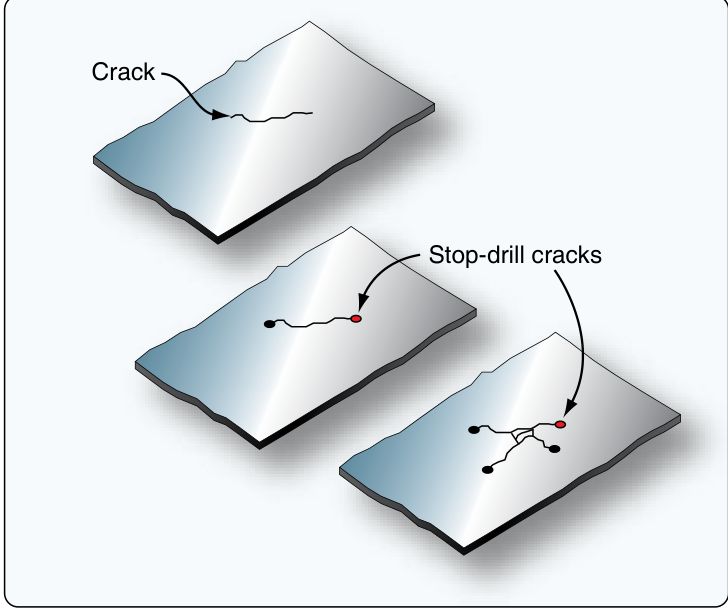
Stop hole, patch, flange and doubler
Where to buy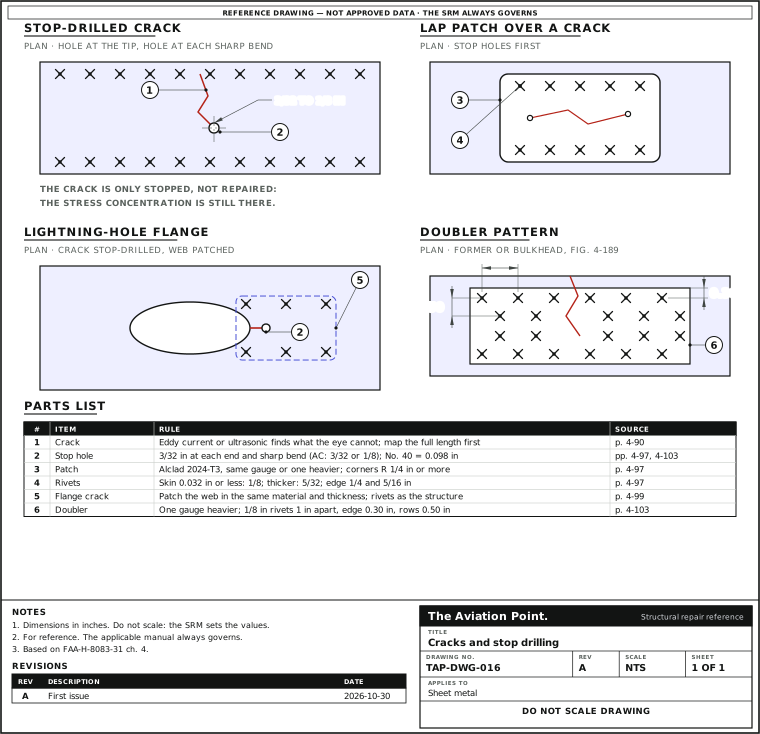
Deal with a crack, one step at a time
| Step | Action | What to do |
|---|---|---|
| 1 | Find the real end | A visual check cannot prove how far a crack in a major member runs. Eddy current and ultrasonic inspection find the end. |
| 2 | Check the neighbours | Small cracks often run away from rivet holes, so check beside every fastener in the row. |
| 3 | Stop-drill | Drill at the tip and at every sharp bend, using the size the SRM gives. |
| 4 | Look for the cause | Cracks come from a stress concentration plus repeated stress. A stop hole alone does not cure that. |
| 5 | Reinforce or replace | Apply the patch the case needs. A cracked fitting is replaced, not repaired. |
What each case needs
| Case | What to do | Source |
|---|---|---|
| Short crack inside the SRM negligible limit | Stop-drill; inspect often to see it has not spread | H 4-91 |
| Skin crack beyond it | Stop-drill each end and sharp bend, then a lap or flush patch | H 4-97 |
| Crack at a lightning-hole flange | Stop-drill or cut out the damage; web patch, same material and thickness | H 4-99 |
| Crack in a former or bulkhead | No. 40 stop holes; doubler one gauge heavier | H 4-103 |
| Cracked steel tube | Straighten, No. 40 stop holes at the ends, split-sleeve reinforcement | AC 4-91 |
| Cracked fitting | Replace it; do not repair a torn, kinked or cracked fitting | AC 4-60 |
H = FAA-H-8083-31 Vol. 1 page; AC = AC 43.13-1B paragraph. Limits for negligible cracks are in the SRM.
Quick check
A fitting has a crack in it. What does it need?
- A stop hole
Not this one. A stop hole does not make a cracked fitting sound.
- A lap patch
Not this one. Lap patches are for skin.
- A new fitting
Best fit. Replace it. Do not repair a torn, kinked or cracked fitting.
On a real job, the SRM decides.
Stop-drilling
Size. The AC says drill small holes 3/32 in (or 1/8 in) at the extreme ends of the crack. The Handbook's lap-patch figure uses 3/32 in at each sharp corner or end; its bulkhead and lightning-hole repairs use a No. 40 drill, which is 0.098 in. Check the numbers in the drill sizes chart. Use the size the SRM gives.
Where. At the tip, and at every sharp bend of the crack. A visual check cannot prove how far a crack in a major member runs: eddy current and ultrasonic inspection find the real end (H 4-90). Small cracks often run away from rivet holes, so check beside every fastener in the row.
Why it is not enough. Cracks come from a stress concentration plus repeated stress, such as vibration. The concentration may be the design, or a nick, scratch, tool mark or forming stress. More thickness alone helps but does not necessarily cure the cause, so the AC adds reinforcement to carry the stress across the crack (AC 4-59).
The patch that follows
Lap patch over a crack (Handbook fig. 4-174, p. 4-97): alclad 2024-T3, same gauge or one gauge heavier; corners radiused 1/4 in or more; edges chamfered 45 degrees for half the thickness and bent down 5 degrees over the edge distance. Rivets 1/8 in for material of 0.032 in or less, 5/32 in for thicker, with minimum edge distance 1/4 in and 5/16 in; the figure spaces them about 1 in apart in staggered rows 1/2 in apart. For the full patch, see the patches guide.
Bulkhead or former (p. 4-103): stop-drill with a No. 40, make a doubler one gauge thicker, sized for 1/8 in rivets 1 in apart, edge distance 0.30 in and 0.50 in between staggered rows; clamp, drill, rivet.
Lightning-hole flange (p. 4-99): the repair plate is the same material and thickness as the part, with the structure's rivets, edge distance at least 2D and spacing 4D to 6D. Count rivets with the rivet spacing and edge distance calculators.
Questions people actually ask
Is a stop hole a repair?
No. It stops the crack growing and is allowed as negligible damage only within the SRM limit, with frequent inspection (H 4-91). Beyond the limit the crack needs a patch or a new part.
3/32 in, 1/8 in or No. 40?
The AC allows 3/32 or 1/8 in; the Handbook figures show 3/32 in and No. 40 (0.098 in). Use what the SRM says for the part.
Do I stop-drill a crack in a fitting?
No. The AC says to replace torn, kinked or cracked fittings (4-60).
Does a thicker patch cure a cracking problem?
Not by itself. Find the stress concentration, and reinforce as the SRM shows (AC 4-59).
Limits of this guide
What the sources support, and no further.
- No crack length limit is given. How long a crack may be before it needs a patch is in the SRM, part by part.
- Pressurised skin and primary structure need the manufacturer's data.
- Hole position and size are from the Handbook and AC figures, which are typical only.
Where to buy
Distributors coming soon.
Sources
- FAA-H-8083-31, AMT Handbook — Airframe, Volume 1, Chapter 4 — p. 4-90, inspection; p. 4-91, negligible damage and fig. 4-170; p. 4-97, fig. 4-174 and lap patch; p. 4-99, lightning holes; p. 4-103, bulkhead crack and fig. 4-189.
- AC 43.13-1B with Change 1 — Acceptable Methods, Techniques, and Practices — Chapter 4: paragraph 4-59, repairing cracked members; 4-60, fittings; 4-91, tubular members.