The drawing
Where to buy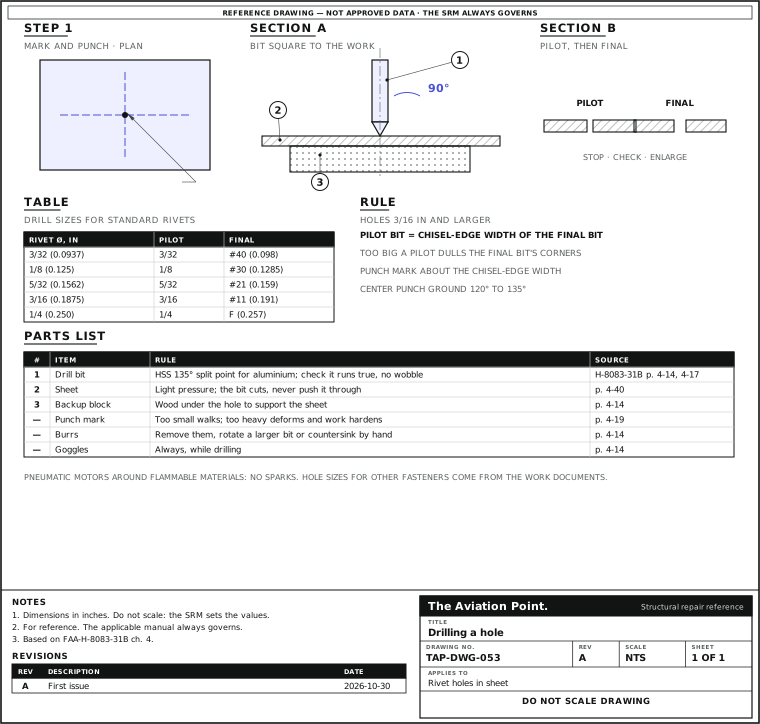
Step by step
| Step | Action | What to do |
|---|---|---|
| 1 | Lay out | Measure the location and mark with crossed lines. See sheet layout. |
| 2 | Punch | Sharp prick punch, then a center punch ground 120° to 135°, held perpendicular, one firm square blow. Put a bucking bar behind the sheet to avoid denting. The mark should be about the width of the bit's chisel edge. |
| 3 | Check the bit | Right size and shape. Run it free: a bit that wobbles makes oversize holes. |
| 4 | Support the sheet | Backup block of wood under the hole. Safety goggles on. |
| 5 | Mark with a small bit | 1/16 in recommended, to check and adjust the location. |
| 6 | Pilot | For holes 3/16 in and larger, pilot with a bit about the chisel-edge width of the final bit. For rivets, the Handbook gives the pilot and final sizes in the table. |
| 7 | Start the hole | Point on the mark, perpendicular, light pressure, slowly. After a few turns check it. If it has drifted, walk it back by leaning the drill the way it should go, turning intermittently. |
| 8 | Enlarge to final | Hold 90° going in and coming out. Avoid excessive pressure. Then deburr and clear the chips. |
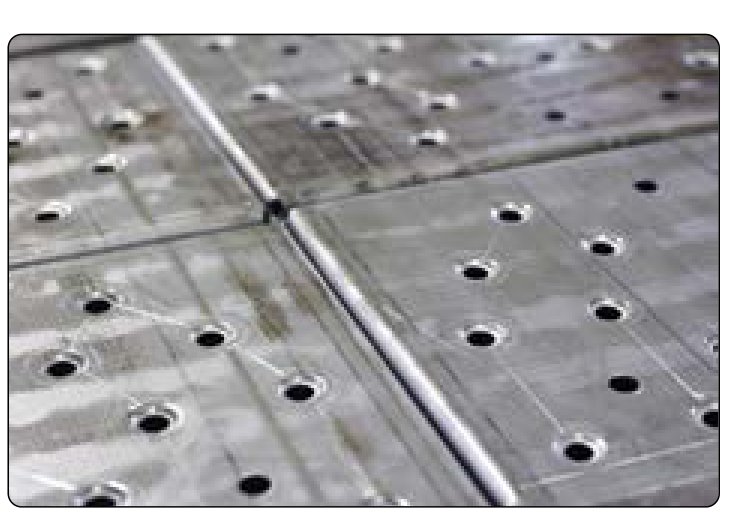
Tools you need
| Tool | What for | Buying guide | Catalog |
|---|---|---|---|
| Drill motor | Pneumatic near flammable materials | Drills guide | Sioux 90° drill |
| Drill bits | HSS 135° split point for aluminium; cobalt for titanium and CRES | Drill bits | Cobalt bits |
| Center punch | Stops the bit walking | Layout tools | — |
| Drill stop | Protects what is behind the sheet | Drill bits | Drill stops |
| Lubricant | Not needed for sheet; for deep drilling, castings and heavy stock | — | BoeLube |
Drill sizes for standard rivets
| Rivet Ø, in | Pilot | Final |
|---|---|---|
| 3/32 (0.0937) | 3/32 | #40 (0.098) |
| 1/8 (0.125) | 1/8 | #30 (0.1285) |
| 5/32 (0.1562) | 5/32 | #21 (0.159) |
| 3/16 (0.1875) | 3/16 | #11 (0.191) |
| 1/4 (0.250) | 1/4 | F (0.257) |
FAA-H-8083-31B p. 4-39, Fig. 4-90. Some SRMs use other bits: their table governs. More in the drill size chart.
What to check when it is done
| Look at | Good | If not |
|---|---|---|
| Size | Rivet slides in easily, no slop | Too large: next size up, if the pattern allows |
| Shape | Round | Egg-shaped from tilting: same remedy |
| Position | On the layout | Off: check edge distance and pitch before going on |
| Edge of the hole | No burr, no scratches | Deburr; check for cracks |
| Behind the sheet | Nothing hit | Inspect what the bit reached |
Questions people actually ask
Do I need lubricant on sheet?
Normally no. The Handbook asks for it in deeper drilling, castings, forgings and heavy stock.
Why pilot first?
It makes the final size accurate. Too large a pilot, though, dulls the final bit and causes chatter.
Limits of this guide
What the sources support, and no further.
- The manual governs. Where the SRM, the drawing or the fastener maker says otherwise, follow them; this page explains general practice.
- Speeds are not here. Use the drill speed calculator or the tool maker's data.
Where to buy
AmericaDistributor coming soonOur partner for this region is on its way
EuropeDistributor coming soonOur partner for this region is on its way
OceaniaDistributor coming soonOur partner for this region is on its way
Distributors coming soon.
Sources
- FAA-H-8083-31B, Aviation Maintenance Technician Handbook: Airframe, Chapter 4 — p. 4-14, hole drilling; p. 4-17, bits and lubrication; pp. 4-19, 4-20, techniques, Fig. 4-52; pp. 4-39, 4-40, rivet holes, Fig. 4-90.
- FAA AC 43.13-1B CHG 1, Acceptable Methods, Techniques and Practices — par. 4-58, drill rivet holes round, straight and free from cracks.
Educational reference only. not approved data. Always consult the applicable SRM, AMM, or AC 43.13-1B and your certifying authority.