The rules
Where to buy| Rule | Detail | Source |
|---|---|---|
| Method | Double twist is the most common. Single wire is for small screws in a closely spaced closed pattern, electrical parts, and hard-to-reach places | H-30B p. 7-77 |
| Twists | Six to eight twists per inch of wire, pulled taut while installing | H-31 p. 2-53 |
| Pigtail | 1/4 to 1/2 in (three to six twists) at the end, bent back or under so it does not snag | H-30B p. 7-80 |
| New wire | Must be new for each application | H-30B p. 7-80 |
| Direction | All the pull on the wire must tend to tighten the nut; the loop around the head stays down | H-30B p. 7-80 |
| Tension | Tight, but not so tight that normal handling or vibration breaks it | H-30B p. 7-80 |
| How many in a run | Widely spaced bolts, double twist: maximum three in series. Closely spaced: as many as a 24 in length of wire will do | H-30B p. 7-77 |
| Torque first | Torque to the recommended value, align the holes; never over-torque or loosen a torqued nut to align the holes | H-30B p. 7-77 |
H-31 = FAA-H-8083-31B, Airframe Handbook; H-30B = FAA-H-8083-30B, General Handbook. The two handbooks give different twist counts: six to eight per inch for the twisted run, three to six twists for the pigtail.
Safety wire a pair of bolts
| Step | Action | What to do |
|---|---|---|
| 1 | Torque and align | Torque both bolts to the manual's value and check that the holes line up. |
| 2 | Thread the wire | New wire through the first bolt head hole, in the direction that tightens it. |
| 3 | Loop around the head | Wire around the head and across to the second bolt; the loop must stay down. |
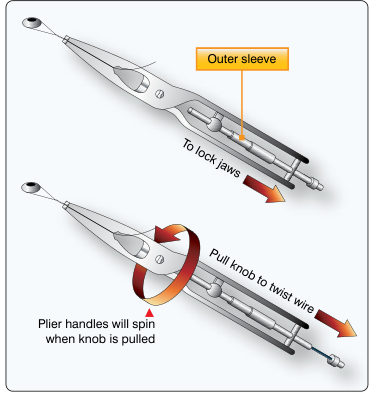
| 4 | Twist with the pliers | Lock the jaws on the wire, then pull the knob to twist: six to eight twists per inch. The pliers' handles spin when the knob is pulled. |
| 5 | Second bolt | Through the second hole so the pull again tightens the bolt. Keep the wire taut. |
| 6 | Pigtail | Finish with a pigtail of 1/4 to 1/2 in, three to six twists, bent back or under. |
| 7 | Check | Taut, no slack loops, pull toward tightening, no snag. |
Typical mistakes
| Mistake | What happens | Fix |
|---|---|---|
| Reusing wire | Fatigued wire breaks | New wire every time |
| Pull in the loosening direction | Wire lets the part turn | Route so the pull tightens |
| Slack loop over the head | Loop rides up, wire goes slack | Twist so the loop stays down |
| Too much tension | Wire breaks in handling or vibration | Taut, not over-twisted |
| Loosening a nut to align the hole | Wrong torque | Never; change parts or follow the manual instead |
| Safety wire on emergency equipment | Must break by hand | Single copper 0.020 in or aluminum 0.031 in wire (H-31 p. 2-53) |
Care
Keep the pliers' jaws clean and the knob mechanism moving freely; worn jaws slip on the wire. Cut off the wire ends neatly, and use diagonal cutters for the pigtail. Plier maintenance is the maker's.
Questions people actually ask
How many twists per inch?
Six to eight per inch of wire for the twisted run (H-31 p. 2-53). The pigtail at the end is 1/4 to 1/2 in, three to six twists (H-30B p. 7-80).
Can I reuse safety wire?
No. The wire must be new on each application (H-30B p. 7-80).
What wire size?
Wire diameter depends on the part and the method; use our safety wire calculator and chart, or the maintenance manual.
Limits of this guide
What the sources support, and no further.
- Not approved data. The maintenance manual may specify the method, wire and routing for a given component, especially for light sport aircraft.
- Wire sizes. No size table is reproduced here; see the safety wire chart.
Where to buy
Distributors coming soon.
Sources
- FAA-H-8083-30B, AMT Handbook: General (2023) — Ch. 7, pp. 7-77 to 7-80, "Safety Wiring", "General Safety Wiring Rules".
- FAA-H-8083-31B, AMT Handbook: Airframe (2023) — Ch. 2, pp. 2-52 to 2-53, safety wire pliers and twists per inch; Fig. 2-92.