Parts and capacity
Where to buy| Item | What it is | Why it matters |
|---|---|---|
| Hand, pneumatic, pneudraulic | Pressure from the hand, air, or air plus hydraulics | All three work on the same principle (H-31 p. 4-38) |
| C-yoke or alligator yoke | The frame carrying the jaws, in various sizes | Sets what can be reached |
| Gap | Distance between the movable and the stationary jaw | Must clear the rivet and the stack |
| Reach | Inside length of the throat, measured from the centre of the end sets | How far from an edge you can squeeze |
| End sets | Same job and heads as rivet sets for a gun, interchangeable | Match the rivet head; one in each jaw |
H-31 pp. 4-38 and 4-39.
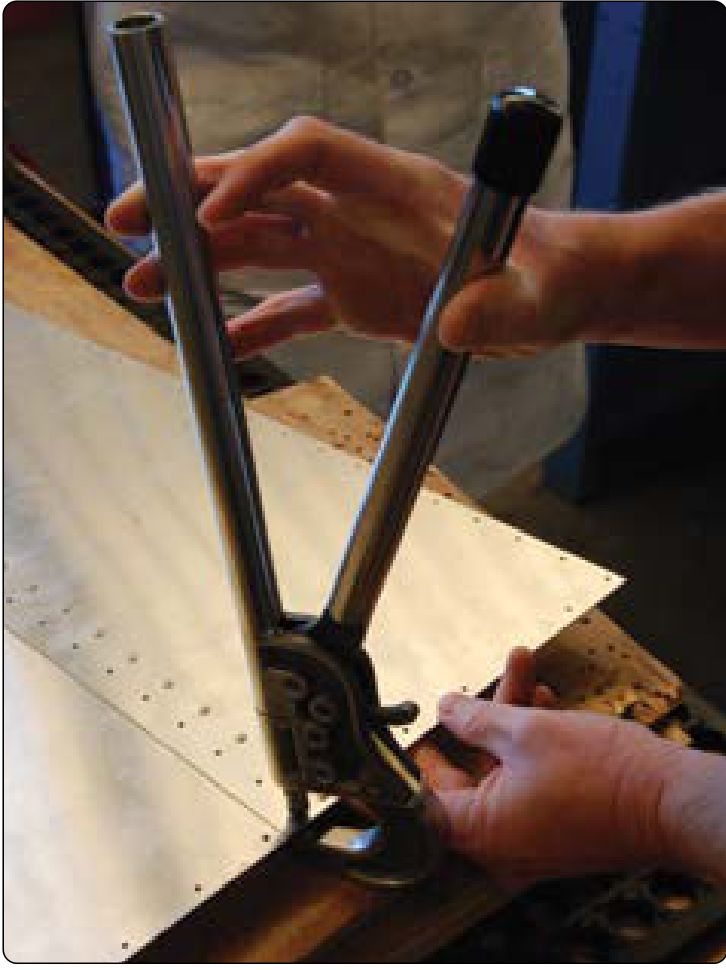
Squeeze a rivet
| Step | Action | What to do |
|---|---|---|
| 1 | Check the reach and gap | Measure how far the hole is from the edge and how thick the stack is. If the throat is too short, squeezing is not the method; use a gun and a bar. |
| 2 | Fit the end sets | One set goes in the stationary jaw, one in the movable jaw, each matching the rivet head type. |
| 3 | Manufactured head on the stationary jaw | Place the manufactured-head set on the stationary jaw whenever possible. If the job needs it, the sets can be reversed. |
| 4 | Seat the rivet and square the jaws | Hole lined up, parts clamped, rivet in, jaws square to the sheet. |
| 5 | Squeeze | Close the jaws until the head is formed. |
| 6 | Inspect | No rotation, no looseness; the head seated snugly (a 0.005 in feeler gauge must not pass under more than half the head circumference, p. 4-40). |
Where squeezing works
The Handbook calls compression riveting of limited value: it can only be used over the edges of sheets or assemblies where conditions permit and the reach of the squeezer is deep enough (p. 4-38).
Dies in a squeezer for dimpling must be adjusted accurately to the thickness of the sheet (p. 4-41).
Typical mistakes
| Mistake | What happens | Fix |
|---|---|---|
| Reach too short | Cannot get over the hole | Use a gun and bar, or a longer yoke |
| End set does not match the head | A marked or deformed head | Fit the right set |
| Manufactured head on the moving jaw | Marks on the finished side, when avoidable | Put it on the stationary jaw when possible |
| Dimpling die not matched to the sheet | Poor dimple | Adjust the gap to the sheet thickness |
Care
Keep the end sets clean and undamaged. For adjustment, lubrication and maintenance of pneumatic and pneudraulic types, follow the maker's manual; the Handbook gives none.
Questions people actually ask
Squeezer or rivet gun?
A squeezer is fast and needs one person, but only over edges where the throat reaches. Anywhere else, use a gun and a bucking bar (p. 4-38).
Which jaw takes the manufactured head?
The stationary jaw, whenever possible. Reverse the sets only if the operation needs it (p. 4-39).
Limits of this guide
What the sources support, and no further.
- Not approved data. The SRM or drawing governs riveting method.
- No force or gap figures. The sources give none; use the maker's data.
Where to buy
Distributors coming soon.
Sources
- FAA-H-8083-31B, AMT Handbook: Airframe (2023), Chapter 4 — pp. 4-38 to 4-39, "Compression Riveting"; p. 4-40, rivet inspection; p. 4-41, dimpling dies in squeezers; Fig. 4-93.