Image coming soonDogleg hole deburring tool
Which tool
Where to buy| Tool | Use | Source |
|---|---|---|
| Burring tool | Removes a burr from an edge of a sheet or from a hole | H-31 p. 4-14 |
| Bearing scraper | Removes the burr round a drilled hole | p. 4-14 |
| Metal countersink | Removes burrs round a hole; rotate by hand | pp. 4-14, 4-40 |
| Drill bit larger than the hole | Same job; rotate by hand | pp. 4-14, 4-40 |
| Deburring tool or oversize drill | AC 43.13-1B wants rivet holes deburred this way | AC par. 4-58 |
| File | Removes rough edges and slivers from a finished part | p. 4-13 |
| Step drill | Can deburr holes left by other bits | p. 4-17 |
H-31 = FAA-H-8083-31B, Airframe Handbook, Chapter 4.
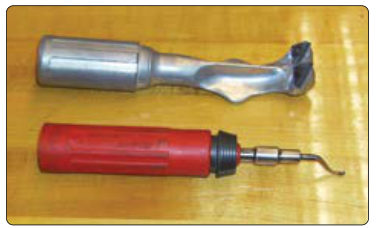
Deburr a drilled hole
| Step | Action | What to do |
|---|---|---|
| 1 | Look for the burr | Burrs form round the edge of the hole, especially with a hand drill, where slow speed and heavy pressure per turn make bigger burrs. |
| 2 | Remove them with the tool | Use the burring tool, a bearing scraper, a countersink or a bit larger than the hole. Rotate bit or countersink by hand. |
| 3 | Both sides | Take the burr off the drill entry and the exit side. Separate the sheets if the burr is between them. |
| 4 | Clean away the chips | Chips left between sheets stop the parts seating and score the surface. |
| 5 | Check | The rivet must fit snugly and not be scratched as it goes in. |
Typical mistakes
| Mistake | What happens | Fix |
|---|---|---|
| Leaving the burr | Rivets do not seat; scratched rivet and sheet | Remove burrs before riveting |
| Deburring with a power drill | Enlarged or damaged hole | Turn the bit or countersink by hand |
| Over-deburring | Takes the hole out of round, or a knife edge | Light touch; just break the burr |
| Chips left between sheets | Parts do not seat | Separate, clean, reassemble |
Care
Keep blades sharp and replace worn ones; a dull tool tears the burr instead of cutting it. File teeth are cleaned with a file card, and files stored apart so the teeth are protected (H-31 p. 4-13).
Questions people actually ask
Why remove burrs before riveting?
So the rivet fits snugly and is not scratched; burrs also keep sheets from seating (H-31 p. 4-14).
Can I use a bigger drill bit to deburr?
Yes: a drill bit larger than the hole, turned by hand, is one of the methods the Handbook names (p. 4-14).
Limits of this guide
What the sources support, and no further.
- Not approved data. A deburring tool that takes away material from a countersink or hole may exceed the SRM's limits; check.
- No depth figure. The sources do not limit how much to remove; the aim is only to break the burr.
Where to buy
AmericaDistributor coming soonOur partner for this region is on its way
EuropeDistributor coming soonOur partner for this region is on its way
OceaniaDistributor coming soonOur partner for this region is on its way
Distributors coming soon.
Sources
- FAA-H-8083-31B, AMT Handbook: Airframe (2023), Chapter 4 — pp. 4-13 to 4-14, "Burring Tool", "Portable Power Drills"; p. 4-17; pp. 4-39 to 4-40; Fig. 4-38.
- FAA AC 43.13-1B CHG 1, Acceptable Methods, Techniques and Practices — par. 4-58, p. 4-12: deburr the hole with an oversize drill or deburring tool.
Educational reference only. not approved data. Always consult the applicable SRM, AMM, or AC 43.13-1B and your certifying authority.