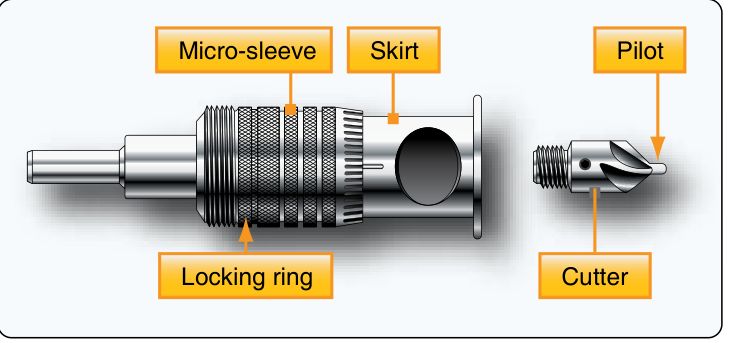
Parts and what they do
Where to buy| Part | What it does | Source |
|---|---|---|
| Cutter | Cuts the cone: the standard angle is 100 degrees; 82 or 120 degrees are sometimes used | H-31 p. 4-41 |
| Pilot | Keeps the cutter centred in the hole; about 0.002 in smaller than the hole | p. 4-41 |
| Cage (micro-sleeve) | Adjustable sleeve that limits depth and holds the cutter vertical | p. 4-41 |
| Depth scale | Some cages adjust in 0.001 in increments | p. 4-36 |
| Flutes | Six flutes work best in aluminum. Three and four flutes chatter more. A single flute suits corrosion-resistant steel | p. 4-41 |
H-31 = FAA-H-8083-31B, Airframe Handbook, Chapter 4.
Set up and cut
| Step | Action | What to do |
|---|---|---|
| 1 | Pick the cutter | Angle to match the rivet head (100 degrees for standard flush rivets), six flutes for aluminum, a pilot about 0.002 in under the hole. |
| 2 | Set the depth on scrap | Adjust the micro-sleeve on a piece of the same material first, not on the repair part. Cut only deep enough for the rivet head and the metal to form a flush surface. |
| 3 | Check the fit | Put the rivet in the test countersink. Adjust and cut again until it sits flush. |
| 4 | Cut the part | Drill square to the sheet. Slow speed, steady firm pressure. |
| 5 | Check the depth against the sheet | In primary structure and pressurized skin, some manufacturers limit depth to 2/3 of the outer sheet thickness, or down to a 0.020 in minimum shank depth, whichever is greater. If the skin is too thin, dimple instead. |
| 6 | Deburr and clean | Remove burrs and chips before riveting. |
If it chatters
| Fix | Why |
|---|---|
| Use sharp tooling | A dull cutter chatters |
| Slow speed and steady firm pressure | Less bounce |
| Piloted cutter, pilot about 0.002 in under the hole | Keeps the cutter centred |
| Back-up material behind thin sheet | Holds the pilot steady |
| A cutter with a different number of flutes | Changes the vibration |
| Pilot-drill small, countersink, then open to final size | Last-resort order of work |
H-31 p. 4-41. Chatter is the most common countersinking problem.
When not to countersink
Countersinking removes material, so countersunk joints need more fasteners than universal-head ones, and edge distance must be greater (p. 4-40). Below a certain sheet thickness you get a knife edge or an enlarged hole. The Handbook's answer is to dimple the skin if it is too thin to countersink.
Keep the rivet high before driving, so the force goes to the rivet and not to the skin (p. 4-40).
Questions people actually ask
What angle countersink for flush rivets?
The standard countersink has a 100 degree angle, matching a standard flush rivet head. 82 and 120 degree cutters exist for other heads (p. 4-41).
What is a cage for?
It sets the cutting depth and keeps the cutter vertical, so every hole is the same and square to the sheet (p. 4-41).
Can I freehand it?
Only where a microstop will not fit. Practise on scrap; holding the drill steady and square matters as much as for drilling (p. 4-41).
Limits of this guide
What the sources support, and no further.
- Not approved data. The SRM or drawing sets countersink depth, angle and minimum sheet thickness.
- Depth rule. The 2/3 and 0.020 in figures are quoted as some manufacturers' current recommendation in the Handbook, not a universal rule (p. 4-40).
Where to buy
Distributors coming soon.
Sources
- FAA-H-8083-31B, AMT Handbook: Airframe (2023), Chapter 4 — pp. 4-36, 4-40 to 4-41, "Countersinking Tool", "Countersinking", "Countersinking Tools"; Figs. 4-84, 4-85.