Which tool for which hole
Where to buy| Tool | Use | Source |
|---|---|---|
| Pilot, then larger drill | Standard method for holes larger than 3/16 in: pilot with a No. 40 or No. 30, then oversize | H-31 p. 4-16 |
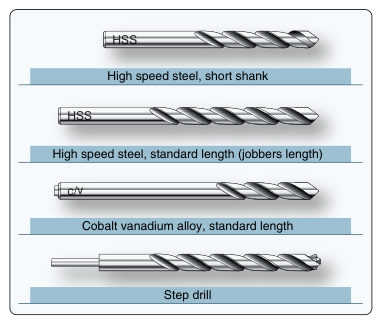
| Step drill | A smaller pilot point drills the first hole; the next step enlarges it to size. Works in most metals, plastic and wood, best in soft materials, usable on very thin sheet metal; can also deburr | pp. 4-16 to 4-17 |
| Hole saw | Named for cutting lightening holes | p. 4-81 |
| Punch | Lightening holes | p. 4-81 |
| Fly cutter | Lightening holes; for composites, only in a drill press | pp. 4-81, 7-50 |
H-31 = FAA-H-8083-31B, Airframe Handbook. The Handbook gives no procedure for a hole saw in structural metal.
Open up a hole with a step drill
| Step | Action | What to do |
|---|---|---|
| 1 | Mark and punch | Centre punch the location, backing the sheet. |
| 2 | Clamp and back up | Hold the sheet and put a block of wood under it. |
| 3 | Start with the pilot point | The smaller pilot point drills the initial hole; keep the drill square to the sheet. |
| 4 | Advance to the next step | Advance until the next step opens the hole to the size you want. Stop on the step for the size you want. |
| 5 | Deburr | Remove burrs on both sides. The step drill can deburr a hole left by another bit. |
| 6 | Check | Hole round and the right size, chips cleaned out. |
Hole saws and lightening holes
Lightening holes are cut in ribs, frames and other parts to save weight, and they are flanged to restore stiffness. The Handbook says they may be cut with a hole saw, a punch or a fly cutter, with the edges filed smooth to prevent cracking or tearing (p. 4-81).
They are never to be cut in a structural part unless authorized. Size and the flange width come from the design specification (p. 4-81).
Typical mistakes
| Mistake | What happens | Fix |
|---|---|---|
| Step drill in hard or thick metal | Poor hole, damaged tool | The Handbook rates it for softer materials and very thin sheet |
| No pilot for a big bit | Walks, tears the sheet | Pilot first, then enlarge |
| Unclamped sheet | Sheet spins on the tool | Clamp, with backup |
| Sharp edges left in a lightening hole | Cracks and tears start there | File the edge smooth |
Care
Keep step drills and saws clean and sharp. Sharpening data and speeds are the maker's; the Handbook gives none for these tools.
Questions people actually ask
What size pilot for a larger hole?
A No. 40 or No. 30 pilot for holes larger than 3/16 in in sheet metal, then enlarge (p. 4-16).
Can I cut a lightening hole in a rib?
Only if the repair data authorizes it. The Handbook says lightening holes are never cut in a structural part unless authorized (p. 4-81).
Limits of this guide
What the sources support, and no further.
- Not approved data. The SRM or drawing says whether a hole may be made, and its size.
- No hole saw procedure. The FAA handbooks name the hole saw but do not describe its use in structural metal, so none is given.
Where to buy
Distributors coming soon.
Sources
- FAA-H-8083-31B, AMT Handbook: Airframe (2023), Chapter 4 — p. 4-16 to 4-17, "Step Drill Bits"; p. 4-81, "Repair of Lightening Holes"; Fig. 4-45.
- FAA-H-8083-31B, AMT Handbook: Airframe (2023) — Ch. 7, p. 7-50: fly cutters for composites, drill press only.