The three types
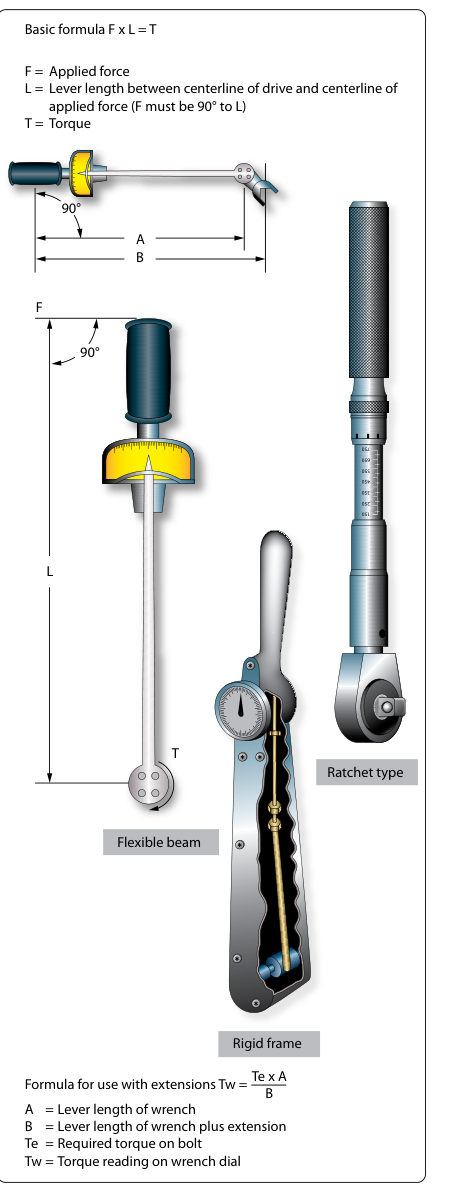
Where to buy| Type (Chapter 11 name) | Also called (Chapter 7) | How it works |
|---|---|---|
| Deflecting beam | Flexible beam | Read the torque on a dial or scale on the handle |
| Dial indicating | Rigid frame | Read the torque on a dial or scale on the handle |
| Micrometer setting (click) | Ratchet type | Preset the torque; at that value the handle breaks away with a click and free travel |
H-30B pp. 7-49 and 11-6. The two chapters use different names for the same three wrench types.
Torque a nut
| Step | Action | What to do |
|---|---|---|
| 1 | Check the wrench | Look for a bent pointer, cracked glass, or signs of rough handling. If found, the wrench must be tested before use. Check the calibration is in date. |
| 2 | Clean and dry threads | Threads clean and dry, unless the maker says otherwise. Do not lubricate except for corrosion-resistant parts or where told. |
| 3 | Run the nut down and read friction drag | Run the nut down near contact with the washer, check the friction drag torque needed to turn it. |
| 4 | Set the final value | Add the friction drag to the torque you want; that is the final torque to set or read on a click wrench. |
| 5 | Pull smoothly | Apply a smooth even pull. On a click wrench set the handle, relock the grip, pull steadily until it breaks. A fast or jerky pull gives a wrong torque. |
| 6 | Apply to the nut | Torque the nut, not the bolt, wherever possible. If the head must turn, go to the high side of the range without exceeding the maximum. |
| 7 | Castle nuts | Start aligning the cotter pin hole at the minimum torque plus friction drag. Do not exceed the maximum; if the holes do not line up, change the washer or nut and try again. |
Typical mistakes
| Mistake | What happens | Fix |
|---|---|---|
| Jerky pull | Wrong torque | Smooth, steady pull |
| Using an extension without the formula | Wrong torque at the bolt | Use Tw = Te x A / B |
| Torque on the bolt head, not the nut | More friction, more bolt wear | Turn the nut when you can |
| Forcing a castle nut to align | Overtorque | Do not exceed the maximum; change washer or nut |
| Wrench dropped or abused | Reading may be off | Test it before use |
| Wrench size confused with bolt size | Wrong value | Torque is for the bolt shank size, not the wrench size (AC 43.13-1B) |
Care and calibration
A torque wrench is a precision tool and should be treated like a delicate measuring instrument. The sources do not agree on the calibration interval: AC 43.13-1B says at least once a year or after abuse or a drop; FAA-H-8083-30B Chapter 7 says at least once a month; Chapter 11 says some makers suggest 6 months and others 12. Follow your maintenance programme and the wrench maker.
Store and handle it as the maker advises; the sources give no storage rules.
Questions people actually ask
How often must I calibrate a torque wrench?
The sources differ: AC 43.13-1B says once a year or after abuse; H-30B Chapter 7 says at least monthly; Chapter 11 says 6 or 12 months depending on the maker. Follow your approved maintenance programme.
Do I need the formula with a crowfoot?
Yes. Any drive-end extension or adapter that changes the effective length changes the dial reading, so the formula is mandatory (H-30B p. 7-49).
What torque do I use when none is given?
The standard torque table in the handbook, when the manual gives no value. See our torque chart.
Limits of this guide
What the sources support, and no further.
- Not approved data. The maintenance manual's torque value and method always govern.
- Calibration interval. Three different intervals appear in the FAA documents; none is chosen here.
- Torque values. No torque values are quoted on this page; use the manual or the torque chart.
Where to buy
Distributors coming soon.
Sources
- FAA-H-8083-30B, AMT Handbook: General (2023) — Ch. 7, pp. 7-49 to 7-51, "Torque Wrenches", "Torque Tables", Fig. 7-33; Ch. 11, pp. 11-5 to 11-6, Fig. 11-10.
- FAA AC 43.13-1B CHG 1, Acceptable Methods, Techniques and Practices — Chapter 7, pp. 7-6 to 7-7, torque procedures a to i, Fig. 7-2.