The drawing
Where to buy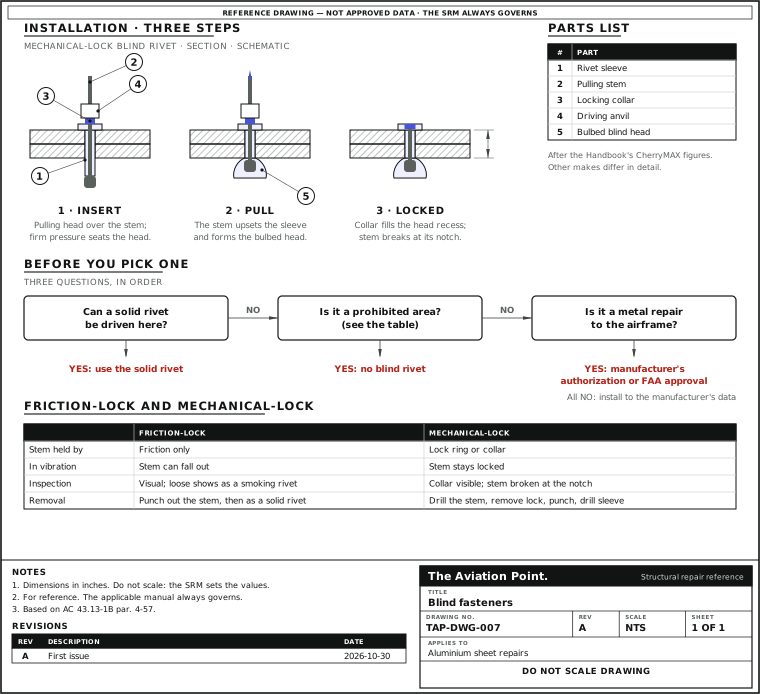
Step by step
| Step | Action | What to do |
|---|---|---|
| 1 | Check it is allowed | Blind rivets have limits on where they may replace solid rivets. See the guide. |
| 2 | Choose by grip | Length relates to the grip of the metal being joined. Work it out. |
| 3 | Prepare the hole | Size from the fastener data. Deburr. |
| 4 | Fit the tool | Pulling head for the diameter and head style. Find it. |
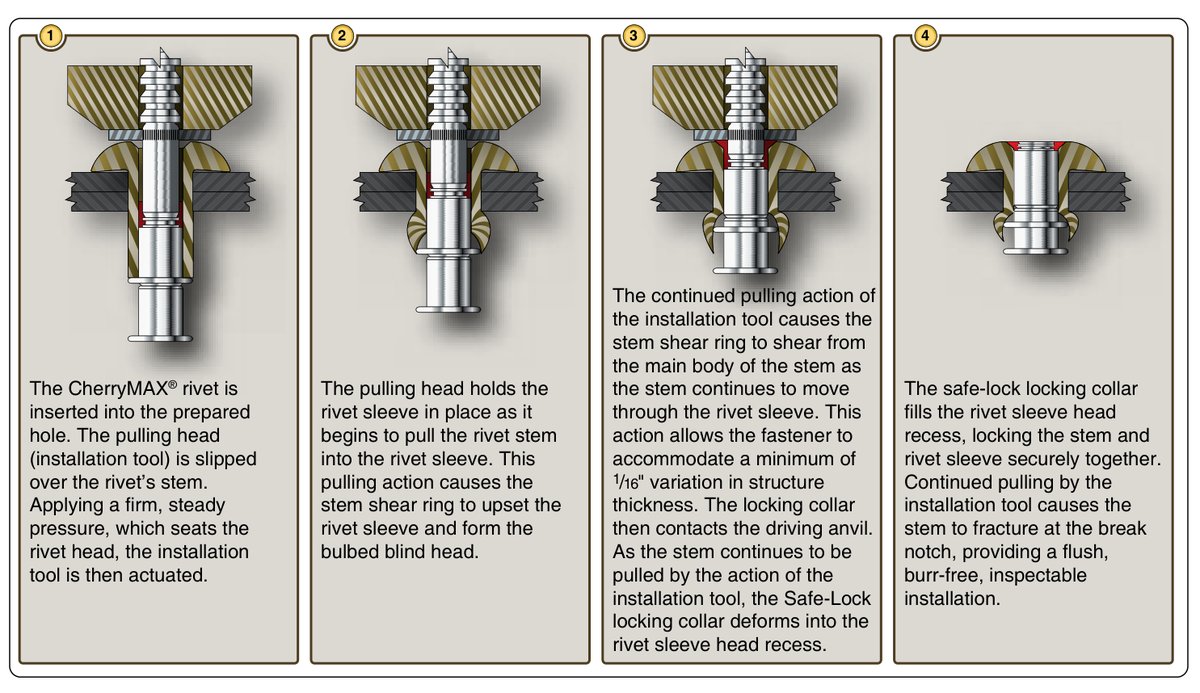
| 5 | Insert | Push in the rivet, slip the pulling head over the stem, firm steady pressure to seat the head, then actuate. |
| 6 | Pull | The sleeve is held in place while the stem shear ring upsets the sleeve into the bulbed blind head. The stem then shears the ring and takes up the grip. |
| 7 | Lock | The locking collar fills the recess in the head, and the stem fractures at the break notch. |
| 8 | Check | Head seated and lock visible. Do not file the stem. |
Tools you need
| Tool | What for | Buying guide | Catalog |
|---|---|---|---|
| Hand riveter | Field use | Blind fasteners | Hand riveter |
| Power tool | Production and CherryMAX | Blind fasteners | Gage Bilt GB704 |
| Rivets | CherryMAX | Blind fasteners | CherryMAX |
What to check when it is done
| Look at | Good | If not |
|---|---|---|
| Head | Tight: a 0.005 in feeler goes under for no more than half the circumference | Replace |
| Stem | Tight, no looseness | Looseness means an oversize hole: oversize shank rivet |
| Lock | Visible, flush | Replace |
| Stem end | Left rough; never filed | Filing weakens the lock ring; the stem could fall out |
Questions people actually ask
Can a CherryMAX replace a solid rivet?
Size for size is its main advantage, where the approved data allow it. See the guide.
Can I remove one?
Yes. Friction-lock: punch out the stem then treat it like any rivet. Mechanical-lock: see the Handbook p. 4-48 and the maker.
Limits of this guide
What the sources support, and no further.
- The manual governs. Where the SRM, the drawing or the fastener maker says otherwise, follow them; this page explains general practice.
- Tool and grip data are the maker's. Use the installation data for the part number.
Where to buy
AmericaDistributor coming soonOur partner for this region is on its way
EuropeDistributor coming soonOur partner for this region is on its way
OceaniaDistributor coming soonOur partner for this region is on its way
Distributors coming soon.
Sources
- FAA-H-8083-31B, Aviation Maintenance Technician Handbook: Airframe, Chapter 4 — pp. 4-47 to 4-49, blind rivets, Figs. 4-101 to 4-103; p. 4-40, stem and seating checks.
- FAA AC 43.13-1B CHG 1, Acceptable Methods, Techniques and Practices — par. 4-57f, blind rivets.
Educational reference only. not approved data. Always consult the applicable SRM, AMM, or AC 43.13-1B and your certifying authority.