Which drill motor
Where to buy| Type | Use | Note |
|---|---|---|
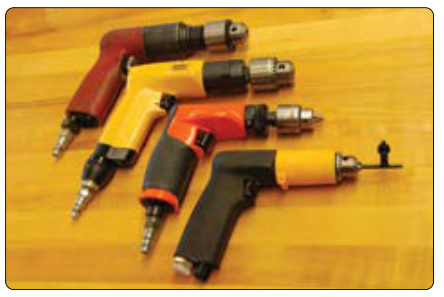
| Pneumatic pistol-grip | The most common motor for aircraft repair: light, enough power, good speed control | Most are rated 3,000 rpm; recommended around flammables because there are no sparks (H-31 p. 4-14) |
| Electric | Portable power drill | Spark hazard around flammable material (p. 4-14) |
| Right-angle and 45 degree | Where a pistol grip does not fit | Mostly threaded drill bits in several lengths (p. 4-14) |
| Two-hole drill | Nutplate holes | Drills both holes at once, so spacing is fixed (p. 4-15) |
| Drill press | Accuracy; clamp the part | Aluminum 200 to 300 sfm, mild steel 30 to 50 sfm; rpm = CS x 4 / D (p. 4-15) |
| Lower rpm, more torque motor | Deep holes, corrosion-resistant steel, titanium | p. 4-14 |
H-31 = FAA-H-8083-31B, Airframe Handbook, Chapter 4. CS is cutting speed in sfm; D is the drill diameter in inches.
Drill sizes for the standard solid rivets
| Rivet diameter | Pilot drill | Final drill |
|---|---|---|
| 3/32 | 3/32 (0.0937) | No. 40 (0.098) |
| 1/8 | 1/8 (0.125) | No. 30 (0.1285) |
| 5/32 | 5/32 (0.1562) | No. 21 (0.159) |
| 3/16 | 3/16 (0.1875) | No. 11 (0.191) |
| 1/4 | 1/4 (0.250) | F (0.257) |
H-31 Fig. 4-90 and pp. 4-39 to 4-40: the smallest size that lets the rivet in easily, about 0.003 in over the largest shank tolerance. Drill an undersized pilot first, then ream to size.
Drill a rivet hole
| Step | Action | What to do |
|---|---|---|
| 1 | Check the bit | Right size, right shape, and true. Run the motor free and watch the bit: a bit that wobbles or is slightly bent makes enlarged holes (p. 4-14). |
| 2 | Centre punch and back up | Punch every rivet location with a bucking bar behind the metal, so the sheet does not dent. Put a block of wood under the hole when drilling (p. 4-39). |
| 3 | Start the bit | Place it in the punch mark. With a power drill, rotate the bit a few turns before starting the motor (p. 4-40). |
| 4 | Drill at 90 degrees | Hold the motor firmly with both hands, square to the work or to the curvature of the sheet. Tilting while going in or coming out can make an egg-shaped hole (p. 4-14). |
| 5 | Do not push | Let the bit cut. Avoid excessive pressure and never push the bit through the stock. |
| 6 | Deburr and clean | Remove burrs with a metal countersink or a file, or a bit larger than the hole turned by hand. Clean away all chips (p. 4-40). |
Typical mistakes
| Mistake | What happens | Fix |
|---|---|---|
| Bent or wobbling bit | Oversize holes | Replace the bit |
| Tilting the drill | Elongated (egg-shaped) hole | Stay at 90 degrees through the whole stroke |
| Pushing hard | Bigger burrs, bit through the stock, damage behind | Light pressure; use a drill stop |
| No backup block | Burr and sheet distortion | Wood block under the hole |
| Extension bit too long or unsupported | Bit whips, hole is off | Shortest bit that works; support those under 1/4 in with a guard (p. 4-16) |
| Wrong bit for the metal | HSS wears fast in titanium or stainless; cobalt does not give a quality hole in aluminum | HSS 135 degree split point for aluminum; cobalt vanadium for titanium and stainless (pp. 4-16, 4-17) |
Care and lubrication
Drill stops. A spring drill stop, properly adjusted, prevents excessive penetration and keeps the chuck off the surface (p. 4-17).
Lubricant. Normal sheet-metal drilling needs none. Use one for deeper holes, castings, forgings and heavy stock. For aluminum, titanium and corrosion-resistant steel the Handbook prefers a cetyl alcohol based lubricant; for steel, sulfurized mineral cutting oil (p. 4-17). It aids chip removal; it does not stop overheating.
Safety. Wear goggles. Disconnect air when the motor is not in use. Clamp the part on a drill press: unclamped parts can bind and spin (p. 4-15).
Questions people actually ask
What rpm for drilling aluminum?
The Handbook gives cutting speed, not rpm: 200 to 300 sfm for aluminum alloy, 30 to 50 for mild steel. rpm = CS x 4 / D. Most pneumatic motors for sheet work are rated at 3,000 rpm (pp. 4-14, 4-15). Our drill speed calculator does the sum.
Do I need a pilot hole for a rivet?
The Handbook says to drill an undersized pilot first, then ream with a twist drill to final size. For holes larger than 3/16 in it suggests a No. 40 or No. 30 pilot (pp. 4-16, 4-39).
Why use a pneumatic motor?
It is light, has good speed control, and makes no sparks around fuel or other flammables (p. 4-14).
Limits of this guide
What the sources support, and no further.
- Not approved data. The SRM or drawing sets hole sizes, fits and limits. Do not drill or enlarge holes in primary structure without the repair data.
- Speeds. The cutting speeds are the Handbook's general range; use the bit maker's data for hard materials.
Where to buy
Distributors coming soon.
Sources
- FAA-H-8083-31B, AMT Handbook: Airframe (2023), Chapter 4 — pp. 4-14 to 4-17, "Hole Drilling" to "Drill Stops"; pp. 4-39 to 4-40, "Drilling"; Figs. 4-39, 4-90.
- FAA AC 43.13-1B CHG 1, Acceptable Methods, Techniques and Practices — par. 4-58, p. 4-12: drill rivet holes round, straight and free from cracks; deburr.