Image coming soonEdge marker block with scribe
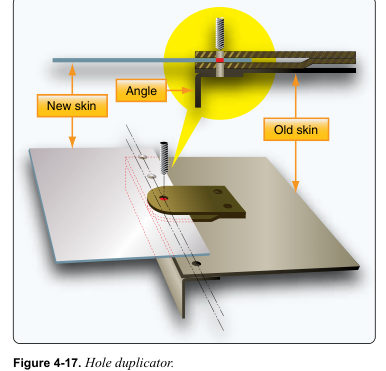
How it works
Where to buy| Part | Job |
|---|---|
| Bottom leg peg | Fits into the existing rivet hole |
| Top leg bushing | Guides the drill through the replacement sheet or patch |
| One per diameter | A separate duplicator must be used for each diameter of rivet |
H-31 p. 4-7. If the duplicator is properly made, holes drilled this way are in perfect alignment.
Transfer holes to a patch
| Step | Action | What to do |
|---|---|---|
| 1 | Position the patch | Cut and form the patch to fit; place it in its correct position. |
| 2 | Drill one hole and fasten | Drill one rivet hole, then fasten the plate temporarily (a cleco). |
| 3 | Find the second hole | Use the hole finder to locate the position of a second hole, drill it and fit a second fastener. |
| 4 | Do the rest | From the back side, through the original holes, locate and drill the remaining holes. |
| 5 | Deburr and protect | Remove burrs from the rivet holes and apply corrosion protection to the contacting surfaces before riveting. |
Typical mistakes
| Mistake | What happens | Fix |
|---|---|---|
| Wrong peg diameter | Slack fit, holes drift | One finder for each rivet diameter |
| Drilling the whole patch from the finder alone | Pattern creeps | Fasten with clecos after the first two holes |
| Matching old holes that are elongated | Copies the error | Check old holes; follow the repair data for the pattern |
| Skipping deburring and sealing | Corrosion and poor fit | Deburr and protect before riveting |
Care
Keep pegs and bushings clean and unworn: wear lets the drill wander. The Handbook gives no maintenance schedule.
Questions people actually ask
What is a hole duplicator?
It is the same tool as a hole finder: it uses the old covering as a template to locate and match existing holes in the structure (p. 4-7).
Do I need one per rivet size?
Yes. A separate duplicator must be used for each rivet diameter (p. 4-7).
Limits of this guide
What the sources support, and no further.
- Not approved data. The repair data gives rivet pattern, edge distance and pitch for a new patch; the finder only copies holes.
- Hole sizes. The tool does not choose the drill: see the drill size chart.
Where to buy
AmericaDistributor coming soonOur partner for this region is on its way
EuropeDistributor coming soonOur partner for this region is on its way
OceaniaDistributor coming soonOur partner for this region is on its way
Distributors coming soon.
Sources
- FAA-H-8083-31B, AMT Handbook: Airframe (2023), Chapter 4 — p. 4-7, "Hole Duplicator", Fig. 4-17; p. 4-100, patch repair using a hole finder.
Educational reference only. not approved data. Always consult the applicable SRM, AMM, or AC 43.13-1B and your certifying authority.