The drawing
Where to buy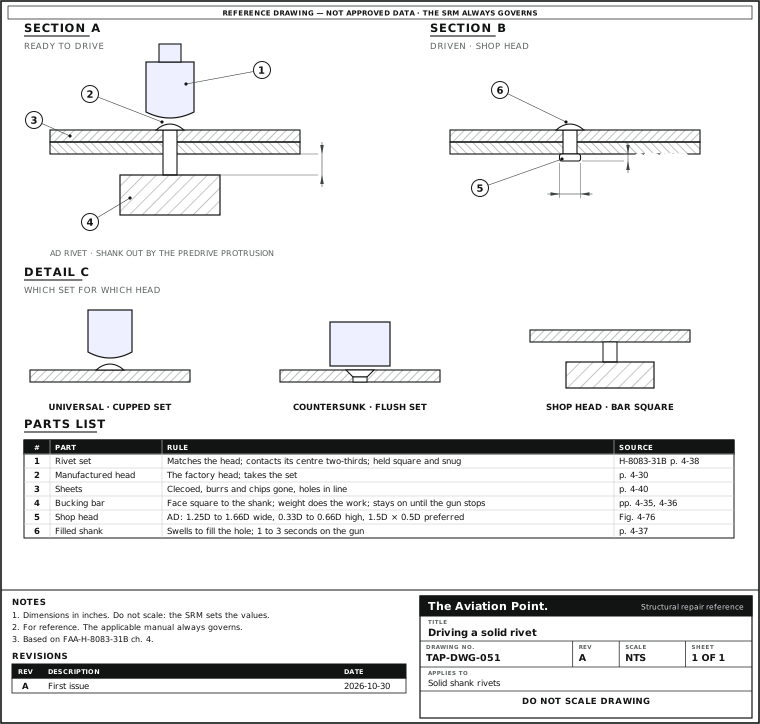
Step by step
| Step | Action | What to do |
|---|---|---|
| 1 | Choose the rivet | Same alloy, head and diameter as the drawing or the rivet you replaced. Length = grip + the shank that forms the head (A = B + C). Work it out here. |
| 2 | Drill and deburr | Smallest hole that takes the rivet easily, about 0.003 in over the largest shank tolerance: pilot, then final. Then take off every burr and shaving. See drilling and deburring. |
| 3 | Fasten the sheets | All holes in line, sheets held tight with clecos. Sheets that are not tight swell the shank between them. |
| 4 | Set up the gun | Air at 90 to 100 psi. A 4X gun for normal work, 3X for small rivets in thin structure, 7X for large rivets in thick structure. Fit the set for this head and try it on scrap. |
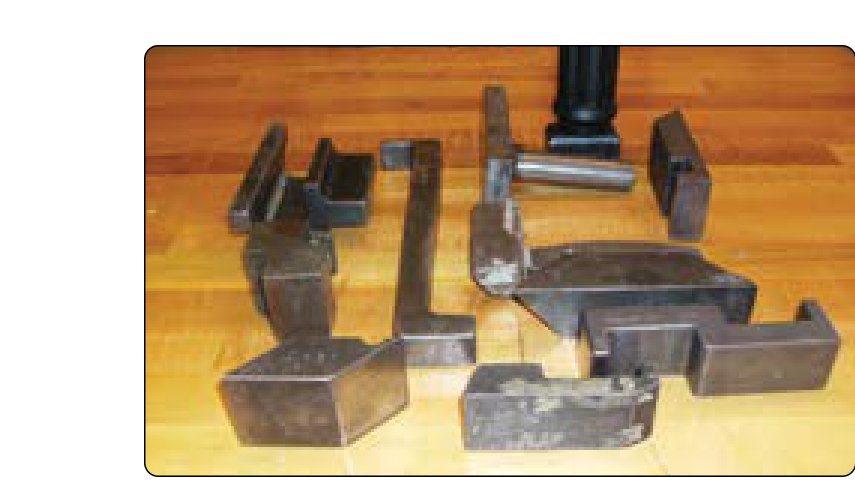
| 5 | Choose the bar | Shape first, so it reaches the tail squarely. Then weight: too light and the sheet bulges toward the shop head; too heavy and it bulges away from it. |
| 6 | Position both tools | Set snug on the head and perpendicular to the surface. Bar face at right angles to the shank. Agree the tap code: one tap, hit it again; two, good rivet; three, bad rivet. |
| 7 | Drive | The gun should upset the rivet in 1 to 3 seconds. The weight of the bar does the work; your hands guide it. Never lift the bar while the gun runs: the set can go through the sheet. |
| 8 | Check the rivet | Shop head to size, manufactured head tight and undamaged, no marks round it. If it is wrong, drill it out properly: removing a rivet. |
Tools you need
| Tool | What for | Buying guide | Catalog |
|---|---|---|---|
| Rivet gun | Drives the head; 900 to 2,500 blows a minute is the common slow-hitting type | Rivet guns | 3X gun |
| Rivet sets | Match the head and the access: straight, offset, long | Rivet guns | Set kit |
| Bucking bar | Forms the shop head | Bucking bars | Bar set |
| Squeezer | Where both sides reach an edge; set dies to the job | Squeezers | Hand squeezer |
| Clecos and pliers | Hold the sheets while you rivet | Cleco pliers | Cleco kit |
| Rivets | MS20470 and MS20426 | Solid rivets | MS20470 |
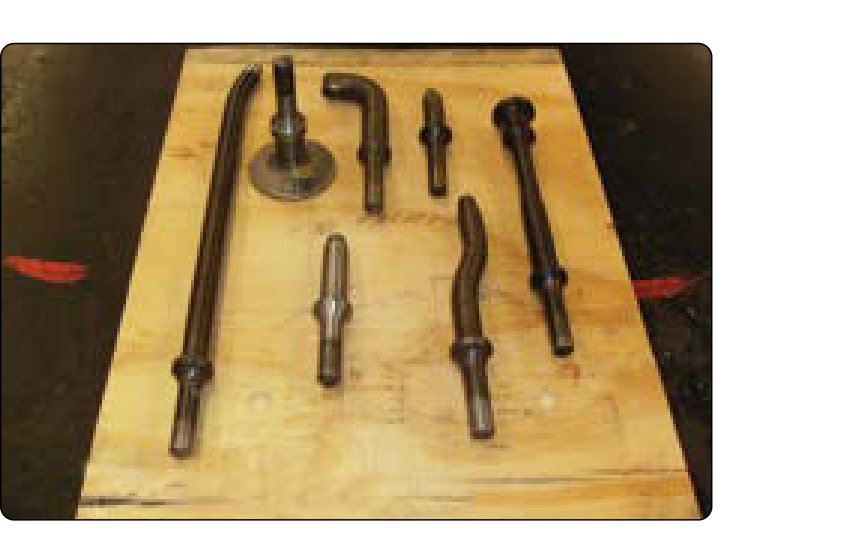
Which set for which head
| Head | Set | Watch for |
|---|---|---|
| Universal | Cupped, to fit the head; contacts about its centre two-thirds | Shallow enough to allow slight misalignment without eyebrowing the sheet |
| Countersunk or flat | Flush or flat set | Smaller sets concentrate the force; larger ones spread it, for thin skins |
| Hard to reach | Offset header for obstructed spots, long header past structure | Keep the set square to the head |
| Any | Right size for the rivet | Too small marks the rivet; too large marks the sheet |
FAA-H-8083-31B pp. 4-36, 4-38. AC 43.13-1B par. 4-58: the set must be cupped slightly flatter than the rivet head.
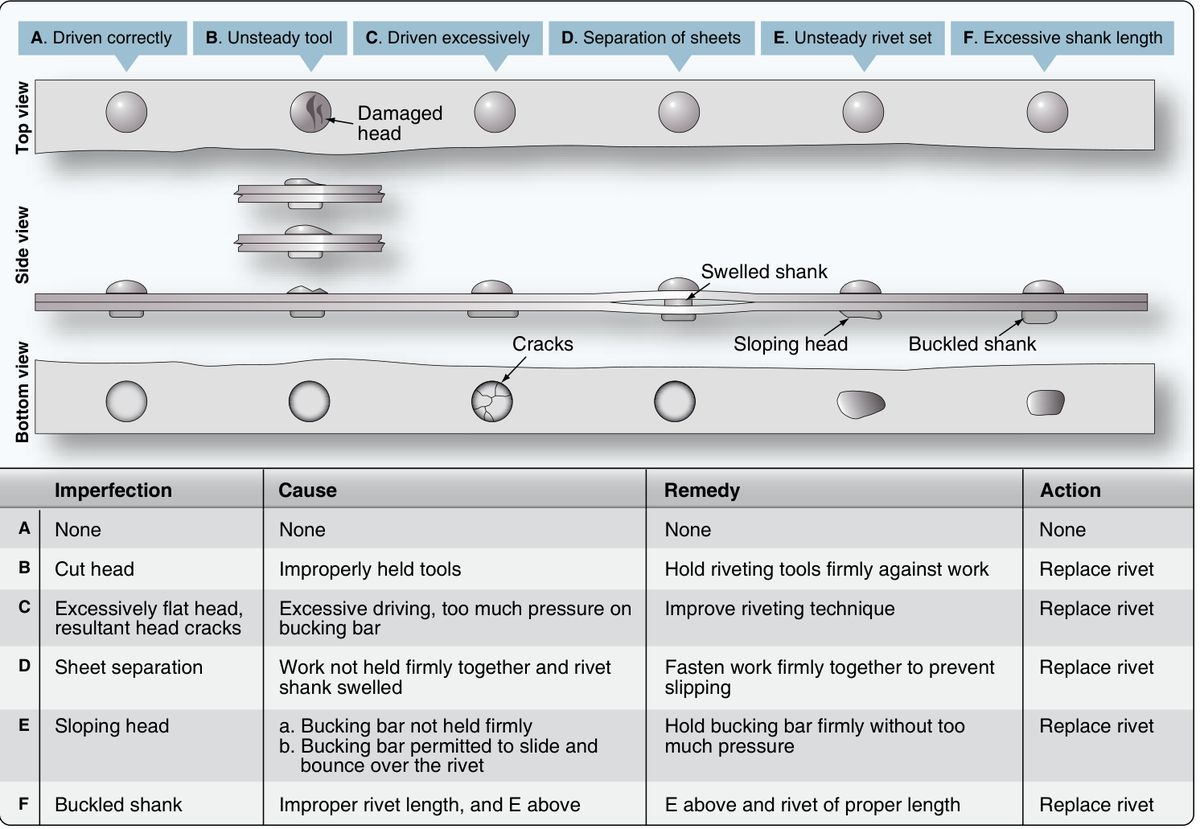
What goes wrong and why
| Defect | Cause | Fix next time | Action |
|---|---|---|---|
| Cut head | Tools held improperly | Hold them firmly against the work | Replace |
| Very flat head, head cracks | Too much driving, too much pressure on the bar | Improve the technique | Replace |
| Sheet separation | Work not held tight; shank swelled between sheets | Fasten the work firmly | Replace |
| Sloping head | Bar not held firmly, or it slid and bounced | Hold the bar firmly, without too much pressure | Replace |
| Buckled shank | Wrong rivet length, or bar faults as above | Right length, steady bar | Replace |
FAA-H-8083-31B p. 4-44, Fig. 4-97.
Quick check
The sheet is bulging towards the shop head as you drive. What is the first thing to suspect?
- The bucking bar is too light
Best fit. Right. The Handbook says too light a bar lets the material bulge toward the shop head.
- The bucking bar is too heavy
Not this one. A bar that is too heavy bulges the sheet away from the shop head.
- Air pressure is too low
Not this one. Low air slows the upset; it does not explain this bulge.
On a real job, the SRM decides.
What to check when it is done
| Look at | Good | If not |
|---|---|---|
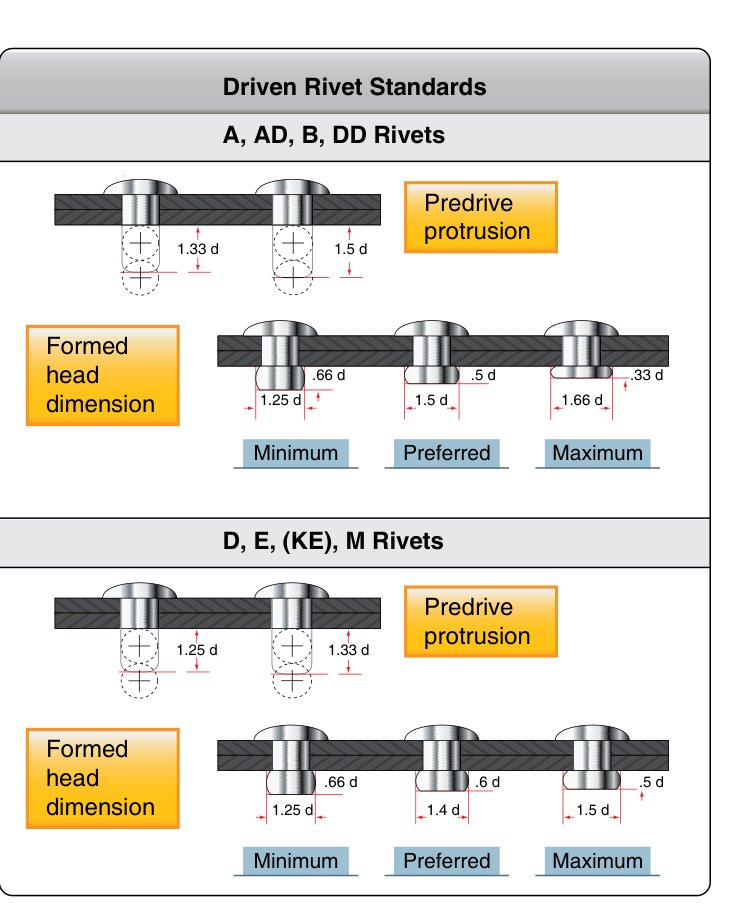
| Shop head | AD rivet: 1.25D to 1.66D wide, 0.33D to 0.66D high; 1.5D × 0.5D preferred | Replace. Check the numbers |
| Manufactured head | Round, undamaged, tight to the sheet | Cut head: tools not held firmly. Replace |
| Sheet round the head | No smiles, eyebrows or bulges | Set too large, or bar too light or heavy |
| Sheets | Closed up, no gap | Work not held firmly and shank swelled. Replace |
| Rivets next to the job | No cracked paint, no heads tipped the same way | Tipped groups show a load problem: investigate |
Questions people actually ask
How big should the shop head be?
1.5 times the shank diameter wide and 0.5 times high is the preferred size in the Handbook, and the AC 43.13-1B minimum. The Handbook accepts 1.25D to 1.66D wide for AD rivets. Your approved data decides which line applies.
How long should the rivet stick out?
1.33D to 1.5D past the sheets for A, AD, B and DD rivets; 1.25D to 1.33D for D, E and M rivets (Handbook Fig. 4-76).
Can I rivet alone?
Yes. In solo riveting you hold the gun in one hand and the bar in the other. Two people, a shooter and a bucker, need a tap code or radios.
Limits of this guide
What the sources support, and no further.
- The manual governs. Where the SRM, the drawing or the fastener maker says otherwise, follow them; this page explains general practice.
- Handbook and AC differ on the minimum shop head: 1.25D and 1.5D. See the shop head calculator for both.
- Gun sizes and pressures are the Handbook's general figures. The gun's own rating is stamped on the barrel.
Where to buy
Distributors coming soon.
Sources
- FAA-H-8083-31B, Aviation Maintenance Technician Handbook: Airframe, Chapter 4 — pp. 4-30 to 4-32, rivets and length; pp. 4-35, 4-36, bucking bar; pp. 4-37, 4-38, gun and sets; pp. 4-39, 4-40, procedure and tap code; pp. 4-43, 4-44, evaluation, Fig. 4-97.
- FAA AC 43.13-1B CHG 1, Acceptable Methods, Techniques and Practices — par. 4-57, riveting; par. 4-58, driving (p. 4-16 on).