The drawing
Where to buy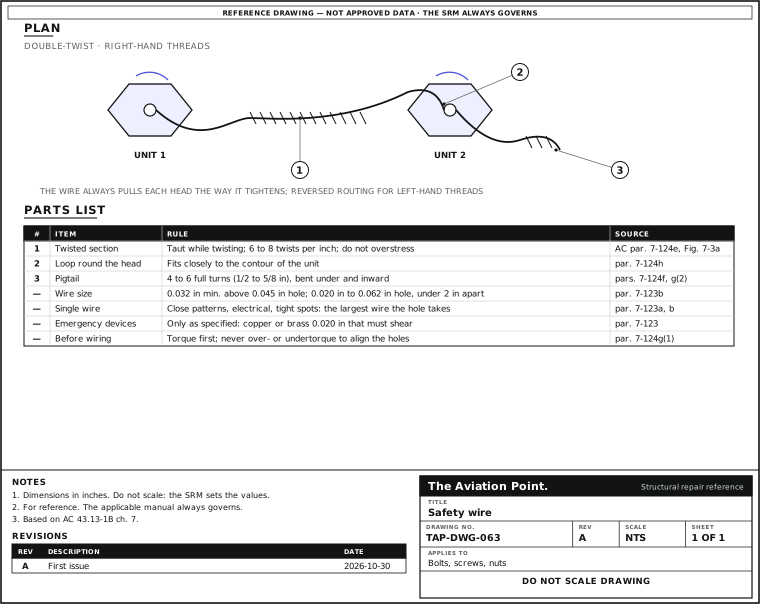
Step by step
| Step | Action | What to do |
|---|---|---|
| 1 | Torque first | Check torque and that the holes line up. Never over- or undertorque to align them: try a washer, or another bolt. |
| 2 | Pick the wire | Double-twist: 0.032 in minimum for holes over 0.045 in. See the calculator. |
| 3 | Through the first hole | Loop round the head so it fits the contour. |
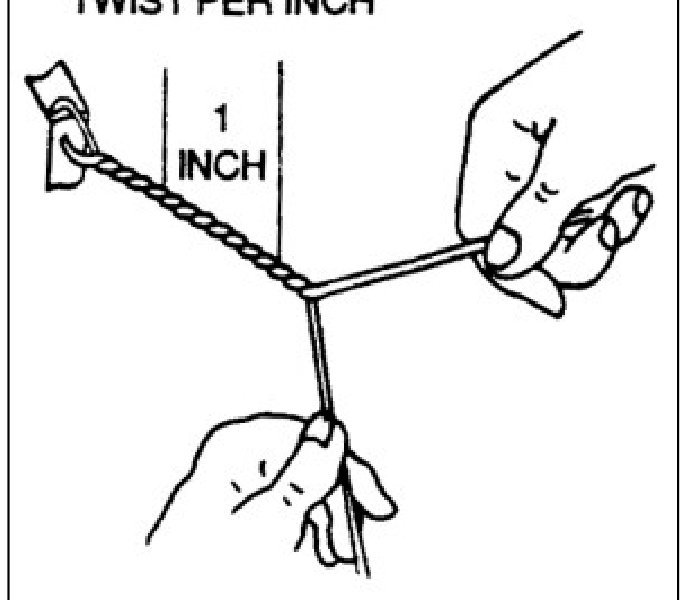
| 4 | Twist | Pull taut, 6 to 8 twists per inch. By hand, or with a wire twister. Do not overstress the wire: too much twist breaks it under vibration. |
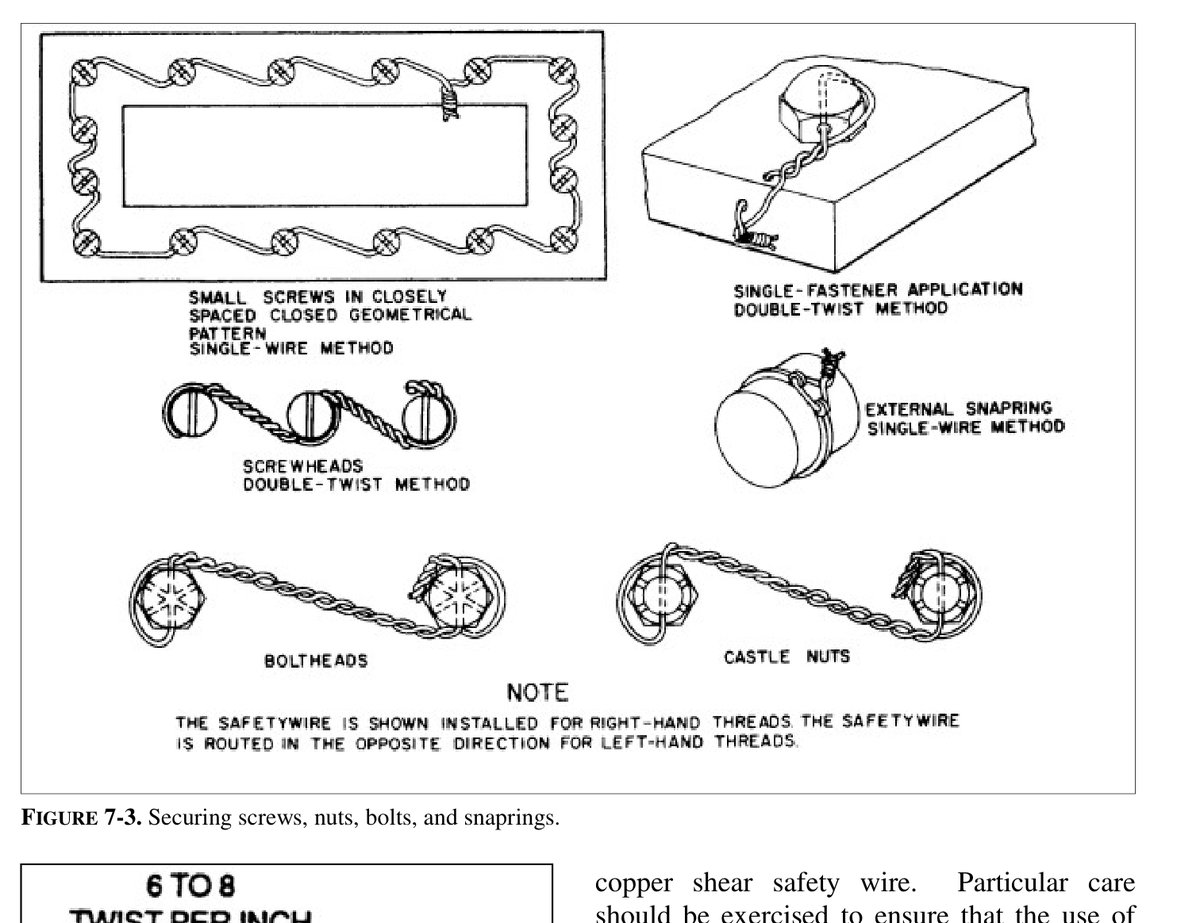
| 5 | Through the second | Route so the wire pulls the next unit in the tightening direction. |
| 6 | Finish the pigtail | Twist four to six full turns (1/2 to 5/8 in) after the loop, cut, bend under and inward. Never twist the end off with pliers. |
| 7 | Check | Tight, no nicks or kinks, no sharp end. |
Tools you need
| Tool | What for | Buying guide | Catalog |
|---|---|---|---|
| Safety wire pliers | Twists evenly | — | 6 in pliers |
| Safety wire | MS20995 | — | MS20995 |
| Kit | Wire and tool | — | Model 200 kit |
Double-twist or single wire
Double-twist
- Use
- Most common
- Wire
- 0.032 in minimum; 0.020 in on 0.045 to 0.062 in holes under 2 in apart
Single wire
- Use
- Close patterns (triangle, square, circle), electrical parts, hard-to-reach spots
- Wire
- Largest the hole takes
AC 43.13-1B par. 7-123.
What to check when it is done
| Look at | Good | If not |
|---|---|---|
| Direction | Pulls tight | Redo |
| Tension | Tight, not overstressed | Redo |
| Twist | 6 to 8 per inch, unmarked | Replace: wire must not be nicked, kinked or mutilated |
| Pigtail | 4 to 6 turns, bent in | Redo |
| Emergency devices | Only the specified shear wire | Stop: do not obstruct operation |
Questions people actually ask
How many twists per inch?
6 to 8, as shown in AC 43.13-1B Fig. 7-3a.
How do I remove safety wire?
Cut it close to the hole, with care. Never twist it off with pliers.
Limits of this guide
What the sources support, and no further.
- The manual governs. Where the SRM, the drawing or the fastener maker says otherwise, follow them; this page explains general practice.
- Left-hand threads reverse the routing: AC Fig. 7-3.
- Fig. 7-3a shows the twist rate; the text does not state it. The chart has the detail.
Where to buy
AmericaDistributor coming soonOur partner for this region is on its way
EuropeDistributor coming soonOur partner for this region is on its way
OceaniaDistributor coming soonOur partner for this region is on its way
Distributors coming soon.
Sources
- FAA AC 43.13-1B CHG 1, Acceptable Methods, Techniques and Practices — pars. 7-122 to 7-125; Figs. 7-3, 7-3a.
Educational reference only. not approved data. Always consult the applicable SRM, AMM, or AC 43.13-1B and your certifying authority.