The drawing
Where to buy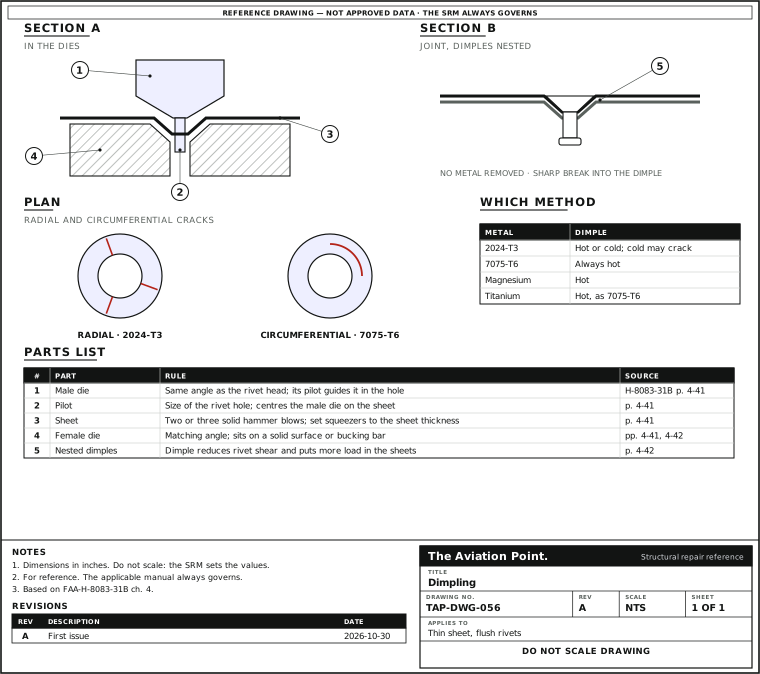
Step by step
| Step | Action | What to do |
|---|---|---|
| 1 | Confirm you can dimple | Thin sheet below the countersinking minimum, and an alloy that allows it. 7075-T6, magnesium and titanium need hot dimpling. |
| 2 | Drill and deburr | A rough hole causes radial cracks. |
| 3 | Pick the dies | A separate set for each rivet size and head shape. The male die's guide is the size of the hole. |
| 4 | Set up | Rest the female die on a solid surface, sheet on top, male die through the hole. In a squeezer, adjust the dies to the sheet thickness. |
| 5 | Form it | Two or three solid hammer blows should do. Keep blows or pressure to a minimum: extra work hardens the area. |
| 6 | Check with a rivet | Head flush, sharp break from surface into the dimple, no cracks. |
Tools you need
| Tool | What for | Buying guide | Catalog |
|---|---|---|---|
| Dimple dies | One set per rivet size | Dimple dies | 1/8 die set |
| Spring-back dies | Another die type | Dimple dies | Spring-back dies |
| Squeezer | Controlled pressure | Squeezers | Hand squeezer |
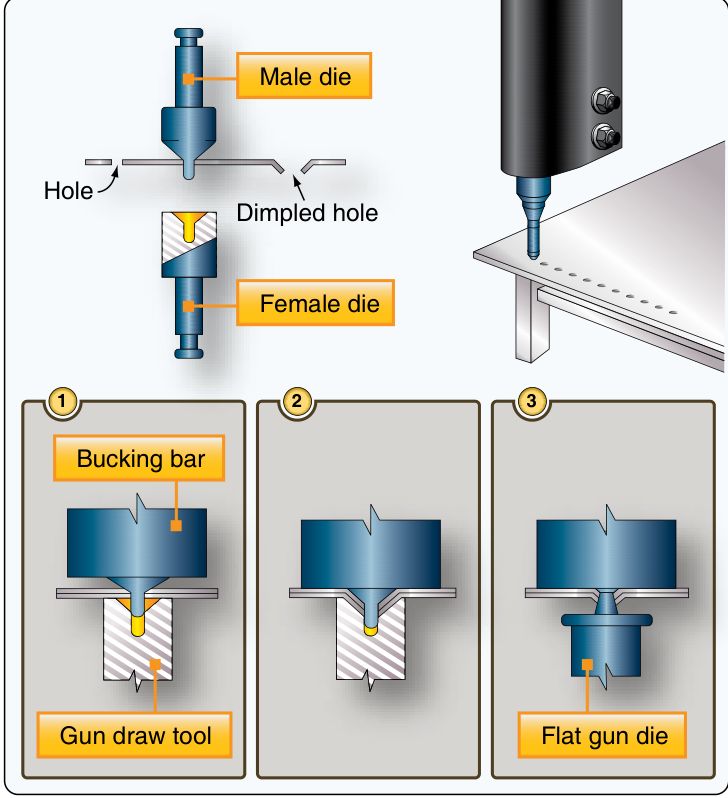
Four ways to dimple
Male and female dies
- How
- Hammer or squeezer
- Use
- Normal light work
Coin
- How
- Countersunk rivet as the male die, driven with the gun; bar behind the female die
- Use
- Only if the male die is broken or missing. Drive the same rivet afterwards
Radius
- How
- Radius die sets in a squeezer
- Use
- Stationary or portable squeezers
Hot
- How
- Heated dies, usually large stationary equipment
- Use
- 7075-T6, magnesium and titanium; prevents cracks in 2024-T3
FAA-H-8083-31B pp. 4-41 to 4-43.
Which metals need heat
| Metal | Dimpling |
|---|---|
| 2024-T3 | Hot or cold; may crack after cold dimpling because of hard spots |
| 7075-T6 | Always hot |
| Magnesium alloys | Hot, low formability |
| Titanium | Hot, tough; same temperature and dwell as 7075-T6 |
FAA-H-8083-31B pp. 4-42, 4-43.
What to check when it is done
| Look at | Good | If not |
|---|---|---|
| Flushness | Sample dimples: fastener sits flush | Too shallow: check the die setting |
| Break | Sharp break into the dimple | More pressure, within reason |
| Radial cracks | Starting at the hole edge, most common in 2024-T3; small tolerance sometimes allowed | Rough hole or too deep; check the limit |
| Circumferential cracks | None, round the edge of the dimple | Cause for rejection; common in hot-dimpled 7075-T6 with too little heat |
Questions people actually ask
Is a dimpled joint weaker?
No. The Handbook says it removes no metal and, by nesting, gives a stronger joint than the non-flush type.
What is a subcountersink?
A countersink well made to receive a dimple: thin sheet dimpled into thick structure.
Limits of this guide
What the sources support, and no further.
- The manual governs. Where the SRM, the drawing or the fastener maker says otherwise, follow them; this page explains general practice.
- No temperatures here. The Handbook gives none; they come from the machine or the SRM.
Where to buy
AmericaDistributor coming soonOur partner for this region is on its way
EuropeDistributor coming soonOur partner for this region is on its way
OceaniaDistributor coming soonOur partner for this region is on its way
Distributors coming soon.
Sources
- FAA-H-8083-31B, Aviation Maintenance Technician Handbook: Airframe, Chapter 4 — p. 4-36, dies; pp. 4-41 to 4-43, dimpling; Figs. 4-93, 4-95, 4-96.
Educational reference only. not approved data. Always consult the applicable SRM, AMM, or AC 43.13-1B and your certifying authority.